

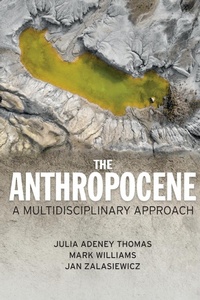
The Anthropocene
A Multidisciplinary Approach
1st Edition
Published on 25. September 2020
Book
Paperback/Softback
288 pages
978-1-5095-3460-9 (ISBN)
Description
Humans rank with the powerful forces of nature transforming Earth. Since the mid-20th century, population growth, industrialization, and globalization have had such deep and wide-ranging impacts that our planet no longer functions as it did during the previous eleven millennia. So distinctive is this collective human intervention that a new geological interval has been proposed; it is called the Anthropocene.
The Anthropocene is intriguing scientifically, fascinating intellectually, and deeply disturbing politically, socially, economically, and ethically. We must learn how to co-exist sustainably with the rest of nature in what is emerging as a new planetary state. To do so, we must first understand what "Anthropocene" means in all its dimensions. This book adopts a multidisciplinary approach, starting with an exploration of the Anthropocene as a geological concept: ranging across the physical changes to the landscape, to the rapidly heating climate, to a biosphere undergoing transformation. And what of the "anthropos" in the Anthropocene? While geoscience does not normally address political and ethical issues of justice and equity, or economics and culture, Anthropocene studies in the humanities and social sciences investigate the complexities of the human activity driving global change. Here the book looks at human history, both in the deep past and more recently, the politics and economics of growth spurring the Anthropocene, and potential ways of mitigating its cruel effects. Our fragile, still beautiful, planet is finite. The new realities of the Anthropocene will need our best efforts, across disciplinary divides, at effective hope and action.
The Anthropocene is intriguing scientifically, fascinating intellectually, and deeply disturbing politically, socially, economically, and ethically. We must learn how to co-exist sustainably with the rest of nature in what is emerging as a new planetary state. To do so, we must first understand what "Anthropocene" means in all its dimensions. This book adopts a multidisciplinary approach, starting with an exploration of the Anthropocene as a geological concept: ranging across the physical changes to the landscape, to the rapidly heating climate, to a biosphere undergoing transformation. And what of the "anthropos" in the Anthropocene? While geoscience does not normally address political and ethical issues of justice and equity, or economics and culture, Anthropocene studies in the humanities and social sciences investigate the complexities of the human activity driving global change. Here the book looks at human history, both in the deep past and more recently, the politics and economics of growth spurring the Anthropocene, and potential ways of mitigating its cruel effects. Our fragile, still beautiful, planet is finite. The new realities of the Anthropocene will need our best efforts, across disciplinary divides, at effective hope and action.
Reviews / Votes
AAn accessible tour de force and an ideal starting point for anyone seeking an understanding of the Anthropocene predicament.AJohn R. McNeill, Georgetown University
AEarth System scientists have proposed the Anthropocene and geologists are confirming its reality. This work explores more important questions: what does the Anthropocene really mean for humanity and what are the many ways we could deal with it?A
Will Steffen, Australian National University
AThe big market for this book in Australia is the "educated general reader" and they will love it. It is not so much an "introductory course book" for them, but rather a review book that empowers them to understand and take action. It is a tour-de-force.A
Libby Robin, author ofA The Environment: A History of the Idea
AAn indispensable guideAA The AnthropoceneA maps cultural and scientific definitions of its subject in ways that experts will find provocative and students accessible.A
Green Letters
AThis book should be required introductory reading for anyone interested in learning about the Anthropocene, and particularly for those concerned about the broad but intertwined challenges facing humanity, our environments, and the planet.A
The Holocene
More details
Language
English
Place of publication
Oxford
United Kingdom
Target group
Professional and scholarly
Dimensions
Height: 226 mm
Width: 150 mm
Thickness: 21 mm
Weight
374 gr
ISBN-13
978-1-5095-3460-9 (9781509534609)
Copyright in bibliographic data and cover images is held by Nielsen Book Services Limited or by the publishers or by their respective licensors: all rights reserved.
Schweitzer Classification
Other editions
Additional editions
E-Book
10/2020
1st Edition
Wiley-Scrivener
€18.99
Available for download
Book
09/2020
1st Edition
Polity Press
€71.00
Article not available at the moment
Persons
Julia Adeney Thomas is Associate Professor of History at the University of Notre Dame.
Mark Williams is Professor of Palaeobiology at the University of Leicester and co-director of the International Laboratory for Palaeobiology and Palaeoenvironments at Yunnan University.
Jan Zalasiewicz is Professor of Palaeobiology at the University of Leicester and Chair of the Anthropocene Working Group of the International Commission on Stratigraphy.
Mark Williams is Professor of Palaeobiology at the University of Leicester and co-director of the International Laboratory for Palaeobiology and Palaeoenvironments at Yunnan University.
Jan Zalasiewicz is Professor of Palaeobiology at the University of Leicester and Chair of the Anthropocene Working Group of the International Commission on Stratigraphy.
Content
Preface
1. The Multidisciplinary Anthropocene
2. The Geological Context of the Anthropocene
3. The Anthropocene as a Geological Time Unit and the Great Acceleration
4. The Anthropocene and Climate Change
5. The Anthropocene and the Biosphere's Transformation
6. The "Anthropos" of the Anthropocene
7. Economics and Politics of the Anthropocene
8. Existential Challenges in the Anthropocene
1. The Multidisciplinary Anthropocene
2. The Geological Context of the Anthropocene
3. The Anthropocene as a Geological Time Unit and the Great Acceleration
4. The Anthropocene and Climate Change
5. The Anthropocene and the Biosphere's Transformation
6. The "Anthropos" of the Anthropocene
7. Economics and Politics of the Anthropocene
8. Existential Challenges in the Anthropocene