

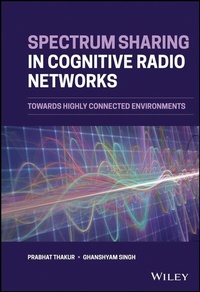
Spectrum Sharing in Cognitive Radio Networks
Description

Discover the latest advances in spectrum sharing in wireless networks from two internationally recognized experts in the field
Spectrum Sharing in Cognitive Radio Networks: Towards Highly Connected Environments delivers an in-depth and insightful examination of hybrid spectrum access techniques with advanced frame structures designed for efficient spectrum utilization. The accomplished authors present the energy and spectrum efficient frameworks used in high-demand distributed architectures by relying on the self-scheduled medium access control (SMC-MAC) protocol in cognitive radio networks.
The book begins with an exploration of the fundamentals of recent advances in spectrum sharing techniques before moving onto advanced frame structures with spectrum accessing approaches and the role of spectrum prediction and spectrum monitoring to eliminate interference. The authors also cover spectrum mobility, interference, and spectrum management for connected environments in substantial detail.
Spectrum Sharing in Cognitive Radio Networks: Towards Highly Connected Environments offers readers a recent and rational theoretical mathematical model of spectrum sharing strategies that can be used for practical simulation of future generation wireless communication technologies. It also highlights ongoing trends, revealing fresh research outcomes that will be of interest to active researchers in the area. Readers will also benefit from:
* An inclusive study of connected environments, 3GPP Releases, and the evolution of wireless communication generations with a discussion of advanced frame structures and access strategies in cognitive radio networks
* A treatment of cognitive radio networks using spectrum prediction and monitoring techniques
* An analysis of the effects of imperfect spectrum monitoring on cognitive radio networks
* An exploration of spectrum mobility in cognitive radio networks using spectrum prediction and monitoring techniques
* An examination of MIMO-based CR-NOMA communication systems for spectral and interference efficient designs
Perfect for senior undergraduate and graduate students in Electrical and Electronics Communication Engineering programs, Spectrum Sharing in Cognitive Radio Networks: Towards Highly Connected Environments will also earn a place in the libraries of professional engineers and researchers working in the field, whether in private industry, government, or academia.
More details
Other editions
Additional editions

Persons
Prabhat Thakur, PhD, is a Post-Doctoral Researcher in the Department of Electrical and Electronics Engineering Science, Faculty of Engineering and the Built Environment at the University of Johannesburg, South Africa. His research focus is on the energy, spectral, and interference efficient designs for spectrum sharing in cognitive radio communication systems.
Ghanshyam Singh, PhD, is Professor with the Department of Electrical and Electronics Engineering Science, APK Campus, at the University of Johannesburg, South Africa. He has authored or co-authored over 250 scientific papers.
Content
Preface xiii
Special Acknowledgements xxi
List of Acronyms xxiii
List of Figures xxvii
List of Tables xxxiii
List of Symbols xxxv
1 Introduction 1
1.1 Introduction 1
1.1.1 Connected Environments 2
1.1.2 Evolution of Wireless Communication 5
1.1.3 Third Generation Partnership Project 10
1.2 Cognitive Radio Technology 10
1.2.1 Spectrum Accessing/Sharing Techniques 13
1.2.1.1 Interweave Spectrum Access 14
1.2.1.2 Underlay Spectrum Access 17
1.2.1.3 Overlay Spectrum Access 17
1.2.1.4 Hybrid Spectrum Access 17
1.3 Implementation of CR Networks 20
1.4 Motivation 22
1.5 Organization of Book 23
1.6 Summary 27
References 27
2 Advanced Frame Structures in Cognitive Radio Networks 39
2.1 Introduction 39
2.2 Related Work 40
2.2.1 Frame Structures 40
2.2.2 Spectrum Accessing Strategies 41
2.3 Proposed Frame Structures for HSA Technique 43
2.4 Analysis of Throughput and Data Loss 45
2.5 Simulations and Results 47
2.6 Summary 50
References 51
3 Cognitive Radio Network with Spectrum Prediction and Monitoring
Techniques 55
3.1 Introduction 55
3.2 Related Work 57
3.2.1 Spectrum Prediction 57
3.2.2 Spectrum Monitoring 58
3.3 System Models 59
3.3.1 System Model for Approach-1 59
3.3.2 System Model for Approach-2 60
3.4 Performance Analysis 61
3.4.1 Throughput Analysis Using Approach-1 61
3.4.2 Analysis of Performance Metrics of the Approach-2 65
3.5 Results and Discussion 67
3.5.1 Proposed Approach-1 67
3.5.2 Proposed Approach-2 69
3.6 Summary 72
References 72
4 Effect of Spectrum Prediction in Cognitive Radio Networks 77
4.1 Introduction 77
4.1.1 Spectrum Access Techniques 78
4.2 System Model 80
4.3 Throughput Analysis 87
4.4 Simulation Results and Discussion 89
4.5 Summary 93
References 94
5 Effect of Imperfect Spectrum Monitoring on Cognitive Radio
Networks 97
5.1 Introduction 97
5.2 Related Work 99
5.2.1 Spectrum Sensing 99
5.2.2 Spectrum Monitoring 100
5.3 System Model 101
5.4 Performance Analysis of Proposed System Using Imperfect Spectrum
Monitoring 102
5.4.1 Computation of Ratio of the Achieved Throughput to Data Loss 108
5.4.2 Computation of Power Wastage 108
5.4.3 Computation of Interference Efficiency 109
5.4.4 Computation of Energy Efficiency 109
5.5 Results and Discussion 110
5.6 Summary 115
References 116
6 Cooperative Spectrum Monitoring in Homogeneous and
Heterogeneous Cognitive Radio Networks 121
6.1 Introduction 121
6.2 Background 122
6.3 System Model 124
6.4 Performance Analysis of Proposed CRN 126
6.4.1 Computation of Achieved Throughput and Data Loss 130
6.4.2 Computation of Interference Efficiency 131
6.4.3 Computation of Energy Efficiency 131
6.5 Results and Discussion 132
6.5.1 Homogeneous Cognitive Radio Network 132
6.5.2 Heterogeneous Cognitive Radio Networks 134
6.6 Summary 143
References 143
7 Spectrum Mobility in Cognitive Radio Networks Using Spectrum
Prediction and Monitoring Techniques 147
7.1 Introduction 147
7.2 System Model 151
7.3 Performance Analysis 153
7.4 Results and Discussion 156
7.5 Summary 162
References 163
8 Hybrid Self-Scheduled Multichannel Medium Access Control Protocol
in Cognitive Radio Networks 167
8.1 Introduction 167
8.2 Related Work 169
8.2.1 CR-MAC Protocols 169
8.2.2 Interference at PU 171
8.3 System Model and Proposed Hybrid Self-Scheduled Multichannel
MAC Protocol 172
8.3.1 System Model 172
8.3.2 Proposed HSMC-MAC Protocol 173
8.4 Performance Analysis 174
8.4.1 With Perfect Spectrum Sensing 176
8.4.2 With Imperfect Spectrum Sensing 178
8.4.3 More Feasible Scenarios 180
8.5 Simulations and Results Analysis 182
8.5.1 With Perfect Spectrum Sensing 182
8.5.2 With Imperfect Spectrum Sensing 185
8.6 Summary 190
References 190
9 Frameworks of Non-Orthogonal Multiple Access Techniques in
Cognitive Radio Networks 195
9.1 Introduction 195
9.1.1 Related Work 196
9.1.2 Motivation 199
9.1.3 Organization 199
9.2 CR Spectrum Accessing Strategies 199
9.3 Functions of NOMA System for Uplink and Downlink Scenarios 204
9.3.1 Downlink Scenario for Cellular-NOMA 204
9.3.2 Uplink Scenario for Cellular-NOMA 207
9.4 Proposed Frameworks of CR with NOMA 208
9.4.1 Framework-1 209
9.4.2 Framework-2 210
9.5 Simulation Environment and Results 212
9.6 Research Potentials for NOMA and CR-NOMA Implementations 213
9.6.1 Imperfect CSI 214
9.6.2 Spectrum Hand-off Management 215
9.6.3 Standardization 215
9.6.4 Less Complex and Cost-Effective Systems 215
9.6.5 Energy-Efficient Design and Frameworks 216
9.6.6 Quality-of-Experience Management 216
9.6.7 Power Allocation Strategy for CUs to Implement NOMA Without
Interfering PU 217
9.6.8 Cooperative CR-NOMA 217
9.6.9 Interference Cancellation Techniques 217
9.6.10 Security Aspects in CR-NOMA 218
9.6.11 Role of User Clustering and Challenges 218
9.6.12 Wireless Power Transfer to NOMA 219
9.6.13 Multicell NOMA with Coordinated Multipoint Transmission 220
9.6.14 Multiple-Carrier NOMA 221
9.6.15 Cross-Layer Design 221
9.6.16 MIMO-NOMA-CR 222
9.7 Summary 222
References 223
10 Performance Analysis of MIMO-Based CR-NOMA Communication
Systems 229
10.1 Introduction 229
10.2 Related Work for Several Combinations of CR, NOMA, and MIMO
Systems 231
10.3 System Model 234
10.3.1 Downlink Scenarios 236
10.3.2 Uplink Scenario 238
10.4 Performance Analysis 238
10.4.1 Downlink Scenario 238
10.4.1.1 Throughput Computation for MIMO-CR-NOMA 239
10.4.1.2 Throughput Computation for CR-NOMA Systems 240
10.4.1.3 Sum Throughput for CR-OMA, CR-NOMA, CR-MIMO, and
CR-NOMA-MIMO Frameworks 240
10.4.2 Uplink Scenario 241
10.4.2.1 Throughput Computation for MIMO-CR-NOMA 241
10.4.2.2 Throughput Calculation for CR-NOMA Systems 242
10.4.2.3 Sum Throughput for CR-OMA, CR-NOMA, CR-MIMO, and
CR-NOMA-MIMO Frameworks 242
10.4.2.4 Computation of Interference Efficiency of CU-4 In Case of
CR-MIMO-NOMA 243
10.5 Simulation and Results Analysis 243
10.5.1 Simulation Results for Downlink Scenario 243
10.5.2 Simulation Results for Uplink Scenario 245
10.6 Summary 249
References 250
11 Interference Management in Cognitive Radio Networks 255
11.1 Introduction 255
11.1.1 White space 257
11.1.2 Grey Spaces 257
11.1.3 Black Spaces 257
11.1.4 Interference Temperature 257
11.2 Interfering and Non-interfering CRN 258
11.2.1 Interfering CRN 258
11.2.2 Non-Interfering CRN 259
11.3 Interference Cancellation Techniques in the CRN 261
11.3.1 At the CU Transmitter 261
11.3.2 At the CR-Receiver 264
11.4 Cross-Layer Interference Mitigation in Cognitive Radio Networks 268
11.5 Interference Management in Cognitive Radio Networks via Cognitive
Cycle Constituents 269
11.5.1 Spectrum Sensing 269
11.5.2 Spectrum Prediction 269
11.5.3 Transmission Below PUs' Interference Tolerable Limit 271
11.5.4 Using Advanced Encoding Techniques 271
11.5.5 Spectrum Monitoring 272
11.6 Summary 274
References 274
12 Simulation Frameworks and Potential Research Challenges for
Internet-of-Vehicles Networks 281
12.1 Introduction 281
12.1.1 Consumer IoT 283
12.1.2 Industrial IoT 283
12.2 Applications of CIoT 284
12.2.1 Smart Home and Automation 284
12.2.2 Smart Wearables 284
12.2.3 Home Security and Smart Domestics 285
12.2.4 Smart Farming 285
12.3 Applications of Industrial IoT 285
12.3.1 Smart Industry 286
12.3.2 Smart Grid/Utilities 286
12.3.3 Smart Communication 286
12.3.4 Smart City 287
12.3.5 Smart Energy Management 287
12.3.6 Smart Retail Management 288
12.3.7 Robotics 288
12.3.8 Smart Cars/Connected Vehicles 289
12.4 Communication Frameworks for IoVs 289
12.4.1 Vehicle-to-Vehicle (V2V) Communication 291
12.4.2 Vehicle to Infrastructure (V2I) Communication 292
12.4.3 Infrastructure to Vehicles (I2V) Communication 293
12.4.4 Vehicle-to-Broadband (V2B) Communication 293
12.4.5 Vehicle-to-Pedestrians (V2P) Communication 293
12.5 Simulation Environments for Internet-of-Vehicles 295
12.5.1 SUMO 296
12.5.2 Network Simulator (NetSim) 296
12.5.3 Ns-2 297
12.5.4 Ns-3 297
12.5.5 OMNeT++ 298
12.6 Potential Research Challenges 299
12.6.1 Social Challenges 299
12.6.2 Technical Challenges 300
12.7 Summary 302
References 302
13 Radio Resource Management in Internet-of-Vehicles 311
13.1 Introduction 311
13.1.1 Dedicated Short-Range Communication 313
13.1.2 Wireless Access for Vehicular Environments 314
13.1.3 Communication Access for Land Mobile (CALM) 314
13.2 Cellular Communication 315
13.2.1 3GPP Releases 315
13.2.2 Long-Term Evolution 317
13.2.3 New Radio 317
13.2.4 Dynamic Spectrum Access 318
13.3 Role of Cognitive Radio for Spectrum Management 319
13.4 Effect of Mobile Nature of Vehicles/Nodes on the Networking 320
13.5 Spectrum Sharing in IoVs 322
13.5.1 Spectrum Sensing Scenarios 322
13.5.2 Spectrum Sharing Scenarios 324
13.5.3 Spectrum Mobility/Handoff Scenarios 325
13.6 Frameworks of Vehicular Networks with Cognitive Radio 326
13.6.1 CR-Based IoVs Networks Architecture 327
13.7 Key Potentials and Research Challenges 328
13.7.1 Key Potentials 328
13.7.2 Research Challenges 329
13.8 Summary 333
References 333
Index 000
Preface
Technology is rapidly transforming our daily live, local community, as well as entire globe and everyone should be able to participate in this transformation. Currently, we rely on the wireless connected devices and systems to not only enable on-demand, pervasive communications for a large proportion of the population, but also other critical application areas such as scientific and medical research, industrial control and automation, and public safety. Thus, the communication technologies are crafting new corporate social responsibility initiatives which address global problems, support innovative ideas, and enable opportunities for all in recent increasingly digital world. As the wireless communication technologies and its applications continue to flourish, the demand for precious spectrum resources, which is an essential foundation block to support the wireless communications in the globally connected world, will continue to grow. Recently, due to exponential increase in the number of wireless connected devices with other bandwidth hungry services have exploded huge communication traffic and we expect that the demand for spectrum will continue to increase as new wireless technologies and applications requirements continue to emerge in the foreseeable future which results in the spectrum scarcity. This voracious enthusiasm for additional spectrum resources cannot be met by simply allocating new spectrum. Therefore, the usable capacity of spectrum must be expanded with innovative technologies, regulatory reforms, and removal of market barriers. The cognitive radio is one of the innovative technologies which has the potential to effectively address the spectrum scarcity problem and radically change the way we utilize spectrum. Due to its potential impact, various stakeholders - including regulatory policymakers, wireless device manufacturers, telecommunication service provider, and academic researchers - have shown strong interest in it, especially with respect to research and development.
The cognitive radio technology has emerged as a prone candidate for exploiting the increasingly flexible licensing (dynamic spectrum access) of the spectrum for the wireless communication system. The regulatory bodies have come to realize that most of the time, a large portion of certain licensed frequency band remain empty/unused. Therefore, to redress this, a new regulation would allow for devices which are able to sense and adapt to their spectral environment, such as cognitive radio to become secondary user and such users are wireless devices that opportunistically employ the spectrum already licensed to the primary users. The primary users generally associate with the primary spectral licensed holder and thus have higher priority right to the spectrum. The intuitive objective behind secondary spectrum licensing is to improve the spectral efficiency of the network, whereas depending on the type of licensing without affecting higher priority users.
In the cognitive radio network, the spectrum prediction, spectrum monitoring, and medium access control protocols play an important role to exploit the spectrum opportunities, manage the interference to the primary users, and coordinate. The dynamic leasing, in which some wireless devices opportunistically employ the spectrum rather than choose for a long-term sub-lease. In order to exploit the spectrum, we require a device which is able to sense the communication opportunity and then take actions based on the sensed environment. The cognitive radio offers a novel way of solving spectrum underutilization problems. The emergence of Federal Communication Commission's secondary market initiative has been brought both the obvious desire for spectral efficiency as well as empirical measurements showing that most of the time certain licensed frequency remain unused. The goal of secondary market initiative is to remove unnecessary regulatory barriers to new secondary market-oriented policies. The key points of the book that benefits the readers are as follows:
- Provides decent background about the fundamentals of the spectrum sharing techniques.
- Explores the advanced frame structures with spectrum accessing techniques.
- Role of spectrum prediction and spectrum monitoring techniques for interference-free spectrum sharing as well as for effective spectrum mobility is analyzed.
- Due to the demand of distributed architectures in various applications, the energy and spectral efficient frameworks are presented by using the self-scheduled medium access control (SMC-MAC) protocol in the CRNs.
- The frameworks of CR-NOMA for further improvement in the spectral efficiency as compared to CR are also the unique contributions of this book.
- The interference management schemes for the spectrum sharing are illustrated.
- The exploitation of CR for the internet-of-vehicles, that is CR-inspired internet-of-vehicles, adds as a novel contribution in the book.
Thus, it is perceived that this book enables readers about the recent advances in the field of spectrum sharing, strategies of mathematical modeling, theories of spectrum sharing in addition to the primary activities of cognitive radio network. This book puts together a rich set of research articles featuring recent advances in theory, design, and analysis of cognitive radio networks with its connected environments. The book consists of 13 chapters, which cover a wide range of topics related to the cognitive radio technology, in particular, the topics covered in this book include fundamental challenges and issues in designing cognitive radio systems, information-theoretic analysis of cognitive radio systems, spectrum sharing, spectrum sensing and coexistence issues, adaptive physical layer protocols and link adaptation techniques for cognitive radio, different techniques for spectrum access by distributed cognitive radio, and cognitive medium access control protocols. The book is organized as follows. Chapter 1 starts with the connected environments, evolution of the wireless communication as well as technical perspectives by using the Third Generation Partnership Project (3GPP) with state-of-the-art spectrum sharing/access techniques and the fundamental issues related to cognitive radio networks with its several connected parameters and the major research challenges mostly from a signal processing and communication-theoretic perspective are well presented. The potential advantages, limiting factors, and characteristic features of the existing cognitive radio spectrum sharing domains are thoroughly discussed. The comparison of various spectrum accessing techniques such as interweave spectrum access, underlay spectrum access, overlay spectrum access, and hybrid spectrum access is presented. As the complexities of wireless technologies increase, novel multidisciplinary approaches for the spectrum sharing/management are required with inputs from the technology, economics, and regulations. To identify the available spectrum resource, decision on the optimal sensing and transmission time with proper coordination among the users for spectrum access are the important characteristics of spectrum sharing methods.
Chapter 2 describes a novel hybrid-cum-improved spectrum access technique to improve the throughput and data loss of the cognitive radio networks. The hybrid-cum-improved spectrum access technique consists of two advanced frame structures which explore the hybrid spectrum accessing strategy to utilize the channel in the presence of primary user. The closed-form expressions of the throughput and data loss for the proposed cognitive radio networks are derived numerically and the simulation results are the witness of superior performance with reference to the throughput and data loss.
Chapter 3 explores the cognitive radio networks in the high traffic environments where the spectrum prediction plays an important role to select a particular channel for spectrum sensing from the pool of channels on the basis of idle prediction probability. The considered frame structure has spectrum prediction phase before the spectrum sensing and data transmission phase. We have exploited the concept of hybrid spectrum access strategy to improve the throughput of the considered frame structure. The probability of primary users' emergence in the data transmission period is very significant which needs to be detected to avoid data loss and interference with primary user; however, there is no mechanism to perform this function. The spectrum monitoring technique has been used simultaneously with the data transmission period which is an advanced technique that exploits the received signal characteristics to detect the emergence of primary user. The use of spectrum monitoring improves the performance of high-traffic cognitive radio networks in terms of data loss, power loss, and interference-at-primary user.
Chapter 4 discusses the potential issues concerning the random selection of spectrum sensing channel after the spectrum prediction phase in the cognitive radio networks. A novel approach of improved channel selection is proposed which relies on the probabilities of channels by which predicted idle and the closed-form expressions for the throughput of cognitive user are derived. To achieve the prediction probabilities, the pre-channel-state-information is prerequisite, which may be unavailable for particular scenarios; therefore, a modified selection method is introduced to avoid the sense and stuck problem. For additional improvement in...
