

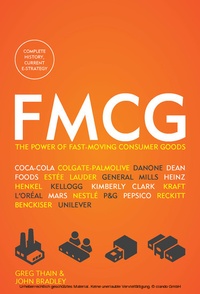
FMCG
Description

More details
Other editions
Additional editions
Content
FMCG
The Power of Fast-moving Consumer Goods
FMCG: Dinosaurs or Deciders?
It has become fashionable in some quarters to regard the FMCG category as old hat: a motley crew of yesterday's manufacturers of humdrum products populating the boring centre aisles of yesterday's bricks-and-mortar retail outlets. MBA course attendees want new and they want exciting: Apple, Amazon, Facebook, Google. Yet the biggest four companies in this book, Nestlé, Procter & Gamble, Unilever and PepsiCo, have combined revenues of more than $300 billion - neck and neck with Amazon, Facebook and Google.
OK, so these FMCG companies might still be big, but hasn't all the power shifted to the retailers? Are not the manufacturers a collective spent force? Once again, the numbers say otherwise. Virtually all our 24 companies are enjoying record turnovers and record margins. If power is shifting to the retailers, the cash isn't. And if the cash isn't, the power can't be.
The fact is that the world's largest FMCG companies have never been more successful or more interesting. They still drive the world's advertising industries: where would Google or Facebook be without them? And they have adapted and evolved faster than ever before to remain relevant to consumers in all corners of the globe. FMCG companies are at the forefrontof new retail developments, emerging markets, E-Retailing and online engagement. The Estée Lauder Company founded its online division in 1998 and now has over 340 web and e-Commerce sites, through which sales have grown ten-fold in a decade.
Our Choice of Companies
So how did we arrive at the list of companies profiled in this book? We began with a simple list of FMCG companies ranked by turnover. But we did not stick with this religiously. We decided to exclude three categories: tobacco, beer and spirits. We did so for two main reasons. Firstly, the retail environments in which such products are sold can differ quite dramatically around the world, which lessens the transferability to other product categories or countries of the lessons such companies can teach us. Secondly, particularly for tobacco and beer, a prolonged process of industry consolidation has drastically reduced differentiation. Scale, and the relentless pursuit of more of it, has become their predominant feature.
A further criterion we used in deciding the final list, and in excluding alcohol and tobacco conglomerates, was a subjective one: any company on our final list could quite conceivably end its days as part of any other. However, whilst it is relatively inconceivable that Nestlé or Unilever might buy SABMiller or Japan Tobacco International, we could easily envisage (ignoring family roadblocks) their acquiring Esteé Lauder, L'Oréal or even Mars Inc. There is also a spread in age: some of the businesses in this book are old, such as Procter & Gamble, which was established in 1837. Others, such as Dean Foods and Reckitt Benckiser, are surprisingly new: both assumed their current forms within the last fifteen years. We have also taken pains to include as many FMCG categories as possible. So we have Dean Foods in the chiller, whilst a couple global giants hold regally forth over on beauty.
How the Book is Organised
The structure of the book is effectively two-fold. We first take an in-depth look at eighteen of the world's largest FMCG businesses, then undertake a less concentrated survey of nine companies based in emerging markets that one day soon might get onto, let alone buy part of, the list. Within the eighteen, there is an almost ten-fold turnover difference between the largest, Nestlé, to the smallest, Esteé Lauder. But all have something to teach us: their differences are as much to do with scope as with capability. Indeed, one of the least impressively performing companies in recent years is Procter & Gamble, now losing out to Colgate in the dental category and to L'Oréal in beauty. Yet P&G are almost twice as big as Colgate and L'Oréal put together.
To understand how this happened, we do not just look at each company's recent performance - we leave that to the investment analysts. We, however, are essentially brand marketers. We look at our chosen companies much more deeply, going right back to their founding and their founding fathers. Despite the prevalence of management consultants sharing best practices and the ubiquity of the MBA case study, we believe each company's performance is as much to do with the strength and uniqueness of its corporate DNA as to how well its senior executives attend to their INSEAD courses.
We are firm believers in the power of institutional knowledge to shape and direct these gigantic businesses. Indeed most companies in this book show a remarkable degree of management continuity. L'Oréal, for example, has had just four CEOs in a century. At Danone, for forty years, there were two, and they were father and son. Itinerant, heroic, parachuted-in CEOs are few and far between at the top of the FMCG food chain.
Sheer Personality
We also start each chapter by looking at how, where, when, why and by whom the company was formed and founded. This is often overlooked by students of business and even by employees in the firms themselves: a quaint bit of historical kitsch irrelevant to the titanic business struggles of today. But the often highly charismatic and driven men and women of the sometimes distant past very frequently bear a wonderfully close relationship with their modern companies' DNA that can still be clearly perceived today. Danone's Daniel Carasso is an excellent example, as certainly is Henkel and, of course, L'Oréal's Eugène Schuller and Estée Lauder, all of whom defined right from the outset the character and strategy of the company and all of whom, were they to walk into head office tomorrow, would feel very much at home right now with what the company was doing and how. Remarkably, the clearest example of this kind of continuity is Mars - only the biggest confectionery company in the world. So, much insight is to be gleaned from quaint historical kitsch after all.
In other businesses, we meet insightful strategists who saw that their existing world was changing, so transformed their businesses to leapfrog the trends. General Mills' James Ford Bell, for example, saw only doom for his regional flour milling company, but reinvented it, revolutionised an industry and created a colossal branded business almost out of nothing.
Competence and Coping
In the second section we look at how each business evolved once it had become established and had developed a core competence or two. In some cases, such as Kellogg's and Heinz, competence was rapidly exploited to create dominant market positions, and then taken international early. In others, as original competences became redundant, it was a case of change them or die. Kimberley-Clark's tariff-driven need to get out of newsprint forced the bet-the-farm commercialisation of their interesting, apparently irrelevant and - at first - highly socially sensitive use of Cellucotton. Henkel's management was almost permanently in crisis mode for forty years, coping with Germany's defeat in the First World War, the French invasion of the Ruhr and their factories based there, the devastation of the Second World War and the post-war Russian theft of almost three quarters of its production capabilities, which were dismantled and shipped off to the Urals. And Nestlé's Swiss head office was surrounded by the Axis powers for years. How management managed has left a permanent imprint. Understanding this imprint means looking at personalities as well as balance sheets.
How Were They Formed and Where Did They Go Next?
The next two sections look at how the modern businesses of today were formed and where they went from the point of formation. And in terms of formation, there were several fronts. For some, it involved the sloughing off of the diversifications that had engulfed many businesses during the 1960s and '70s. Unilever went through trucking, fishing, car dealing, advertising and packaging. General Mills was at one time the world's leading toy company, as it simultaneously solved America's 'What's for supper, Mom?' problem with convenience foods and the Red Lobster and Olive Garden chains. Other businesses reinvented themselves from within: Colgate's George H. Lesch was recalled from their thriving international division to reinvigorate a moribund US organisation. Acquisitions and mergers transformed PepsiCo from serial bankrupt one-hit-wonders into major industry players, while the influx of Phillip Morris tobacco money created new company breed Kraft Foods, formed from the imposed amalgamation of Kraft, General Foods and Nabisco.
All of our chosen companies have, of course, vast international markets. Unilever, Nestlé and Henkel have been regional or global businesses for decades. Nestlé recently celebrated its first hundred years in India, while Unilever has dominated South America for almost as long. In India, Hindustan Lever built the country's leading FMCG business. Kellogg's and Heinz built hugely successful businesses in the U.K. and are so well-established in some of the former British colonies that local customers consider them home-grown.
Of...
