

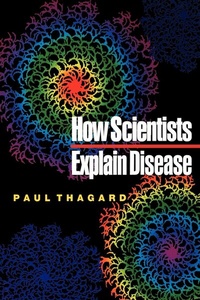
How Scientists Explain Disease
1st Edition
Published on 5. November 2018
268 pages
978-0-691-18730-3 (ISBN)
Description

How do scientists develop new explanations of disease? How do those explanations become accepted as true? And how does medical diagnosis change when physicians are confronted with new scientific evidence? These are some of the questions that Paul Thagard pursues in this pathbreaking book that develops a new, integrative approach to the study of science.
Ranging through the history of medicine, from the Hippocratic theory of humors to modern explanations of Mad Cow Disease and chronic fatigue syndrome, Thagard analyzes the development and acceptance of scientific ideas. At the heart of the book is a case study of the recent dramatic shift in medical understanding of peptic ulcers, most of which are now believed to be caused by infection by the bacterium Helicobacter pylori. When this explanation was first proposed in 1983, it was greeted with intense skepticism by most medical experts, but it became widely accepted over the next decade. Thagard discusses the psychological processes of discovery and acceptance, the physical processes involving instruments and experiments, and the social processes of collaboration, communication, and consensus that brought about this transformation in medical knowledge.
How Scientists Explain Disease challenges both traditional philosophy of science, which has viewed science as largely a matter of logic, and contemporary science studies that view science as largely a matter of power. Drawing on theories of distributed computing and artificial intelligence, Paul Thagard develops new models that make sense of scientific change as a complex system of cognitive, social, and physical interactions.
This is a book that will appeal to all readers with an interest in the development of science and medicine. It combines an engaging style, significant research, and a powerfully original argument.
Ranging through the history of medicine, from the Hippocratic theory of humors to modern explanations of Mad Cow Disease and chronic fatigue syndrome, Thagard analyzes the development and acceptance of scientific ideas. At the heart of the book is a case study of the recent dramatic shift in medical understanding of peptic ulcers, most of which are now believed to be caused by infection by the bacterium Helicobacter pylori. When this explanation was first proposed in 1983, it was greeted with intense skepticism by most medical experts, but it became widely accepted over the next decade. Thagard discusses the psychological processes of discovery and acceptance, the physical processes involving instruments and experiments, and the social processes of collaboration, communication, and consensus that brought about this transformation in medical knowledge.
How Scientists Explain Disease challenges both traditional philosophy of science, which has viewed science as largely a matter of logic, and contemporary science studies that view science as largely a matter of power. Drawing on theories of distributed computing and artificial intelligence, Paul Thagard develops new models that make sense of scientific change as a complex system of cognitive, social, and physical interactions.
This is a book that will appeal to all readers with an interest in the development of science and medicine. It combines an engaging style, significant research, and a powerfully original argument.
More details
Other editions
Additional editions
Paul Thagard
How Scientists Explain Disease
Book
07/2000
Princeton University Press
€44.20
Article not available at the moment

Paul Thagard
How Scientists Explain Disease
Book
04/1999
Princeton University Press
€55.80
Article exhausted; check different version
Person
Paul Thagard is Professor of Philosophy and Director of the Cognitive Science Program at the University of Waterloo (Canada). His previous books include Conceptual Revolutions (Princeton) and Mind: Introduction to Cognitive Science (MIT Press).
Content
- Cover
- Title Page
- Copyright Page
- Contents
- List of Figures
- List of Tables
- Preface
- Acknowledgments
- PART ONE: EXPLANATIONS
- Chapter 1 Explaining Science
- Explanation Schemas
- Explaining Belief Change
- Lavoisier and the Chemical Revolution
- Hadden on the Mathematical-Mechanistic World View
- Alternatives to Cognitive Individualism
- Mind, Society, and Rationality
- Summary
- Chapter 2 Explaining Disease
- Explanation Schemas in the History of Medicine
- Explanation Schemas from Molecular Genetics
- Explanatory and Conceptual Unification
- Summary
- PART TWO: THE BACTERIAL THEORY OF PEPTIC ULCERS
- Chapter 3 Ulcers and Bacteria: Discovery
- The Discoveries
- Models of Discovery
- Modeling the Discoveries
- Conceptual Change
- The Process of Discovery
- Summary
- Chapter 4 Ulcers and Bacteria: Acceptance
- Early Reception of the Bacterial Theory of Ulcers
- Causation and Koch's Postulates
- Causation and Cure
- Rejection, Acceptance, and Explanatory Coherence
- Conclusion
- Summary
- Chapter 5 Ulcers and Bacteria: Instruments and Experiments
- Instruments
- Experiments
- Experiment and Theory
- Medical Realism
- Summary
- Chapter 6 Ulcers and Bacteria: Social Interactions
- Collaboration
- Communication
- Consensus
- Organizations and Funding
- Science as a Social Process
- Conclusion
- Summary
- PART THREE: COGNITIVE PROCESSES
- Chapter 7 Causes, Correlations, and Mechanisms
- Correlation and Causes
- Causes and Mechanisms
- Disease Explanation as Causal Network Instantiation
- Conclusion
- Summary
- Chapter 8 Discovering Causes: Scurvy, Mad Cow Disease, AIDS, and Chronic Fatigue Syndrome
- Stages of Disease Understanding
- Scurvy
- Spongiform Encephalopathies
- AIDS
- Chronic Fatigue Syndrome
- Complexities of Causal Inference
- Summary
- Chapter 9 Medical Analogies
- Models of Analogical Transfer
- Theoretical Analogies
- Experimental Analogies
- Diagnostic Analogies
- Therapeutic Analogies
- Technological Analogies
- Educational Analogies
- Summary
- Chapter 10 Diseases, Germs, and Conceptual Change
- Conceptual Change
- Changes in Disease Concepts
- Representational Changes in Germ Concepts
- Germs: Referential Change
- Representation, Reference, and Conceptual Change
- Summary
- PART FOUR: SOCIAL PROCESSES
- Chapter 11 Collaborative Knowledge
- The Prevalence of Collaboration
- The Nature of Collaboration
- Goldman's Standards for Epistemic Appraisal
- Why Collaborate? Gains and (Occasional) Losses
- Explanatory Efficacy
- Applications: Ulcers and Analogy
- Summary
- Chapter 12 Medical Consensus
- Anatomy of a Consensus Conference
- Evidence-Based Medicine
- The Logic of Testing and Treatment
- Contributions of Consensus Conferences
- Summary
- Chapter 13 Science and Medicine on the Internet
- A Day in the Life of a Cyberscientist
- Revolutions in Scientific Communication
- Science on the Web
- Evaluation of the Internet According to Epistemic Criteria
- Conclusion
- Summary
- PART FIVE: CONCLUSION
- Chapter 14 Science as a Complex System
- Metaphors and Analogies in Science Studies
- Distributed Computation
- Objections and Limitations of Science as Distributed Computation
- Reduction
- Rationality
- Realism
- Conclusion
- Summary
- References
- Index
