


How Scientists Explain Disease
Published on 26. April 1999
Book
Hardback
268 pages
978-0-691-00261-3 (ISBN)
Description
Ranging through the history of medicine, from the Hippocratic theory of humours to modern explanations of Mad Cow Disease and chronic fatigue syndrome, this book analyzes the development and acceptance of scientific ideas. At the heart of the book is a case study of the recent shift in medical understanding of peptic ulcers, most of which are now believed to be caused by infection by the bacterium, Heliobacter pylori. Among the questions asked are: how do scientists develop new explanations of disease? How do those explanations become accepted as true? How does medical diagnosis change when physicians are confronted with new scientific evidence? The book challenges both traditional philosophy of science, which has viewed science as largely a matter of logic, and contemporary science studies that view science as largely a matter of power.
Reviews / Votes
"Thagard . . . presents a detailed structure for the scientific understanding of disease. . . . [A] valuable work. . . . Recommended." * Library Journal * "This book is remarkable for its clarity and its lack of doctrine. At each stage, Thagard outlines in plain terms precisely what he is trying to explain, and illustrates his explanation . . . It is precisely this even-handed and commonsense approach that allows him to give an accurate portrayal of what scientific advance is like. If this is what philosophers can do for science and medicine, we need more help from them."---Charles Bangham, The Times Higher Education Supplement "An engaging look at contemporary medical science."---K. Codell Carter, Journal of the History of Medicine "For anyone who has practised medicine long enough to wonder how and why some theories become fashionable and others fail to thrive, this book will make an interesting read. Paul Thagard finds both the traditional view of science as logic and the postmodern view of science as power inadequate for understanding how science develops."---Julia Lowe, British Medical Journal "This clear and easy to read book is suitable for the general public and students, as well as professional philosophers of science. . . . The general reader will appreciate introductions to the logical, cognitive, and sociological approaches to the study of science. . . . Useful summaries at the end of each chapter allow a quick read of main points."---Lindley Darden, Philosophy of ScienceMore details
Language
English
Place of publication
New Jersey
United States
Target group
College/higher education
Professional and scholarly
Product notice
Trade binding
Illustrations
8 tables 33 line illus. 1 halftone
Dimensions
Height: 229 mm
Width: 152 mm
Weight
567 gr
ISBN-13
978-0-691-00261-3 (9780691002613)
Copyright in bibliographic data is held by Nielsen Book Services Limited or its licensors: all rights reserved.
Schweitzer Classification
Other editions
Additional editions
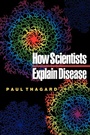
Paul Thagard
How Scientists Explain Disease
E-Book
11/2018
1st Edition
Princeton University Press
€54.49
Available for download
Person
Paul Thagard is Professor of Philosophy and Director of the Cognitive Science Program at the University of Waterloo (Canada). His previous books include Conceptual Revolutions (Princeton) and Mind: Introduction to Cognitive Science (MIT Press).