

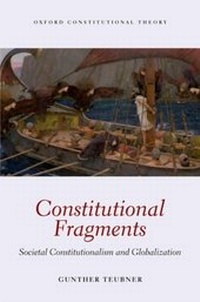
Constitutional Fragments
Societal Constitutionalism and Globalization
1st Edition
Published on 2. March 2012
226 pages
978-0-19-162933-4 (ISBN)
Description

In recent years a series of scandals have challenged the traditional political reliance on public constitutional law and human rights as a safeguard of human well-being. Multinational corporations have violated human rights, private intermediaries in the internet have threatened freedom of opinion, and the global capital markets unleashed catastrophic risks. All of these phenomena call for a response from traditional constitutionalism. Yet it is outside the limits of the nation-state in transnational politics and outside institutionalized politics, in the 'private' sectors of global society that these constitutional problems arise. It is widely accepted that there is a crisis in traditional constitutionalism caused by transnationalization and privatization. How the crisis can be overcome is one of the major controversies of modern political and constitutional theory. This book sets out an answer to that problem. It argues that the obstinate state-and-politics-centricity of traditional constitutionalism needs to be counteracted by a sociological approach which, so far, has remained neglected in the constitutional debate. Constitutional sociology projects the questions of constitutionalism not only onto the relationship between public politics and law, but onto the whole society. It argues that constitutionalism has the potential to counteract the expansionist tendencies of social systems outside the state world, particularly of the globalized economy, science and technology, and the information media, when they endanger individual or institutional autonomy. The book identifies transnational regimes, particularly in the private area, as the new constitutional subjects in a global society, rivals to the order and power of nation states. It presents a model of transnational, societal constitutional fragments that could bring the values of constitutionalism to bear on these private networks, examining the potential horizontal application of human rights in the private sphere, and how such fragments could interact. An original and provocative contribution to the literature on modern constitutionalism, Constitutional Fragments is essential reading for all those engaged in transnational political theory.
More details
Other editions
Additional editions
Book
03/2012
1st Edition
Oxford University Press
€154.80
Shipment within 15-20 days
Content
- Cover
- Contents
- Abbreviations
- 1: The New Constitutional Question
- I. A Crisis in Modern Constitutionalism?
- 1. Nation-state constitution versus global constitution
- 2. Impulses from constitutional sociology
- II. False Premises
- 1. Societal constitutionalism as a genuine problem of globalization?
- 2. Constitutional emptiness of the transnational?
- 3. Reducing transnational governance to political processes?
- 4. Reducing the third-party effects of fundamental rights to the states' duties of care?
- 5. A unitary, cosmopolitan global constitution?
- 2: Sectorial Constitutions in the Nation State
- I. Societal Institutions under Liberal Constitutionalism
- 1. Constitution-free spheres of individual freedom
- 2. Autonomous societal orders
- II. Totalitarian Societal Constitutions
- III. Sub-constitutions in the Welfare State
- 1. Historical lessons
- 2. Statist societal constitutionalism
- 3. Politicization of social sectors
- IV. Economic Constitutionalism for the Whole Society
- 1. Ordoliberal constitutionalism
- 2. Constitutional economics
- V. Constitutional Pluralism
- 1. Neo-corporatist arrangements
- 2. Societal constitutionalism
- 3: Transnational Constitutional Subjects: Regimes, Organizations, Networks
- I. Global Structures
- II. Social Constitutionalization by the States?
- 1. The UN Charter
- 2. Soft law of the states
- 3. International public law and global administrative law
- III. The Independent Constitutions of Global Institutions
- 1. Constitutional fragmentation
- 2. Constitutions of international organizations
- 3. Regime constitutions
- IV. Transnational Regimes as Constitutional Subjects?
- 1. Pouvoir constituant/constitué
- 2. Collective identity
- 4: Transnational Constitutional Norms: Functions, Arenas, Processes, Structures
- I. Constitutional Functions: Constitutive/Limitative
- 1. Self-foundation of social systems
- 2. 'Double movement' of global constitutionalism
- 3. Self-constraint of growth pressures
- 4. 'Capillary constitutions'
- 5. Devil and Beelzebub
- II. Constitutional Arenas: Internal Differentiation in Social Systems
- 1. Spontaneous sphere
- 2. Organized-professional sphere
- 3. The self-regulatory sphere of the communicative medium
- III. Constitutional Processes: Double Reflexivity
- 1. Reflexivity of the social system
- 2. Reflexivity of the legal system
- IV. Constitutional Structures: Hybrid Meta-codes
- 1. Coding and meta-coding
- 2. Hybridity
- V. The Politics of Societal Constitutionalism
- 1. La politique versus le politique
- 2. In the shadow of politics
- 3. Internal politics of social subsystems
- 5: Transnational Fundamental Rights: Horizontal Effect
- I. Fundamental Rights Beyond the Nation State
- 1. Extraterritorial effect of national constitutional rights?
- 2. Global colère publique
- 3. Regime-specific standards of fundamental rights
- II. Fundamental Rights Binding 'Private' Transnational Actors
- 1. Beyond state action
- 2. Generalization: communicative media instead of general values
- 3. Respecification in different social contexts
- III. Inclusionary Effect of Fundamental Rights: Right to Access
- IV. Exclusionary Effect of Fundamental Rights
- V. The Anonymous Matrix
- VI. Justiciability?
- 6: Inter-constitutional Collisions
- I. The Lack of a Third-party Authority
- II. Inter-regime Conflicts
- 1. Modifications of the traditional conflict of laws
- 2. Normative networks
- III. Intercultural Conflicts
- 1. Cultural polycentrism
- 2. Re-entry of the 'extrinsic' into the 'intrinsic'
- 3. Intercultural conflict norms
- IV. Guiding Principles in Various Constitutional Conflicts
- References
- Subject Index
- A
- B
- C
- D
- E
- F
- G
- H
- I
- J
- L
- M
- N
- O
- P
- R
- S
- T
- U
- W
- Author Index
- A
- B
- C
- D
- E
- F
- G
- H
- J
- K
- L
- M
- N
- O
- P
- R
- S
- T
- U
- V
- W
- Y
- Z
