

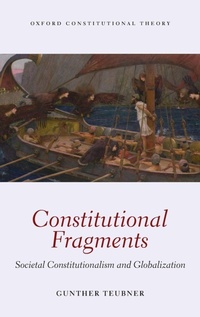
Constitutional Fragments
Societal Constitutionalism and Globalization
1st Edition
Published on 1. March 2012
Book
Hardback
226 pages
978-0-19-964467-4 (ISBN)
Description
In recent years a series of scandals have challenged the traditional political reliance on public constitutional law and human rights as a safeguard of human well-being. Multinational corporations have violated human rights; private intermediaries in the internet have threatened freedom of opinion, and the global capital markets unleashed catastrophic risks. All of these phenomena call for a response from traditional constitutionalism. Yet it is outside the limits of the nation-state in transnational politics and outside institutionalized politics, in the 'private' sectors of global society that these constitutional problems arise.
It is widely accepted that there is a crisis in traditional constitutionalism caused by transnationalization and privatization. How the crisis can be overcome is one of the major controversies of modern political and constitutional theory. This book sets out an answer to that problem. It argues that the obstinate state-and-politics-centricity of traditional constitutionalism needs to be counteracted by a sociological approach which, so far, has remained neglected in the constitutional debate. Constitutional sociology projects the questions of constitutionalism not only onto the relationship between public politics and law, but onto the whole society. It argues that constitutionalism has the potential to counteract the expansionist tendencies of social systems outside the state world, particularly of the globalized economy, science and technology, and the information media, when they endanger individual or institutional autonomy.
The book identifies transnational regimes, particularly in the private area, as the new constitutional subjects in a global society, rivals to the order and power of nation states. It presents a model of transnational, societal constitutional fragments that could bring the values of constitutionalism to bear on these private networks, examining the potential horizontal application of human rights in the private sphere, and how such fragments could interact. An original and provocative contribution to the literature on modern constitutionalism, Constitutional Fragments is essential reading for all those engaged in transnational political theory.
It is widely accepted that there is a crisis in traditional constitutionalism caused by transnationalization and privatization. How the crisis can be overcome is one of the major controversies of modern political and constitutional theory. This book sets out an answer to that problem. It argues that the obstinate state-and-politics-centricity of traditional constitutionalism needs to be counteracted by a sociological approach which, so far, has remained neglected in the constitutional debate. Constitutional sociology projects the questions of constitutionalism not only onto the relationship between public politics and law, but onto the whole society. It argues that constitutionalism has the potential to counteract the expansionist tendencies of social systems outside the state world, particularly of the globalized economy, science and technology, and the information media, when they endanger individual or institutional autonomy.
The book identifies transnational regimes, particularly in the private area, as the new constitutional subjects in a global society, rivals to the order and power of nation states. It presents a model of transnational, societal constitutional fragments that could bring the values of constitutionalism to bear on these private networks, examining the potential horizontal application of human rights in the private sphere, and how such fragments could interact. An original and provocative contribution to the literature on modern constitutionalism, Constitutional Fragments is essential reading for all those engaged in transnational political theory.
Reviews / Votes
sociologists of law and constitutionalism now have powerful methodological tools, a sociological conceptual framework, and invaluable sources of the new constitutional imagination which has capacity to accommodate even recent elaborations on Nietzsche's theory of command structures. * Jiri Priban (Cardiff University), Journal of Law and Society *More details
Series
Language
English
Place of publication
Oxford
United Kingdom
Target group
Professional and scholarly
Academics and students of the social sciences; Lawyers working in international law, constitutional law, private law, legal theory; transnational policy makers.
Dimensions
Height: 240 mm
Width: 161 mm
Thickness: 17 mm
Weight
508 gr
ISBN-13
978-0-19-964467-4 (9780199644674)
Copyright in bibliographic data and cover images is held by Nielsen Book Services Limited or by the publishers or by their respective licensors: all rights reserved.
Schweitzer Classification
Other editions
Additional editions
E-Book
03/2012
1st Edition
Oxford University Press
€164.34
Available for download
E-Book
03/2012
1st Edition
OUP eBook
€30.49
Available for download
Person
Gunther Teubner is Professor of comparative private law and legal sociology at the International University College at Torino. He is former Otto Kahn Freund Professor at the London School of Economics. At present he is Principal Investigator at the Excellence Cluster "Normative Orders" at the Goethe-University Frankfurt. He taught at the European University Institute Florence, Italy, and at the universities of Bremen and Frankfurt. He was Visiting Professor in Berkeley, Ann Arbor, Stanford, Leyden, Toronto, Berlin, and Maastricht. He received honorary doctorates from the universities Lucerne, Napoli, Tiflis, Macerata, Lund.
Content
1. The New Constitutional Question ; 2. Societal Constitutionalism in the Nation State ; 3. Transnational Constitutional Subjects: Regimes, Organisations, Networks ; 4. Transnational Constitutional Norms: Functions, Arenas, Processes, Structures ; 5. Transnational Constitutional Rights: Horizontal Effect ; 6. Colliding Constitutions