

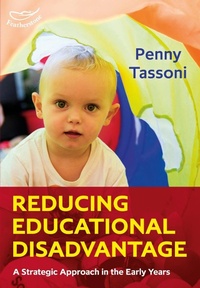
Reducing Educational Disadvantage: A Strategic Approach in the Early Years
How to Provide a Safety Net for Children in Your Care Who are Most at Risk
1st Edition
Published on 5. May 2016
208 pages
978-1-4729-3300-3 (ISBN)
Description

Winner of the ERA award for Early Years
_______________
On average, children from low income backgrounds enter reception with lower scores in literacy and mathematics than their peers. This book provides early years practitioners with the skills to narrow this gap.
In the early years, children's cognitive development is largely shaped by their home environment, but research shows that on average, children who are entitled to free school meals start primary school with lower scores in reading and mathematics than their peers. As an early years practitioner, you can influence these children's learning within your setting, and help them to achieve the same levels as their more affluent peers. That's what this book aims to do: help you to narrow the gap.
This unique book shows you how to provide a 'safety net' for children who are most at risk of underachievement. You will be taught about the different factors that positively impact upon children's learning (including adult interaction and literacy and mathematical experiences) and how they link to good practice within the EYFS.
From tips for creating a rich, and diverse play environment for them to enjoy, to suggestions on how to carefully guide activities and experiences, this book will help you to establish a strong, long term education programme. You will be amazed at the impact you will have upon these children simply by making small changes to your practice and planning, and you might even increase your setting's chance of gaining an 'outstanding' Ofsted grade.
_______________
On average, children from low income backgrounds enter reception with lower scores in literacy and mathematics than their peers. This book provides early years practitioners with the skills to narrow this gap.
In the early years, children's cognitive development is largely shaped by their home environment, but research shows that on average, children who are entitled to free school meals start primary school with lower scores in reading and mathematics than their peers. As an early years practitioner, you can influence these children's learning within your setting, and help them to achieve the same levels as their more affluent peers. That's what this book aims to do: help you to narrow the gap.
This unique book shows you how to provide a 'safety net' for children who are most at risk of underachievement. You will be taught about the different factors that positively impact upon children's learning (including adult interaction and literacy and mathematical experiences) and how they link to good practice within the EYFS.
From tips for creating a rich, and diverse play environment for them to enjoy, to suggestions on how to carefully guide activities and experiences, this book will help you to establish a strong, long term education programme. You will be amazed at the impact you will have upon these children simply by making small changes to your practice and planning, and you might even increase your setting's chance of gaining an 'outstanding' Ofsted grade.
More details
Edition
1. Auflage
Language
English
Place of publication
London
United Kingdom
Publishing group
Bloomsbury Publishing PLC
Target group
Professional and scholarly
ISBN-13
978-1-4729-3300-3 (9781472933003)
Copyright in bibliographic data and cover images is held by Nielsen Book Services Limited or by the publishers or by their respective licensors: all rights reserved.
Schweitzer Classification
Other editions
Additional editions
Penny Tassoni
Reducing Educational Disadvantage: A Strategic Approach in the Early Years
How to provide a safety net for children in your care who are most at risk
Book
05/2016
Featherstone
€44.79
Article exhausted; check different version
Person
Penny Tassoni is an education consultant, author and trainer who specialises in the whole spectrum of learning and play. Penny began her career as an early years teacher, before training nursery nurses. She has also worked for a large daycare chain as their education and training manager.
Penny has written forty books many of which are core textbooks in the UK for training nursery nurses and early years teachers. In February 2013, she was asked to take on the role of President of the Professional Association of Early Years and Childcare - an organisation with over 35,000 members in the UK. Penny is a well known speaker and trainer. She regularly visits and supports nurseries and pre-schools which allows her to maintain regular contact with babies and young children. She also works regularly in Turkey but has supported nurseries in China, Dubai and Hong Kong.
Penny has written forty books many of which are core textbooks in the UK for training nursery nurses and early years teachers. In February 2013, she was asked to take on the role of President of the Professional Association of Early Years and Childcare - an organisation with over 35,000 members in the UK. Penny is a well known speaker and trainer. She regularly visits and supports nurseries and pre-schools which allows her to maintain regular contact with babies and young children. She also works regularly in Turkey but has supported nurseries in China, Dubai and Hong Kong.
Content
- Cover
- Title
- Copyright
- Contents
- Introduction: Closing the gap
- 1. Working in partnership with parents
- Understanding the factors that may impact on parental engagement
- Creating a welcoming environment that supports positive parental engagement
- The importance of the key person role in fostering relationships with parents
- The process of settling in
- Practical pressures on parents
- Supporting children's development at home
- 2. Creating a rich play environment
- The importance of a rich play environment
- Designing an environment for play
- Assessing the play environment
- Creating a long term plan for play opportunities
- 3. Constructing an education programme
- The importance of planning for the long term
- The wider issues in creating an education programme
- Tailoring the education programme to your setting
- Working with the early years curriculum
- 4. Widening knowledge, skills and horizons
- Why rich experiences matter?
- Planning for experiences
- Experiences within the setting
- Planning an education programme around experiences
- 5. Creating an environment for personal, social and emotional development
- Factors affecting children's personal, social and emotional development
- Supporting children's emotional well-being
- Building a positive self-image
- Supporting children's social skills
- Creating an environment to support self-regulation
- Developing children's concentration
- Coaching for perseverance
- 6. Communication and language
- Why communication and language matters
- Relationships first
- The importance of prioritising the key person
- Precise assessment
- Factors affecting children's communication and language
- Role of the adult
- Taking a language partner approach
- Stimuli
- Monitoring levels of interaction with individual children
- Specific skills to support children's communication and language development
- Development charts
- 7. Supporting bilingual children
- What is bilingualism?
- How children may acquire more than one language
- Myths
- How young children learn more than one language
- The importance and benefits of bilingualism
- Starting out - learning about language use at home
- Settling in and the key person role
- Meeting the needs of simultaneous bilingual children
- Meeting the needs of sequential learners
- Factors affecting children's journey
- Common issues when children learn more than one language
- Supporting parents
- 8. Creating an environment for early literacy
- Motivation, joy and discovery
- The link between language and literacy
- Specific skills associated with reading
- Learning to write
- Handwriting
- 9. Cognition, problem solving and mathematics
- Links to language
- Developing language for thinking
- Contexts
- Adult-led activities to support cognition
- Specific activities and opportunities
- Construction play
- Playing mathematical games
- Sorting
- Counting
- Measuring
- Patterns
- Memory games
- 10. Physical development and self-care
- Role and importance of physical development and self-care skills
- Observing and assessing children's physical skills
- Specific physical skills that children need to acquire
- Role of rich play provision in supporting children's physical skills
- Self-care
- Toileting
- Feeding
- Dressing
- Nose blowing
- Hand washing
- Role of routines to support self-care and life skills
- Conclusion: a final word
- Bibliography and further reading
