

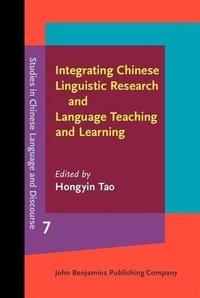
Integrating Chinese Linguistic Research and Language Teaching and Learning
1st Edition
Published on 3. October 2016
257 pages
978-90-272-6635-4 (ISBN)
Description

Linguistic research and language teaching have generally been viewed as two separate types of academic endeavor. While linguists have been preoccupied with pattern finding and theory building, language teachers often encounter issues that are not readily addressed by theoretical linguistic research. This collection, with eleven papers touching upon a wide range of issues, stands out as one of the rare concerted efforts toward a meaningful integration of the two endeavors. Subject matters include tone, stress, word structure, grammatical categories (e.g. classifiers), syntactic structures (including argument structure), discourse particles, implicit and explicit knowledge, conversational repair, and learner corpus. With a diverse range of theoretical orientations, this collection serves to showcase some of the productive ways to create synergy between Chinese linguistic research and language education.
More details
Other editions
Additional editions
Book
10/2016
John Benjamins Publishing Co
€123.30
Shipment within 10-15 days
Content
- Intro
- Integrating Chinese Linguistic Research and Language Teaching and Learning
- Editorial page
- Title page
- LCC data
- Table of contents
- Contributors
- Acknowledgments
- Integrating Chinese Linguistic Research and Language Teaching and Learning
- Refrences
- The Emergence of Verb Argument Structure in Mandarin Chinese
- 0. Introduction
- 1. The current study
- 1.1 Data
- 1.2 Coding
- 1.3 Results
- 2. Discussion and conclusion
- References
- A corpus linguistics approach to the research and teaching of Chinese as a second language
- 0. Introduction
- 1. Literature Review
- 1.1 Corpus Linguistics Research in Chinese and Applied Linguistics
- 1.2 The ba-construction
- 1.3 Contrastive Interlanguage Analysis (CIA)
- 2. Research questions
- 3. Methods
- 3.1 Learner Corpora
- 3.1.1 Written Corpus
- 3.1.2 Spoken Corpus
- 3.2 Reference Corpora (Native Corpora)
- 3.2.1 Written Native Corpora
- 3.2.2 Spoken Native Corpora
- 3.3 Analyses
- 3.4 Computer adaptive Chinese proficiency test
- 4. Results
- 4.1 Written corpus: Journals
- 4.2 Spoken corpus of the six students who studied in China for a year
- 4.3 Comparison of normalized frequencies of ba between Learner and native corpora
- 4.4 Ba used by the six yearlong students over time
- 4.5 Computer Proficiency Test Scores of the Six Yearlong Students
- 5. Discussion
- 6. Pedagogical Implications
- 7. Further research
- 8. Conclusion
- References
- Online corpora used or cited
- Facilitating language learning
- 0. Introduction
- 1. Generative theory and language teaching - issues
- 2. Fundamentals of generative linguistic theory
- 3. Pedagogical implications
- 3.1 The "what" of teaching
- 3.2 Teaching methodologies
- 4. Possible implementations
- 5. Linguistic research and universal grammar
- 6. Conclusion
- Acknowledgments
- References
- An ERP Study of the Processing of Mandarin Classifiers
- 0. Introduction
- 1. Method
- 1.1 Participants
- 1.2 Materials and design
- 1.3 Procedure
- 1.4 EEG Recording and Data Analysis
- 2. Results
- 2.1 Match vs. Mismatch
- 2.2 Match vs. Missing
- 3. Discussion and conclusion
- 3.1 Match vs Mismatch
- 3.2 Match vs Missing
- 3.3 Pedagogical implications
- Notes
- References
- Explicit, Implicit and Metalinguistic Knowledge in L2 Chinese
- 0. Introduction
- 1. Theoretical background and literature review
- 2. Research Questions
- 3. Method
- 3.1 Participants
- 3.2 Instruments
- 3.3 Material
- 3.4 Scoring
- 4. Results
- 5. Discussion
- 6. Conclusion
- References
- Appendix 1
- Appendix 2
- Metalinguistic awareness and self-repair in Chinese language learning
- 1. Introduction
- 2. Self-initiated self-repair
- 2.1 The road to language proficiency
- 2.2 The present study
- 3. Repair by Beginning Chinese Learners
- 3.1 Subjects and materials
- 3.2 Repair from the beginning Chinese students
- 3.2.1 Usage Frequency and Chunking
- 3.2.2 Production Problems
- 3.2.3 L1 influence and repair
- 3.2.4 Speech error and repair
- 3.2.5 Interim summary
- 4. Conclusion, what is hard to learn is better remembered!
- References
- Appendix
- De-stressed words in Mandarin
- 1. Introduction
- 2. Stress and non-stress in Mandarin
- 2.1 Phonetic cues for stress/non-stress in Mandarin
- 2.2 The importance of non-stress
- 2.3 The reverse view
- 2.4 The taxonomy of unstressed items
- 3. English
- 3.1 Words with weak forms
- 3.2 Phonetic changes in weak forms
- 3.3 The choice between strong and weak forms
- 3.4 Items belonging to words with weak forms
- 4. Standard Mandarin
- 4.1 Monosyllabic function words with lexical tone (the cliticoids)
- 4.2 Phonetic changes in reduced forms
- 4.3 The choice between full and reduced forms
- 4.4 The membership of the group of cliticoids
- 4.5 A comparison of the Chinese cliticoids and English words with weak forms
- 4.6 The cliticoids in Chinese language teaching
- 5. Conclusion
- References
- Prosody and discourse functions of ranhou ??
- 0. Introduction
- 1. Data and methodology
- 2. Discourse functions
- 2.1 TCU extensions
- 2.2 Turn continuation
- 2.3 New turn initiation
- 3. Correlation between prosody and discourse functions
- 3.1 TCU extension and prosody
- 3.2 Turn continuation and prosody
- 3.3 New turn initiation
- 3.4 Interim summary
- 4. Teaching discourse functions and prosody
- 4.1 Transforming linguistic findings pedagogically
- 4.2 Teaching discourse features in the classroom
- 4.2.1 Perception exercise
- 4.2.2 Production exercise
- 5. Conclusion
- References
- Patterns of plural NP + dou ( ) expressions in conversational discourse and their pedagogical implications*
- 1. Introduction
- 2. Previous studies on dou
- 3. Data and distribution of categories
- 3.1 Data
- 3.2 Coding
- 3.3 Frequency of dou-expressions in terms of the associated NP form
- 3.4 (Inter)subjectivity versus objectivity
- 4. Interactive functions
- 4.1 A rapport-building device to create solidarity among co-participants
- 4.2 A backgrounding device for projecting perspectives
- 4.3 A persuasive device to strengthen the speaker's argument and win over the addressee
- 4.4 A mitigation device to reconcile conflicting stances
- 4.5 Interim Summary
- 5. Implications for Chinese language teaching
- 5.1 Teaching-material design
- 5.2 Sample classroom activity
- 5.3 Evaluation and assessment
- 5.4 Interim summary
- 6. Conclusions
- References
- Appendix I - Transcription Conventions:
- Appendix II - Abbreviations:
- Prominence Marking in Second Language Chinese Tones
- 0. Introduction
- 1. Phonological background
- 1.1 Chinese
- 1.2 English prosodic structure
- 1.3 Japanese prosodic structure
- 1.4 The present study
- 2. Methodology
- 2.1 Participants
- 2.2 Stimuli
- 2.3 Procedures and Analysis
- 3. Results and discussion
- 3.1 General patterns
- 3.2 Focused monosyllabic words
- 3.3 Discussion: Monosyllabic focus
- 3.4 Focused disyllabic words
- 4. Pedagogical implications
- 5. Conclusion
- References
- A Multi-dimensional Corpus Study of Mixed Compounds in Chinese
- 1. Introduction
- 1.1 What are mixed compounds?
- 1.2 Why mixed compounds?
- 2. Methodology
- 2.1 MM framework of register variation
- 2.2 Statistical Method: Correspondence Analysis
- 2.3 Corpora
- 2.3.1 Main Corpus
- 2.3.2 Supplemental corpora
- 2.4 Types of Features
- 3. Results
- 3.1 LCMC (v2)
- 3.1.1 Evidence for the Literate Dimension
- 3.1.2 Evidence for the Classical Dimension:
- 3.1.3 Support for the interpretation of the dimensions
- 3.1.4 Independent collaboration from Feng, S. L. (2010) and Feng &Yan (2013)
- 3.1.5 Mixed Compounds
- 3.2 Replication with CCL and Beiyu
- 3.2.1 CCL
- 3.2.2 Beiyu
- 4. Why are mixed compounds most literate?
- 5. Future directions
- 6. Pedagogical implications
- References
- Index
