

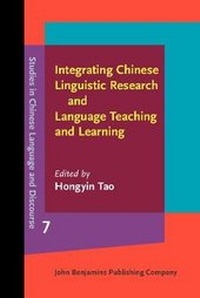
Integrating Chinese Linguistic Research and Language Teaching and Learning
Published on 3. October 2016
Book
Hardback
239 pages
978-90-272-0187-4 (ISBN)
Description
Linguistic research and language teaching have generally been viewed as two separate types of academic endeavor. While linguists have been preoccupied with pattern finding and theory building, language teachers often encounter issues that are not readily addressed by theoretical linguistic research. This collection, with eleven papers touching upon a wide range of issues, stands out as one of the rare concerted efforts toward a meaningful integration of the two endeavors. Subject matters include tone, stress, word structure, grammatical categories (e.g. classifiers), syntactic structures (including argument structure), discourse particles, implicit and explicit knowledge, conversational repair, and learner corpus. With a diverse range of theoretical orientations, this collection serves to showcase some of the productive ways to create synergy between Chinese linguistic research and language education.
More details
Series
Language
English
Place of publication
Amsterdam
Netherlands
Target group
Professional and scholarly
Weight
560 gr
ISBN-13
978-90-272-0187-4 (9789027201874)
Copyright in bibliographic data and cover images is held by Nielsen Book Services Limited or by the publishers or by their respective licensors: all rights reserved.
Schweitzer Classification
Other editions
Additional editions
E-Book
10/2016
1st Edition
John Benjamins Publishing Company
€123.99
Available for download
Person
Content
1. Contributors; 2. Acknowledgments; 3. Integrating Chinese linguistic research and language teaching and learning: An introduction (by Tao, Hongyin); 4. The emergence of verb argument structure in Mandarin Chinese (by Chen, Jidong); 5. A corpus linguistics approach to the research and teaching of Chinese as a second language: The case of the ba-construction (by Du, Hang); 6. Facilitating language learning: A generative perspective (by Li, Yen-Hui Audrey); 7. An ERP study of the processing of Mandarin classifiers (by Qian, Zhiying); 8. Explicit, implicit and metalinguistic knowledge in L2 Chinese (by Romagnoli, Chiara); 9. Metalinguistic awareness and self-repair in Chinese language learning (by Tao, Liang); 10. De-stressed words in Mandarin: drawing parallel with English (by Triskova, Hana); 11. Prosody and discourse functions of ranhou : With implications for teaching Mandarin conjunctions at the discourse level (by Wang, Wei); 12. Patterns of plural NP + dou ( ) expressions in conversational discourse and their pedagogical implications (by Wu, Haiping); 13. Prominence marking in second language Chinese tones (by Zhang, Hang); 14. A multi-dimensional corpus study of mixed compounds in Chinese (by Zhang, Zheng-sheng); 15. Index