

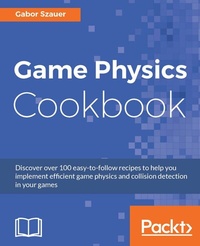
Game Physics Cookbook
Discover over 100 easy-to-follow recipes to help you implement efficient game physics and collision detection in your games
Published on 7. October 2025
480 pages
978-1-78712-081-5 (ISBN)
Description

Collision Detection and Rigid body physics for Game Development
Key Features
Get a comprehensive coverage of techniques to create high performance collision detection in games
Learn the core mathematics concepts and physics involved in depicting collision detection for your games
Get a hands-on experience of building a rigid body physics engine
Book DescriptionPhysics is really important for game programmers who want to add realism and functionality to their games. Collision detection in particular is a problem that affects all game developers, regardless of the platform, engine, or toolkit they use. This book will teach you the concepts and formulas behind collision detection. You will also be taught how to build a simple physics engine, where Rigid Body physics is the main focus, and learn about intersection algorithms for primitive shapes. You'll begin by building a strong foundation in mathematics that will be used throughout the book. We'll guide you through implementing 2D and 3D primitives and show you how to perform effective collision tests for them. We then pivot to one of the harder areas of game development-collision detection and resolution. Further on, you will learn what a Physics engine is, how to set up a game window, and how to implement rendering. We'll explore advanced physics topics such as constraint solving. You'll also find out how to implement a rudimentary physics engine, which you can use to build an Angry Birds type of game or a more advanced game. By the end of the book, you will have implemented all primitive and some advanced collision tests, and you will be able to read on geometry and linear Algebra formulas to take forward to your own games!What you will learn
Implement fundamental maths so you can develop solid game physics
Use matrices to encode linear transformations
Know how to check geometric primitives for collisions
Build a Physics engine that can create realistic rigid body behavior
Understand advanced techniques, including the Separating Axis Theorem
Create physically accurate collision reactions
Explore spatial partitioning as an acceleration structure for collisions
Resolve rigid body collisions between primitive shapes
Who this book is forThis book is for beginner to intermediate game developers. You don't need to have a formal education in games-you can be a hobbyist or indie developer who started making games with Unity 3D.
Key Features
Get a comprehensive coverage of techniques to create high performance collision detection in games
Learn the core mathematics concepts and physics involved in depicting collision detection for your games
Get a hands-on experience of building a rigid body physics engine
Book DescriptionPhysics is really important for game programmers who want to add realism and functionality to their games. Collision detection in particular is a problem that affects all game developers, regardless of the platform, engine, or toolkit they use. This book will teach you the concepts and formulas behind collision detection. You will also be taught how to build a simple physics engine, where Rigid Body physics is the main focus, and learn about intersection algorithms for primitive shapes. You'll begin by building a strong foundation in mathematics that will be used throughout the book. We'll guide you through implementing 2D and 3D primitives and show you how to perform effective collision tests for them. We then pivot to one of the harder areas of game development-collision detection and resolution. Further on, you will learn what a Physics engine is, how to set up a game window, and how to implement rendering. We'll explore advanced physics topics such as constraint solving. You'll also find out how to implement a rudimentary physics engine, which you can use to build an Angry Birds type of game or a more advanced game. By the end of the book, you will have implemented all primitive and some advanced collision tests, and you will be able to read on geometry and linear Algebra formulas to take forward to your own games!What you will learn
Implement fundamental maths so you can develop solid game physics
Use matrices to encode linear transformations
Know how to check geometric primitives for collisions
Build a Physics engine that can create realistic rigid body behavior
Understand advanced techniques, including the Separating Axis Theorem
Create physically accurate collision reactions
Explore spatial partitioning as an acceleration structure for collisions
Resolve rigid body collisions between primitive shapes
Who this book is forThis book is for beginner to intermediate game developers. You don't need to have a formal education in games-you can be a hobbyist or indie developer who started making games with Unity 3D.
All prices
More details
Edition
Digital original
Language
English
Place of publication
Birmingham
United Kingdom
Target group
Professional and scholarly
US School Grade: College Graduate Student
Edition type
Digital original
File size
4,56 MB
ISBN-13
978-1-78712-081-5 (9781787120815)
Copyright in bibliographic data and cover images is held by Nielsen Book Services Limited or by the publishers or by their respective licensors: all rights reserved.
Schweitzer Classification
Other editions
Additional editions
Person
Szauer Gabor :
Gabor Szauer has been making games since 2010. He graduated from Full Sail University in 2010 with a bachelor's degree in game development. Gabor maintains an active Twitter presence, and maintains a programming-oriented game development blog. Gabor's previously published books are Game Physics Programming Cookbook and Lua Quick Start Guide, both published by Packt.
Gabor Szauer has been making games since 2010. He graduated from Full Sail University in 2010 with a bachelor's degree in game development. Gabor maintains an active Twitter presence, and maintains a programming-oriented game development blog. Gabor's previously published books are Game Physics Programming Cookbook and Lua Quick Start Guide, both published by Packt.
Content
Table of Contents
Vectors
Matrices
Matrix Transformations
2D Shapes
2D Collisions
2D Optimizations
3D Primitive Shapes
3D Point Tests
3D Shape Intersections
3D Line Intersections
Triangles and Meshes
Models and Scenes
Camera and Frustum
Constraint Solving
Manifolds and Impulses
Springs and Joints
Advanced Topics
Vectors
Matrices
Matrix Transformations
2D Shapes
2D Collisions
2D Optimizations
3D Primitive Shapes
3D Point Tests
3D Shape Intersections
3D Line Intersections
Triangles and Meshes
Models and Scenes
Camera and Frustum
Constraint Solving
Manifolds and Impulses
Springs and Joints
Advanced Topics

