

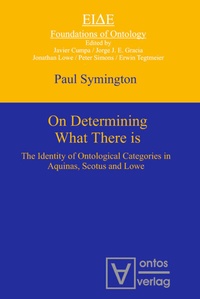
On Determining What There is
Description

Generally, categories are understood to express the most general features of reality. Yet, since categories have this special status, obtaining a correct list of them is difficult. This question is addressed by examining how Thomas Aquinas establishes the list of categories through a technique of identifying diversity in how predicates are per se related to their subjects. A sophisticated critique by Duns Scotus of this position is also examined, a rejection which is fundamentally grounded in the idea that no real distinction can be made from a logical one. It is argued Aquinas's approach can be rehabilitated in that real distinctions are possible when specifically considering per se modes of predication. This discussion between Aquinas and Scotus bears fruit in a contemporary context insofar as it bears upon, strengthens, and seeks to correct E. J. Lowe's four-category ontology view regarding the identity and relation of the categories.
More details
Other editions
Additional editions
Content
2 - INTRODUCTION [Seite 11]
3 - CHAPTER ONE: AQUINAS ON ESTABLISHING THE IDENTITY OF ARISTOTLE'S CATEGORIES [Seite 25]
3.1 - I. The Aristotelian Context for the Derivation: Aristotle's Metaphysics V.7 [Seite 28]
3.2 - II. Fr. John Wippel's Interpretation [Seite 32]
3.3 - III. per se Predication and the Identity of the Categories [Seite 41]
3.4 - IV. The Derivation of the Categories from per se Predication [Seite 48]
3.5 - V. Conclusion [Seite 55]
4 - CHAPTER TWO: SCOTUS'S CRITICISM OF AQUINAS'S DERIVATION OF THE CATEGORIES [Seite 57]
4.1 - I. Second Intentions, Essences, and Modes of Predication [Seite 60]
4.2 - II. Additional Criticisms of Aquinas's Method of Establishing the Categories [Seite 88]
4.3 - III. Scotus and the Role of per se Modes of Predication in the Derivation [Seite 98]
5 - CHAPTER THREE: A RECONSIDERATION AND DEFENSE OF AQUINAS'S POSITION [Seite 100]
5.1 - I. The Categories in Aquinas: Their Nature and Relation to Predication [Seite 102]
5.2 - II. Addressing Scotus's Arguments [Seite 119]
5.3 - III. Conclusion [Seite 138]
6 - CHAPTER FOUR: LOGICAL SYNTAX AND LOWE'S FOUR-CATEGORY ONTOLOGY [Seite 139]
6.1 - I. Lowe's Categories and Aquinas's Strategy of Deriving Categories [Seite 142]
6.2 - II. The Relationship between Logical Syntax and Ontology [Seite 149]
6.3 - III. A Problem with Lowe's Justification of the Four-Category Ontology and its Resolution [Seite 157]
6.4 - IV. Conclusion [Seite 163]
7 - CONCLUSION [Seite 164]
8 - WORKS CITED [Seite 170]
