

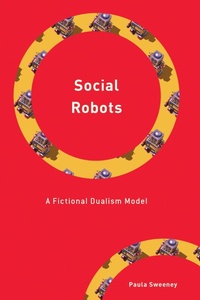
Social Robots
A Fictional Dualism Model
1st Edition
Published on 6. December 2023
152 pages
979-8-216-28898-5 (ISBN)
Description

Social robots are an increasingly integral part of society, already appearing as customer service assistants, care-home helpers, teaching assistants and personal companions. This book argues that the wider inclusion of social robots in our society is having a revolutionary impact on some of our key intuitions regarding ethics, metaphysics and epistemology and, as such, will put pressure on many of our best theories.
Social robots elicit an emotional and social response in humans that some have taken to be evidence that robots deserve moral consideration. Others have argued that, as robots are only machines, we should avoid designing robots that encourage emotional engagement. The fictional dualism model provides a new way for us to view social robots and a new route for our continued relationship with them. When we engage with a social robot, we create a fictional overlay that has wants, needs and desires. Our emotional attachment to social robots is a natural continuation of our relationship to fiction: a life-enhancing and important connection, but not one that prompts moral consideration for the fictional entity.
In this book, Paula Sweeney shows how the fictional dualism model of social robots differs from other popular models. In addition to providing a distinctive and ethically appropriate framework for emotional engagement without moral consideration, the model provides conditions for trusting social robots and, uniquely, allows us to individuate social robots as distinct persons, even in contexts in which they share a collective mind.
Social robots elicit an emotional and social response in humans that some have taken to be evidence that robots deserve moral consideration. Others have argued that, as robots are only machines, we should avoid designing robots that encourage emotional engagement. The fictional dualism model provides a new way for us to view social robots and a new route for our continued relationship with them. When we engage with a social robot, we create a fictional overlay that has wants, needs and desires. Our emotional attachment to social robots is a natural continuation of our relationship to fiction: a life-enhancing and important connection, but not one that prompts moral consideration for the fictional entity.
In this book, Paula Sweeney shows how the fictional dualism model of social robots differs from other popular models. In addition to providing a distinctive and ethically appropriate framework for emotional engagement without moral consideration, the model provides conditions for trusting social robots and, uniquely, allows us to individuate social robots as distinct persons, even in contexts in which they share a collective mind.
More details
Series
Edition
1. Auflage
Language
English
Place of publication
United States
Publishing group
Bloomsbury Publishing Plc
Target group
College/higher education
US School Grade: From College Freshman to College Graduate Student
ISBN-13
979-8-216-28898-5 (9798216288985)
Copyright in bibliographic data and cover images is held by Nielsen Book Services Limited or by the publishers or by their respective licensors: all rights reserved.
Schweitzer Classification
Other editions
Additional editions
Book
12/2023
Rowman & Littlefield Publishers
€98.10
Available immediately
Person
Paula Sweeney is senior lecturer at the University of Aberdeen. She previously published in philosophy of language and the philosophy of time but most recently has been gripped by philosophical questions arising from our engagement with robots and other social technologies.
Content
Introduction
Chapter 1. What Can Philosophy Teach Us About Social Robots?
Chapter 2. Humans and Robots
Chapter 3. Social Robots and Moral Consideration
Chapter 4. The Fictional Dualism Model of Social Robots
Chapter 5. Robots and Identity
Chapter 6. Trusting Social Robots
Chapter 7. Robot Right and Indirect Harms
Conclusion
Bibliography
Index
About the Author
Chapter 1. What Can Philosophy Teach Us About Social Robots?
Chapter 2. Humans and Robots
Chapter 3. Social Robots and Moral Consideration
Chapter 4. The Fictional Dualism Model of Social Robots
Chapter 5. Robots and Identity
Chapter 6. Trusting Social Robots
Chapter 7. Robot Right and Indirect Harms
Conclusion
Bibliography
Index
About the Author
