

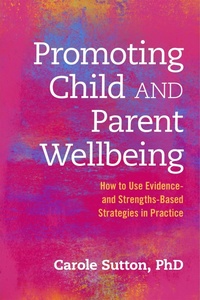
Promoting Child and Parent Wellbeing
How to Use Evidence- and Strengths-Based Strategies in Practice
Published on 21. February 2016
232 pages
978-1-78450-015-3 (ISBN)
Description

Informed by a wealth of research, this accessible book focuses on a strengths-based approach to promoting children's wellbeing and giving them the best opportunities to succeed.
By identifying risk factors and the protective factors which can be used to counter them, this book stresses the importance of preventative measures and early intervention to effectively support parents and their children. It shows that there are many protective factors and practices that parents, teachers and carers can employ to support children's development, promote mental and emotional wellbeing, and reduce the risks of crime and anti-social behaviour. Each section explores the issues associated with specific age groups, from pregnancy to early teens. It identifies areas that should be a key focus for practitioners and services such as promoting attachment and communication, and highlights effective practices such as motivational interviewing and cognitive behavioural therapy (CBT).
Bringing together the international evidence-base concerning ways of working with young children and their families, this book offers practical advice for practitioners, managers and commissioners of services across health and social care.
By identifying risk factors and the protective factors which can be used to counter them, this book stresses the importance of preventative measures and early intervention to effectively support parents and their children. It shows that there are many protective factors and practices that parents, teachers and carers can employ to support children's development, promote mental and emotional wellbeing, and reduce the risks of crime and anti-social behaviour. Each section explores the issues associated with specific age groups, from pregnancy to early teens. It identifies areas that should be a key focus for practitioners and services such as promoting attachment and communication, and highlights effective practices such as motivational interviewing and cognitive behavioural therapy (CBT).
Bringing together the international evidence-base concerning ways of working with young children and their families, this book offers practical advice for practitioners, managers and commissioners of services across health and social care.
Reviews / Votes
Carole Sutton has provided a comprehensive and thought-provoking text that, whilst grounded in the evidence, is accessible to a range of practitioners and disciplines who are focused on making things better for children and young people. This is a compelling and tangible account of how promoting positive behaviours and emotions can make a real difference. -- Julie Taylor, Professor of Child Protection, Medical School, University of Birmingham This book is an excellent resource for all those who aspire to work more constructively with families. The author shows how by identifying protective factors in families, resilience can be developed and the wellbeing of children and their families promoted. -- Judith Milner, Freelance Solution Focused Trainer and WriterMore details
Edition
Digital original
Language
English
Place of publication
London
United Kingdom
Target group
College/higher education
Professional and scholarly
Edition type
Digital original
Illustrations
3 figures
File size
2,06 MB
ISBN-13
978-1-78450-015-3 (9781784500153)
Copyright in bibliographic data and cover images is held by Nielsen Book Services Limited or by the publishers or by their respective licensors: all rights reserved.
Schweitzer Classification
Other editions
Additional editions
Carole Sutton
Promoting Child and Parent Wellbeing
How to Use Evidence- and Strengths-Based Strategies in Practice
Book
02/2016
Jessica Kingsley Publishers
€48.50
Shipment within 15-20 days
Person
Carole Sutton is currently a part-time lecturer at De Montfort University, Leicester. Following qualifying and practising as a social worker, she went on to gain a BA Psychology and an MSc Psychopathology, and then while teaching psychology to social workers and health visitors undertook the research for her PhD in the Psychology Department of Leicester University. Since that time she has been teaching social workers and health visitors for 18 years and has published many books and papers.
Content
- Intro
- Promoting Child and Parent Wellbeing by Carole Sutton
- Introduction
- Overview
- So what do we mean by children's wellbeing?
- Early intervention to support families is essential
- Some policy initiatives by central government
- A matrix of cumulative risk and protective factors
- Values, knowledge and skills for practice
- A chronological focus and the evidence selected
- A process for practice: ASPIRE
- The Common Assessment Framework (CAF)
- 1. Pregnancy
- Overview
- Acknowledging risk factors
- Building on protective factors
- Engaging with fathers and other family members
- Highlighting the strengths of the family
- Attending to the parents' wellbeing
- Motivational interviewing (MI)
- Bonding with the baby during pregnancy
- Looking ahead to parenthood
- The Family Nurse Partnership
- 2. Birth and the First Year of Life
- Overview
- Acknowledging risk factors
- Building on protective factors
- Supporting new parents: helping to reduce stress
- Supporting breastfeeding
- Getting sleeping patterns off to a good start
- Supporting recovery from PND
- Using ideas from CBT
- Supporting parent-to-infant bonding
- Encouraging father involvement
- Encouraging baby massage
- Supporting the beginnings of infant-to-parent attachment
- Encouraging play and early communication
- Support for parents or infants with learning disabilities
- 3. One to Two Years
- Overview
- Acknowledging risk factors
- Building on protective factors
- Supporting processes of bonding and attachment
- Accessing networks of support
- Encouraging authoritative parenting
- Using principles of social learning theory
- Encouraging cognitive and linguistic development
- Enjoying play, singing, music and movement
- Helping toddlers to develop self-control
- 4. Three to Eight Years
- Overview
- Acknowledging risk factors
- Building on protective factors
- Encouraging the generous use of praise
- Encouraging authoritative parenting
- Developing family activities
- High quality early childhood education
- Supporting close home/nursery/school relationships
- Encouraging language and literacy
- Close supervision of the child
- Encouraging self-control by the child
- 5. Nine to Thirteen Years
- Overview
- Acknowledging risk factors
- Building on protective factors
- Encouraging authoritative parenting
- The importance of fathers
- Parents' involvement in children's activities
- Close supervision of the young person's whereabouts
- Parenting/child management skills training
- Devising written agreements
- A strong school ethos: backing school standards
- Mentoring programmes
- Multisystemic therapy
- Using cognitive behavioural principles in work with parents
- Other approaches with a strong evidence base
- 6. Summary and Cross-Cutting Themes
- Overview
- Cumulative risk: the impact of poverty and disadvantage
- The protective contribution of relationships: parents' bonding with their baby
- The protective contribution of relationships: baby's attachment to parents
- The impact of parenting styles: principles from social learning theory
- Talking and reading to babies, toddlers and children
- The importance of fathers and grandparents: involvement in children's activities
- Close supervision of children's activities: start young!
- Encouraging self-control by the child
- Facilitating close relationships with nurseries, playgroups and schools
- The helping person as positive model, coach and architect of success
- Appendix 1. Maternal Confidence Questionnaire (Dilmore 2004)
- Appendix 2. A simple scale to indicate bonding (after Silverstein 1996)
- Appendix 3. The Postpartum Bonding Instrument (Brockington 2001)
- Appendix 4. Ways of increasing family attachment (after Silverstein 1996)
- Appendix 5. Activities to encourage speech and language development
- Appendix 6. A Child's Spirit
- Appendix 7. Five praises a day
- Appendix 8. The ten skills a child must have by the time they start school
- Appendix 9. Charting behaviours: doing/not doing as asked
- Appendix 10a. Positive comments to young children
- Appendix 10b. When. then.
- Appendix 11. Please talk to ME!
- Appendix 12. Form for framing an agreement in one-to-one or family work
- References
- Subject Index
- Author Index
- Blank Page
