

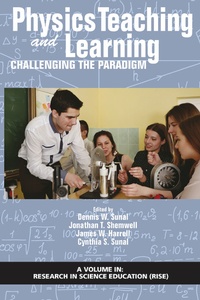
Physics Teaching and Learning
Challenging the Paradigm
1st Edition
Published on 5. January 2019
265 pages
978-1-64113-658-7 (ISBN)
Description

Physics Teaching and Learning: Challenging the Paradigm, RISE Volume 8, focuses on research contributions challenging the basic assumptions, ways of thinking, and practices commonly accepted in physics education. Teaching physics involves multifaceted, research-based, value added strategies designed to improve academic engagement and depth of learning.
In this volume, researchers, teaching and curriculum reformers, and reform implementers discuss a range of important issues. The volume should be considered as a first step in thinking through what physics teaching and physics learning might address in teacher preparation programs, in-service professional development programs, and in classrooms.
To facilitate thinking about research-based physics teaching and learning each chapter in the volume was organized around five common elements:
1. A significant review of research in the issue or problem area.
2. Themes addressed are relevant for the teaching and learning of K-16 science
3. Discussion of original research by the author(s) addressing the major theme of the chapter.
4. Bridge gaps between theory and practice and/or research and practice.
5. Concerns and needs are addressed of school/community context stakeholders including students, teachers, parents, administrators, and community members.
In this volume, researchers, teaching and curriculum reformers, and reform implementers discuss a range of important issues. The volume should be considered as a first step in thinking through what physics teaching and physics learning might address in teacher preparation programs, in-service professional development programs, and in classrooms.
To facilitate thinking about research-based physics teaching and learning each chapter in the volume was organized around five common elements:
1. A significant review of research in the issue or problem area.
2. Themes addressed are relevant for the teaching and learning of K-16 science
3. Discussion of original research by the author(s) addressing the major theme of the chapter.
4. Bridge gaps between theory and practice and/or research and practice.
5. Concerns and needs are addressed of school/community context stakeholders including students, teachers, parents, administrators, and community members.
All prices
More details
Other editions
Additional editions
Dennis W. Sunal | Jonathan T. Shemwell | James W. Harrell
Physics Teaching and Learning
Challenging the Paradigm
Book
04/2019
Information Age Publishing
€70.50
Shipment within 3-4 weeks
Dennis W. Sunal | Jonathan T. Shemwell | James W. Harrell
Physics Teaching and Learning
Challenging the Paradigm
Book
04/2019
Information Age Publishing
€122.50
Shipment within 3-4 weeks
Content
- Cover
- Physics Teaching and Learning: Challenging the Paradigm
- Research in Science Education (RISE)
- Physics Teaching and Learning: Challenging the Paradigm
- Copyright
- CONTENTS
- PREFACE TO THE SERIES
- PREFACE
- 1: HIGH SCHOOL PHYSICS TEACHING REFORM: Support for Professional Development in the Literature
- BACKGROUND
- CREATING REFORM IN HIGH SCHOOL PHYSICS CLASSROOMS
- EFFECTIVE PHYSICS FOCUSED PROFESSIONAL DEVELOPMENT
- Content Focus
- Participant Active Learning
- Sufficient Duration and Spacing of Training and Practice
- Coherence in Training and Classroom Practice
- Collaboration of Efforts among Peer Teachers
- CONCLUSION
- Instrumentation Used to Gather Evidence in Physics Teaching Reform Studies
- Reformed Teaching Observation Protocol
- Science Teaching Efficacy Belief Instrument
- Content Representation and the Pedagogical and Professional- Experience Repertoires
- CONCLUSION
- DISCUSSION
- REFERENCES
- 2: EFFECTS OF PROFESSIONAL DEVELOPMENT ON REFORM IN HIGH SCHOOL PHYSICS TEACHING
- REVIEW OF LITERATURE
- THE ALLIANCE FOR PHYSICS EXCELLENCE PROFESSIONAL DEVELOPMENT PROGRAM
- THEORETICAL MODEL OF THE RESEARCH STUDY
- PROBLEM
- RESEARCH QUESTION
- RESEARCH DESIGN
- PROCEDURE
- RESULTS
- Quantitative Data Results from RTOP and SLE
- Changes in Reform Classroom Practice
- Changes in Levels of Reform
- Changes in Categories of Reform
- Changes in Student Learning Engagement
- Qualitative Data Interview Results
- Year 0, Prior to Intervention Professional Development
- Year 2, During Intervention Professional Development
- Representative Teacher Profiles
- Teacher 1
- Teacher 2
- Teacher 3
- Teacher 4
- Teacher Efficacy
- CROSS-STRAND INTEGRATION AND CONCLUSION
- ACKNOWLEGEMENT
- REFERENCES
- 3: DESTABILIZING THE STATUS QUO IN STEM PROFESSIONAL DEVELOPMENT WITH MODELING INSTRUCTION
- LITERATURE REVIEW
- Teacher Professional Development
- ELEMENTS OF SUCCESSFUL PROFESSIONAL DEVELOPMENT
- Duration
- Content
- Active Learning
- Participation
- Type of Activity
- Coherence
- Traditional Professional Development Programs
- MODELING INSTRUCTION
- Modeling Workshops
- LONGITUDINAL STUDY OF PROFESSIONAL DEVELOPMENT AT A MODELING INSTRUCTION WORKSHOP
- Context
- Methods
- Participants
- Workshop Activities
- Teacher's Perspectives on Classroom Implementation
- SIGNIFICANCE, CONTRIBUTION, AND LIMITATIONS
- REFERENCES
- 4: CO-CONSTRUCTING MODELS THROUGH WHOLE CLASS DISCUSSIONS IN HIGHS CHOOL PHYSICS
- THEORETICAL FRAMEWORK
- STUDY BACKGROUND AND RATIONALE
- STUDY CONTEXT AND SETTING
- DATA COLLECTION AND ANALYSIS
- RESULTS
- Diagrammatic Representations of the Modeling Discussions
- Episode 1: Teacher A
- Episode 2: Teacher B
- Student and Teacher Model Construction Participation Ratios
- DISCUSSION
- CONCLUSION
- APPENDIX: ELECTRIC CIRCUITS PRE/ POST TEST
- REFERENCES
- 5: EXTENDING THE BOUNDARIES OF HIGH-SCHOOL PHYSICS: Introducing Computational Modeling of Complex Systems
- DEVELOPING AND USING COMPUTER MODELS FOR LEARNING SCIENCE
- CONTEXT OF THE STUDY
- OUTLINE OF THE STUDY
- INTERPRETING AND MODIFYING COMPUTATIONAL MODELS OF PHYSICAL PROCESSES-10TH GRADE
- CONSTRUCTION OF NOVEL COMPUTATIONAL MODELS OF COMPLEX PHENOMENA-12TH GRADE
- TEACHER INVOLVEMENT IN STUDENTS' COMPUTATIONAL PROJECTS
- STUDENTS' PERCEPTIONS OF LEARNING INTERDISCIPLINARY COMPUTATIONAL PHYSICAL SCIENCE
- SUMMARY
- APPENDIX-ATTITUDINAL SURVEY ITEMS
- REFERENCES
- 6: PERSONIFICATION OF PARTICLES IN MIDDLE SCHOOL STUDENTS' EXPLANATIONS OF GAS PRESSURE
- REVIEW OF RESEARCH
- THE PRESENT STUDY
- Method
- RESULTS
- Case Studies
- Case 1: Tracey Draws on Experiences Feeling Hot in Tight Spaces
- Case 2: Amanda Connects to Walking in Crowded Hallways
- Case 3: Blake Calls Molecules Claustrophobic
- Case 4: Lisa Imagines Blind People in a Room
- Cross-Case Results
- 1. How do Students Use Conceptual Metaphors Underlying Instances of Students' Personification of Molecules?
- 2. Can Affordances and Constraints of Those Conceptual Metaphors on Students' Understanding of Gas Pressure Phenomena be Identified?
- CONNECTIONS TO PRACTICE, IMPLICATIONS, AND HYPOTHESES GENERATED
- ACKNOWLEDGMENTS
- REFERENCES
- 7: COMPROMISED PHYSICS TEACHING: Assessment Driven Teaching
- BELIEFS AND CONCEPTIONS OF PHYSICS TEACHERS ABOUT PHYSICS
- METHOD
- RESULTS
- Conceptions about Teaching
- Teaching Practice
- Contextual Factors Supporting or Constraining Teachers Enacting their Beliefs
- DISCUSSION AND IMPLICATIONS
- IMPLICATIONS FOR POLICY AND PRACTICE
- REFERENCES
- 8: COLLABORATIVE LEARNING WITH NETWORKED SIMULATIONS
- BACKGROUND
- Collaborative Learning in Networked Classrooms
- Designing Networked Simulations
- Reasoning in Networked Learning Environments
- Networked Simulation Designs
- Electric Fields Networked Simulation
- Wave Builder Networked Simulation
- METHOD
- Participants and Data Collection
- Analytic Approach
- RESULTS
- Episode One
- Episode Two
- DISCUSSION
- CONCLUSION AND IMPLICATIONS
- ACKNOWLEDGEMENTS
- REFERENCES
- 9: DESIGN, IMPLEMENTATION AND EVALUATION OF A RESEARCH-INFORMED TEACHING SEQUENCE ABOUT ENERGY
- PERSPECTIVE ON ENERGY TAKEN FOR DEVELOPMENT OF THE RESEARCH-INFORMED TEACHING SEQUENCE
- LITERATURE ABOUT THE ENERGY CONCEPT FOR THE PURPOSE OF TEACHING
- CYPRUS NATIONAL CURRICULUM FOR ENERGY FOR UPPER SECONDARY SCHOOL, FIRST GRADE
- DESIGN OF THE TEACHING INTERVENTION
- Step 1: The School Science Knowledge to be Taught
- Aspect 1: Energy Can Be Stored
- Aspect 2: Energy Can be Transferred Along Transfer Pathways from One Energy Store to Another
- Aspect 3: Energy is Conserved
- Aspect 4: Energy is degraded
- Describing Changes in Terms of Energy
- Step 2: The Students' Likely Interpretations about Energy
- Step 3: Identify the Learning Demands
- Step 4: Design a Teaching Intervention to Address each Aspect of the Learning Demand
- IMPLEMENTATION AND EVALUATION OF THE TEACHING SEQUENCE
- DESIGN AND METHOD OF THE STUDY IN OVERVIEW
- Participants
- Data Collection
- Pre-test
- Post-test
- Student Interviews
- Teacher Interviews
- THE EVALUATION OF THE RESEARCH INFORMED TEACHING SEQUENCE FOR ENERGY
- Research Question 1
- Research Question 2
- Research Question 3
- DISCUSSION
- APPENDIX A: PRE-TEST QUESTIONNAIRES
- APPENDIX B: POST-TEST QUESTIONNAIRES
- Part A: Study carefully the simulation. Afterwards, answer the following questions
- PART B
- APPENDIX C: FIRST INTERVIEW PROTOCOL
- APPENDIX D: SECOND INTERVIEW PROTOCOL
- REFERENCES
- BIOGRAPHIES

