

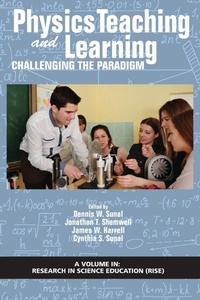
Physics Teaching and Learning
Challenging the Paradigm
Published on 24. April 2019
Book
Paperback/Softback
266 pages
978-1-64113-656-3 (ISBN)
Description
Physics Teaching and Learning: Challenging the Paradigm, RISE Volume 8, focuses on research contributions challenging the basic assumptions, ways of thinking, and practices commonly accepted in physics education. Teaching physics involves multifaceted, research-based, value added strategies designed to improve academic engagement and depth of learning.
In this volume, researchers, teaching and curriculum reformers, and reform implementers discuss a range of important issues. The volume should be considered as a first step in thinking through what physics teaching and physics learning might address in teacher preparation programs, in-service professional development programs, and in classrooms.
To facilitate thinking about research-based physics teaching and learning each chapter in the volume was organized around five common elements:
1. A significant review of research in the issue or problem area.
2. Themes addressed are relevant for the teaching and learning of K-16 science
3. Discussion of original research by the author(s) addressing the major theme of the chapter.
4. Bridge gaps between theory and practice and/or research and practice.
5. Concerns and needs are addressed of school/community context stakeholders including students, teachers, parents, administrators, and community members.
In this volume, researchers, teaching and curriculum reformers, and reform implementers discuss a range of important issues. The volume should be considered as a first step in thinking through what physics teaching and physics learning might address in teacher preparation programs, in-service professional development programs, and in classrooms.
To facilitate thinking about research-based physics teaching and learning each chapter in the volume was organized around five common elements:
1. A significant review of research in the issue or problem area.
2. Themes addressed are relevant for the teaching and learning of K-16 science
3. Discussion of original research by the author(s) addressing the major theme of the chapter.
4. Bridge gaps between theory and practice and/or research and practice.
5. Concerns and needs are addressed of school/community context stakeholders including students, teachers, parents, administrators, and community members.
More details
Series
Language
English
Place of publication
Charlotte
United States
Publishing group
Emerald Publishing Inc
Target group
Professional and scholarly
Dimensions
Height: 234 mm
Width: 156 mm
Thickness: 14 mm
Weight
409 gr
ISBN-13
978-1-64113-656-3 (9781641136563)
Copyright in bibliographic data and cover images is held by Nielsen Book Services Limited or by the publishers or by their respective licensors: all rights reserved.
Schweitzer Classification
Other editions
Additional editions
E-Book
01/2019
1st Edition
Information Age Publishing
from
€62.33
Available for download
Persons
Dennis W. Sunal, University of Alabama
Jonathan T. Shemwell, University of Alabama
James W. Harrell, University of Alabama
Cynthia S. Sunal, University of Alabama
Jonathan T. Shemwell, University of Alabama
James W. Harrell, University of Alabama
Cynthia S. Sunal, University of Alabama
Content
Preface to the Series.
Preface; Dennis W. Sunal, Jonathan Shemwell, James W. Harrell, and Cynthia S. Sunal.
Chapter 1. High School Physics Teaching Reform: Support for Professional Development in the Literature; Cynthia S. Sunal, Dennis W. Sunal, Justina Ogodo, and Marilyn Stephens.
Chapter 2. Effects of Professional Development on Reform in High School Physics Teaching; Dennis W. Sunal, Marsha E. Simon, Cynthia S. Sunal, Justina Ogodo, James W. Harrell, Marilyn Stephens and Mohan Aggarwal.
Chapter 3. Destabilizing the Status Quo in STEM Professional Development with Modeling Instruction; Kathleen A. Harper, Ted M. Clark, and Lin Ding.
Chapter 4. Co-Constructing Models through Whole Class Discussions in High School Physics; Grant Williams and John Clement.
Chapter 5. Extending the Boundaries of High-School Physics: Introducing Computational Modeling of Complex Systems; Elon Langbeheim, Haim Edri, Nava Schulmann, Samuel Safran, and Edit Yerushalmi.
Chapter 6. Personification of Particles in Middle School Students' Explanations of Gas Pressure; Robert C. Wallon and David E. Brown.
Chapter 7. Compromised Physics Teaching: Assessment Driven Teaching; Isaac Buabeng, Lindsey Conner, and David Winter.
Chapter 8. Collaborative Learning with Networked Simulations; Lisa Hardy and Tobin White.
Chapter 9. Design, Implementation and Evaluation of a Research-Informed Teaching Sequence about Energy; Dora Orfanidou and John Leach.
Biographies.
Preface; Dennis W. Sunal, Jonathan Shemwell, James W. Harrell, and Cynthia S. Sunal.
Chapter 1. High School Physics Teaching Reform: Support for Professional Development in the Literature; Cynthia S. Sunal, Dennis W. Sunal, Justina Ogodo, and Marilyn Stephens.
Chapter 2. Effects of Professional Development on Reform in High School Physics Teaching; Dennis W. Sunal, Marsha E. Simon, Cynthia S. Sunal, Justina Ogodo, James W. Harrell, Marilyn Stephens and Mohan Aggarwal.
Chapter 3. Destabilizing the Status Quo in STEM Professional Development with Modeling Instruction; Kathleen A. Harper, Ted M. Clark, and Lin Ding.
Chapter 4. Co-Constructing Models through Whole Class Discussions in High School Physics; Grant Williams and John Clement.
Chapter 5. Extending the Boundaries of High-School Physics: Introducing Computational Modeling of Complex Systems; Elon Langbeheim, Haim Edri, Nava Schulmann, Samuel Safran, and Edit Yerushalmi.
Chapter 6. Personification of Particles in Middle School Students' Explanations of Gas Pressure; Robert C. Wallon and David E. Brown.
Chapter 7. Compromised Physics Teaching: Assessment Driven Teaching; Isaac Buabeng, Lindsey Conner, and David Winter.
Chapter 8. Collaborative Learning with Networked Simulations; Lisa Hardy and Tobin White.
Chapter 9. Design, Implementation and Evaluation of a Research-Informed Teaching Sequence about Energy; Dora Orfanidou and John Leach.
Biographies.