
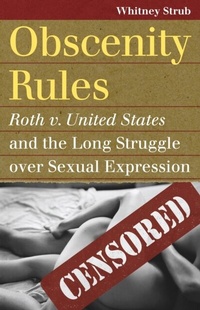
Obscenity Rules
Description
Alles über E-Books | Antworten auf Fragen rund um E-Books, Kopierschutz und Dateiformate finden Sie in unserem Info- & Hilfebereich.
For some, he was ?America's leading smut king,? hauled into court repeatedly over thirty years for peddling obscene publications through the mail. But when Samuel Roth appealed a 1956 conviction, he forced the Supreme Court to finally come to grips with a problem that had plagued both American society and constitutional law for longer than he had been in business. For while the facts of Roth v. United States were unexceptional, its constitutional issues would define the relationship of obscenity to the First Amendment.
The Supreme Court's 6-3 decision in Roth for the first time tried to definitively rule on the issue of obscenity in American life and law?and failed. In this first book-length examination of the case, Whitney Strub lays out the history of obscenity's meaning as a legal concept, highlights the influence of antivice crusaders like Anthony Comstock and John Sumner, and chronicles the shadowy career that led Roth to spend nearly a decade of his life imprisoned for the allegedly obscene materials that he sent through the mails. Strub then unwraps the events that produced Roth v. United States, placing the trial in the context of its times?the Kinsey Reports, the Kefauver hearings, free speech debates?by using Roth's own private papers along with the records of the various prosecutions and the memos of the justices.
The significance of Roth, as Strub reveals, lay in the two faces of Justice William Brennan's majority opinion?which on the one hand reflected the liberalizing attitude toward sexual matters in mid-century America, but on the other kept ?obscene? expressions beyond First Amendment protection. Because that ruling points up the contradictions of a society where the prurient and repressive commingle uncomfortably, Strub shows how Roth says much more about American sexual values than Brennan's written words necessarily acknowledged.
In our era of internet pornography and Fifty Shades of Grey, it may be difficult to imagine a time when obscenity was a matter for the courts. As Strub tracks the legacy of Roth and obscenity law through the ongoing policing of acceptable sexuality into the twenty-first century, his riveting narrative brings those times to life and helps readers navigate the fine line between what is socially acceptable and what is criminally obscene.
All prices
More details
Other editions
Additional editions
Person
Content
Editors' Preface
Introduction
1. Toward Obscenity: Legal Evolution from Colonies to Comstock
2. Modernizing Free Speech: Politics, Sex, and the First Amendment in the Early Twentieth Century
3. Samuel Roth, From Art to Smut
4. The Absent Supreme Court: Obscenity Doctrine in the 1940s
5. Cold War, Hot Lust: Sexual Politics in the 1950s
6. Anatomy of a Case
7. Writing Roth: The Court Opines
8. The Two Roths: Liberalization, Regulation, and the Apparent Paradox of Obscenity in the 1960s
9. From Porno chic to New Critiques: Conservatives, Feminists, and Backlash to Obscenity
Epilogue: After Obscenity?
Major Cases Cited
Chronology
Bibliographical Essay
Index

System requirements
File format: ePUB
Copy protection: Adobe-DRM (Digital Rights Management)
System requirements:
- Computer (Windows; MacOS X; Linux): Install the free reader Adobe Digital Editions prior to download (see eBook Help).
- Tablet/smartphone (Android; iOS): Install the free app Adobe Digital Editions or the app PocketBook before downloading (see eBook Help).
- E-reader: Bookeen, Kobo, Pocketbook, Sony, Tolino and many more (not Kindle).
The file format ePub works well for novels and non-fiction books – i.e., „flowing” text without complex layout. On an e-reader or smartphone, line and page breaks automatically adjust to fit the small displays.
This eBook uses Adobe-DRM, a „hard” copy protection. If the necessary requirements are not met, unfortunately you will not be able to open the eBook. You will therefore need to prepare your reading hardware before downloading.
Please note: We strongly recommend that you authorise using your personal Adobe ID after installation of any reading software.
For more information, see our ebook Help page.
File format: PDF
Copy-Protection: Adobe-DRM (Digital Rights Management)
System requirements:
- Computer (Windows; MacOS X; Linux): Install the free reader Adobe Digital Editions prior to download (see eBook Help).
- Tablet/smartphone (Android; iOS): Install the free app Adobe Digital Editions or the app PocketBook before downloading (see eBook Help).
- E-reader: Bookeen, Kobo, Pocketbook, Sony, Tolino and many more (only limited: Kindle).
The file format PDF always displays a book page identically on any hardware. This makes PDF suitable for complex layouts such as those used in textbooks and reference books (images, tables, columns, footnotes). Unfortunately, on the small screens of e-readers or smartphones, PDFs are rather annoying, requiring too much scrolling.
This eBook uses Adobe-DRM, a „hard” copy protection. If the necessary requirements are not met, unfortunately you will not be able to open the eBook. You will therefore need to prepare your reading hardware before downloading.
Please note: We strongly recommend that you authorise using your personal Adobe ID after installation of any reading software.
For more information, see our eBook Help page.
File format: ePUB
Copy protection: Watermark-DRM (Digital Rights Management)
System requirements:
- Computer (Windows; MacOS X; Linux): Use a reading software that can process the file format ePUB: e.g., Adobe Digital Editions or FBReader – both free (see eBook Help).
- Tablet/Smartphone (Android; iOS): Before downloading, install the free app Adobe Digital Editions (see eBook Help).
- E-reader: Bookeen, Kobo, Pocketbook, Sony, Tolino and many more (not Kindle).
The file format ePUB works well for novels and non-fiction books – i.e., „flowing” text without complex layout. On an e-reader or smartphone, line and page breaks automatically adjust to fit the small displays.
This eBook uses Watermark-DRM, a „soft” copy protection. This means that there are no technical restrictions to prevent illegal distribution. However, there is a personalised watermark embedded in the eBook that can be used to identify the purchaser of the eBook in the event of misuse and to provide evidence for legal purposes.
For more information, see our eBook Help page.
