

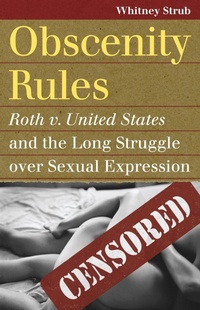
Obscenity Rules
Roth V. United States' and the Long Struggle Over Sexual Expression
Published on 24. September 2013
Book
Hardback
264 pages
978-0-7006-1936-8 (ISBN)
Description
For some, he was "America's leading smut king," hauled into court repeatedly over thirty years for peddling obscene publications through the mail. But when Samuel Roth appealed a 1956 conviction, he forced the Supreme Court to finally come to grips with a problem that had plagued both American society and constitutional law for longer than he had been in business. For while the facts of Roth v. United States were unexceptional, its constitutional issues would define the relationship of obscenity to the First Amendment.
The Supreme Court's 6-3 decision in Roth for the first time tried to definitively rule on the issue of obscenity in American life and law-and failed. In this first book-length examination of the case, Whitney Strub lays out the history of obscenity's meaning as a legal concept, highlights the influence of antivice crusaders like Anthony Comstock and John Sumner, and chronicles the shadowy career that led Roth to spend nearly a decade of his life imprisoned for the allegedly obscene materials that he sent through the mails. Strub then unwraps the events that produced Roth v. United States, placing the trial in the context of its times-the Kinsey Reports, the Kefauver hearings, free speech debates-by using Roth's own private papers along with the records of the various prosecutions and the memos of the justices.
The significance of Roth, as Strub reveals, lay in the two faces of Justice William Brennan's majority opinion-which on the one hand reflected the liberalising attitude toward sexual matters in mid-century America, but on the other kept "obscene" expressions beyond First Amendment protection. Because that ruling points up the contradictions of a society where the prurient and repressive commingle uncomfortably, Strub shows how Roth says much more about American sexual values than Brennan's written words necessarily acknowledged.
In our era of internet pornography and Fifty Shades of Grey, it may be difficult to imagine a time when obscenity was a matter for the courts. As Strub tracks the legacy of Roth and obscenity law through the ongoing policing of acceptable sexuality into the twenty-first century, his riveting narrative brings those times to life and helps readers navigate the fine line between what is socially acceptable and what is criminally obscene.
The Supreme Court's 6-3 decision in Roth for the first time tried to definitively rule on the issue of obscenity in American life and law-and failed. In this first book-length examination of the case, Whitney Strub lays out the history of obscenity's meaning as a legal concept, highlights the influence of antivice crusaders like Anthony Comstock and John Sumner, and chronicles the shadowy career that led Roth to spend nearly a decade of his life imprisoned for the allegedly obscene materials that he sent through the mails. Strub then unwraps the events that produced Roth v. United States, placing the trial in the context of its times-the Kinsey Reports, the Kefauver hearings, free speech debates-by using Roth's own private papers along with the records of the various prosecutions and the memos of the justices.
The significance of Roth, as Strub reveals, lay in the two faces of Justice William Brennan's majority opinion-which on the one hand reflected the liberalising attitude toward sexual matters in mid-century America, but on the other kept "obscene" expressions beyond First Amendment protection. Because that ruling points up the contradictions of a society where the prurient and repressive commingle uncomfortably, Strub shows how Roth says much more about American sexual values than Brennan's written words necessarily acknowledged.
In our era of internet pornography and Fifty Shades of Grey, it may be difficult to imagine a time when obscenity was a matter for the courts. As Strub tracks the legacy of Roth and obscenity law through the ongoing policing of acceptable sexuality into the twenty-first century, his riveting narrative brings those times to life and helps readers navigate the fine line between what is socially acceptable and what is criminally obscene.
More details
Series
Language
English
Place of publication
Kansas
United States
Target group
Professional and scholarly
Product notice
With printed dust jacket
Dimensions
Height: 216 mm
Width: 140 mm
Thickness: 19 mm
Weight
494 gr
ISBN-13
978-0-7006-1936-8 (9780700619368)
Copyright in bibliographic data and cover images is held by Nielsen Book Services Limited or by the publishers or by their respective licensors: all rights reserved.
Schweitzer Classification
Other editions
Additional editions
E-Book
04/2014
1st Edition
University Press of Kansas
from
€56.99
Available for download
Person
Whitney Strub is an assistant professor of history at Rutgers University in Newark, USA and the author of Perversion for Profit: The Politics of Pornography and the Rise of the New Right.