

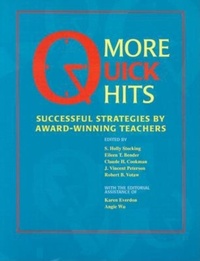
More Quick Hits
Successful Strategies by Award-Winning Teachers
Published on 22. September 1998
112 pages
978-0-253-02812-9 (ISBN)
Description

This sequel to the popular Quick Hits puts the focus on learning. More Quick Hits offers simple but successful strategies that award-winning teachers have found help promote student understanding and retention. The book also tells how to create the best environment in which to teach the courses you love.
More details
Language
English
Place of publication
Bloomington, IN
United States
Target group
Professional and scholarly
Product notice
Reflowable
ISBN-13
978-0-253-02812-9 (9780253028129)
Copyright in bibliographic data and cover images is held by Nielsen Book Services Limited or by the publishers or by their respective licensors: all rights reserved.
Schweitzer Classification
Other editions
Additional editions
S. Holly Stocking | Eileen Teper Bender | Claude H. Cookman
More Quick Hits
Successful Strategies by Award-Winning Teachers
Book
09/1998
Indiana University Press
€16.50
Shipment within 10-20 days
Persons
S. Holly Stocking is Associate Professor of Journalism at Indiana University Bloomington. She has written numerous articles on teaching and a book about journalism that has been adopted in undergraduate and graduate classrooms. She also regularly gives workshops to teachers on teaching and learning.
Eileen T. Bender, professor of English at Indiana University South Bend and one of the founders of FACET--The Faculty Colloquium on Excellence in Teaching--at Indiana University, and has served as its director since its inception in 1989. She is also Special Assistant to the Chancellor at Indiana University South Bend, and Professor of English at IUSB. She has served on the board of editors of Soundings and edited The IUSB Review and is the author of Joyce Carol Oates, Author in Residence and one of the editors of Quick Hits: Successful Strategies by Award Winning Teachers.
Claude H. Cookman, Assistant Professor of Journalism at Indiana University/Bloomington, is the author of A Voice is Born: The Founding and Early Years of the National Press Photographers Association under the Leadership of Joseph Costa and several articles.
Vince Peterson, Professor of Education and Program Director of Counseling and Human Services at Indiana University, South Bend, is the author of Orientation to Counseling, and numerous articles.
Bob Votaw, Associate Professor of Geology and Director of the Academic Resource Center at Indiana University Northwest, is a national leader in the discussion about effectively teaching science to diverse student populations.
Karen L. Everdon is the current coordinator of the FACET program at Indiana University .She received a B.A. in English and a MLS from Indiana University. Her interests encompass uses of technology in higher education, faculty development at the post-secondary level, and learning styles.
Eileen T. Bender, professor of English at Indiana University South Bend and one of the founders of FACET--The Faculty Colloquium on Excellence in Teaching--at Indiana University, and has served as its director since its inception in 1989. She is also Special Assistant to the Chancellor at Indiana University South Bend, and Professor of English at IUSB. She has served on the board of editors of Soundings and edited The IUSB Review and is the author of Joyce Carol Oates, Author in Residence and one of the editors of Quick Hits: Successful Strategies by Award Winning Teachers.
Claude H. Cookman, Assistant Professor of Journalism at Indiana University/Bloomington, is the author of A Voice is Born: The Founding and Early Years of the National Press Photographers Association under the Leadership of Joseph Costa and several articles.
Vince Peterson, Professor of Education and Program Director of Counseling and Human Services at Indiana University, South Bend, is the author of Orientation to Counseling, and numerous articles.
Bob Votaw, Associate Professor of Geology and Director of the Academic Resource Center at Indiana University Northwest, is a national leader in the discussion about effectively teaching science to diverse student populations.
Karen L. Everdon is the current coordinator of the FACET program at Indiana University .She received a B.A. in English and a MLS from Indiana University. Her interests encompass uses of technology in higher education, faculty development at the post-secondary level, and learning styles.
Content
- Intro
- Title Page
- Copyright Page
- Table of Contents
- Foreword
- Introduction
- 1 Designing courses and environments for learning
- Too much fun to be work?
- Collaborative syllabus
- Facilitating discussion through review
- Chemistry party animals
- Passport for non-traditional students
- Mixing student levels can improve discussion
- Agenda for the classroom
- Language-learning and student involvement
- Top ten lists
- The compleat discussion section
- The power of the bad example
- Quick wits
- 2 Creating learning communities
- Checking in/checking out
- Seriously seeking playful writing
- Revisiting the journal
- It's her idea, not mine!
- Collaborative fieldwork
- Case study in transparent teaching
- The autobiographical collage
- Just their type
- Who am I?
- Launching self-propelled people
- Teach locally, learn globally
- Collaboration in large classes
- Using a 'contract' on a commuter campus
- First-day questions
- Learning students' names
- A piece of the learning puzzle
- Socializing the classroom
- From competition to community
- Exploring diversity through storytelling
- A classy ice-breaker
- Quick wits
- 3 Fostering critical and creative thinking
- How to be (gasp!) New Yorkers
- Dig into primary sources
- Challenging students' beliefs
- What's new in the world today?
- Developing solid arguments
- Debating controversial issues
- Organized chaos in the classroom
- Is it just me, or is this guy crazy?
- Questions for critical reading and discussion
- Create a poem, a skit, a song ...
- A question of understanding
- Don't confuse the model with reality
- Research projects and job skills
- Teaching language through literature
- Issue papers: Short and to the point
- Professional journal scan
- Finding poetry
- Helping students understand ADD
- Quick wits
- 4 Helping students direct their own learning
- The five habits of successful students
- The toughest test of all
- Learning from exam results
- 'Just' an opinion paper?
- 'The totalitarian classroom'
- Creating a future
- Argument? Discussion? What's the difference?
- A syllabus for active inquirers
- Shifting responsibility for learning
- Exams as diagnostic tools
- Weaning students from dependency
- Teaching to learn
- Helping students reframe criticism
- Imparting the courage to fail
- Practice, practice, practice
- 5 Service and learning
- Pro bono public relations promotes learning
- The community as a learning resource
- Fostering reflection about service
- Service-learning in a community project
- Community-service writing
- Service-learning: Building an ethic of caring
- Environmental action and service projects
- LeaderLab
- Passing the torch
- 6 Technology and learning
- Learning from a television miniseries
- Putting it on the Web
- Choosing and using video for learning
- Better learning through technology?
- Closing the distance in distance-learning
- Raiding virtual libraries
- Learning on the listserv
- Classes for the MTV generation
- Creating interactive lectures on video
- Active learning in the computer classroom
- Team-teaching at a distance
- Take me out to the movies
- 7 Using assessment and evaluation for learning
- Evolving peer-review
- Quizzes to end classroom silence
- Writing across the curriculum: Peer-critique
- Reduce test stress: Use exam cards
- Assessment of student learning by teachers
- Assessment of teachers by students
- Collaborative exams
- Self-graded student participation
- Multiple choice, multiple insights
- Using counter-arguments for assessment
- Recording class participation
- Assessing basic skills of a discipline
- No-penalty quizzes
- An assignment/learning/evaluation sheet
- Reducing students' resistance to grades
- Is there a Lake Woebegone syndrome?
- In lieu of the practice exam
- Clarifying student expectations about exams
- Stress-free practical exams
- No whining: The value of one-page appeals
- Student-teacher snail-mail
- Mini-journals
- Uncovering prior knowledge
- What did you learn today?
- Thumbs up or thumbs down
- The one-minute paper
- Optional assignments
- Grading exams fairly
- Instant feedback on exams
- Peer-evaluation of teaching
- Quick wits
- 8 Learning to teach and teaching to learn
- Taking the risk to team-teach
- Team-teaching with your eyes open
- From my teachers I have learned
- 'I teach people'
- Prepping for essay exams
- Training teachers through peer-mentoring
- No pat on the back in order
- Less teaching, more learning?
- General rules for enthusiasm
- Evaluating ourselves
- Engaging associate instructors in the course
- What associate instructors need to know
- A hit is a hit is a hit (Not!)
- A new look at class preparation
- Students teaching teachers
- FOILed again
- The critical reading guide
- Learning is a matter of perspective
- Quick wits
- 9 Quick list: Recommended books on teaching
- O'Reilly, Mary Rose. The Peaceable Classroom
- Palmer, Parker J. To Know as We are Known: Education as a Spiritual Journey
- Kroll, Barry M. Teaching Hearts and Minds: College Students Reflect on the Vietnam War in Literature
- Boice, Robert. First-Order Principles for College Teachers: Ten Basic Ways to Improve The Teaching Process
- Grasha, Anthony F. Teaching With Style: A Practical Guide to Enhancing Learning by Understanding Teaching and Learning Styles
- Ericson, Betty LaSere, and Diane Weltner Strommer. Teaching College Freshmen
- Rose, Mike. Lives on The Boundary: The Struggles and Achievements of America's Underprepared
- Tobias, Sheila. They're Not Dumb, They're Just Different
- Champagne, Audrey B. and Leslie E. Hornig. Science Teaching
- Denby, David. Great Books: My Adventure with Homer, Rousseau, Woolf, and Other Indestructible Writers of the Western World
- Gibaldi, Joseph, Series Editor. Approaches to Teaching World Literature Series
- Palmer, Parker J. The Courage to Teach: Exploring the Inner Landscape of a Teacher's Life
- Senge, Peter M. Leading Learning Organizations: The Bold, The Powerful, and The Invisible
- Hutchings, Pat. Making Teaching Community Property: A Menu for Peer-Collaboration and Peer-Review
- Rogers, Carl. Freedom to Learn
- Mills, C. Wright. The Sociological Imagination
- Index of contributors
- Index of subjects
