

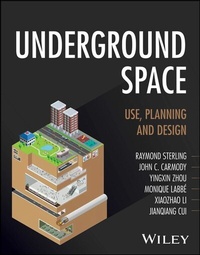
Underground Space
Description

Unlocking the Hidden Potential of Cities from the Ground Down
With cities worldwide facing pressures from rapid urbanization, climate change, and land scarcity, underground space has become a vital resource for sustainable and resilient urban development. Underground Space: Use, Planning and Design provides a comprehensive framework for planners, engineers, architects, and policymakers to understand and apply underground solutions and updates a landmark reference work on the topic. Combining many decades of research, practice, and global examples, this book offers authoritative guidance on how underground space can contribute to the creation of livable, future-ready cities.
Written by a team of experts from around the globe, Underground Space offers:
- An understanding of the many reasons why underground space is used and when to choose to build underground.
- Broad coverage of underground uses, from transport and urban utilities to underground architectural applications.
- Recent advances made in three-dimensional urban underground planning.
- Updated design approaches and human-centered considerations for the exterior and interior design, layout, lighting, and safety of underground spaces.
- In-depth exploration of sustainability, resilience, and adaptability issues.
- Insights from several decades of hands-on experience with modern underground designs.
Underground Space: Use, Planning and Design is an essential, up-to-date reference on the subject for architects, planners, and engineers in public agencies, private sectors, and research institutions. It is also valuable for use in courses on architectural design, urban planning, underground infrastructure, and infrastructure provision.
More details
Other editions
Additional editions
Persons
Raymond Sterling is a Professor Emeritus (Civil Engineering) at Louisiana Tech University where he directed the Trenchless Technology Center from 1995-2009. From 1977-1995, he was on the faculty of the University of Minnesota where he was the founding Director of the Underground Space Center.
John C. Carmody (1947-2019) was an architect and the Associate Director of the Underground Space Center at the University of Minnesota. His major research interests included the planning, design, and construction of underground facilities, energy-efficient building design, building technology, and life safety in buildings.
Yingxin Zhou is Technical Director with Knights Synergy (S) Pte Ltd and Academy of Engineering Singapore and served as Head Engineering (Underground Facilities) with the Defence Science and Technology Agency, Singapore.
Monique Labbé is the recipient of the Pioneering Woman Architect ARVHA Prize in 2023 and runs Les Ateliers Monique LABBÉ. She created and chaired the AFTES Underground Space Committee. She initiated in 2009 and directs the Ville 10D-Ville d'Idées National Research Project on the urban use of the underground.
Xiaozhao Li is Director, Professor of the State Key Laboratory for Geo-Mechanics and Deep Underground Engineering, China University of Mining & Technology. He is also Founding Director of Yunlong Lake Laboratory for Deep Underground Science and Engineering.
Jianqiang Cui is a Senior Lecturer in Urban Planning at Griffith University, Brisbane, Australia. Her research interests lie in the fields of urban planning and design, transport planning and policy, environment and behaviour, and urban underground space.
Content
List of Figures xiii
List of Tables xix
Preface xxi
Acknowledgments xxiii
About the Companion Website xxv
1 Introduction to Underground Space Use 1
2 Decision Making for Underground Space 21
3 Sustainability and Resilience Issues 47
4 Underground Space Classifications and Configurations 69
5 Historical Development and Current Use of Underground Space 87
6 Planning Issues for Underground Space 133
7 Urban Underground Space Planning Tools and Case Examples 155
8 Project-Related Planning 179
9 Designing Underground Spaces - Toward a New Paradigm 203
10 Psychological and Physiological Effects in Underground Space 225
11 Exterior and Entrance Design 257
12 Layout and Spatial Configuration 281
13 Interior Design Elements and Systems 313
14 Lighting 341
15 Life Safety 365
16 Underground Construction Technology Development and Its Implications 391
17 Managing Underground Space Facilities 403
Appendix A: Glossary of Terms, Abbreviations, and Acronyms 417
Appendix B: Effect of Land Cost on Choice for Underground Space Use 423
Appendix C: Database Formats for Cataloging Underground Space Uses 429
Appendix D: Worldwide Examples of Underground Space Uses 435
Index 437
List of Figures
Figure 1.1 What is perceived as underground space? Figure 1.2 World population density 2020 Figure 1.3 Breakeven cost ratio for basement vs aboveground building space Figure 1.4 GDP per capita vs energy use per capita in 2011 Figure 1.5 Private passenger transport fuel use per capita vs urban density Figure 1.6 Subsurface utility congestion in San Francisco in 1965 Figure 1.7 Transit-oriented commercial development in Beijing Figure 1.8 "Rue Future" concept for Paris in the early 1900s Figure 1.9 Underground space concept for the University of Minnesota Minneapolis Campus Figure 1.10 Shimizu Geo-Grid Concept Figure 1.11 BNK Arquitectura Earthscraper concept Figure 2.1 Decision making process for evaluation of building alternatives Figure 2.2 Annual temperature fluctuations in Minneapolis USA Figure 2.3 Seward Townhouses in Minneapolis in 1981 Figure 2.4 Interior of the Temppeliaukio Rock Church in Helsinki Figure 2.5 A rural house damaged by a bush fire in South Australia in 1983 Figure 2.6 An earth-sheltered dome house set into a coastal dune in Kapiti, New Zealand Figure 2.7 Examples of easement cost versus depth in 1990 Figure 2.8 Cost comparisons for underground oil storage in Sweden in 1977 Figure 2.9 The Subtropolis office space in a repurposed limestone mine in Kansas City, USA Figure 2.10 Capacity and travel times vs vertical rise (a) Passenger capacity (b) Min. travel time (c) Freight capacity Figure 2.11 Holmlia underground sports facility and community shelter in Norway Figure 2.12 Sinkhole caused by groundwater pumping in Florida in 2010 Figure 3.1 United Nations sustainable development goals for 2030 Figure 3.2 Growth of urban population percentage by world region Figure 3.3 Benefits and detriments of UUS towards climate neutral cities Figure 3.4 Comparison of selected minerals used in the manufacture of electric vs conventional cars Figure 3.5 Sustainable development goals with respect to the three pillars of sustainability Figure 3.6 Interrelationships for a viable urban community Figure 3.7 Protection for underground facility entrances. Camouflaged tunnel entrances with dog-legged long tunnels and bomb traps combined with blast doors for protection Figure 3.8 Indicative bomb protection requirements for concrete and rock facilities Figure 3.9 Suggested measure for "resilience" of an infrastructure system Figure 4.1 Shapes of natural cavities Figure 4.2 Rock quarry Figure 4.3 Open-pit mining Figure 4.4 Traditional chamber mine Figure 4.5 Shaft and tunnel mine Figure 4.6 Horizontal adit mine Figure 4.7 Mine with room-and-pillar configuration Figure 4.8 Open stope mine Figure 4.9 Cut-and-fill stope mine Figure 4.10 Longwall mine Figure 4.11 Solution mine Figure 4.12 End use configurations - utility pipes and tunnels Figure 4.13 End-use configurations - cut-and-cover structures Figure 4.14 End-use configurations - caverns Figure 4.15 Section of a rail transit station constructed by multi-shield tunnel Figure 4.16 Complexity of caverns, tunnels, and shafts for a pumped hydro facility Figure 4.17 Minimal urban use of underground space Figure 4.18 Moderate urban use of underground space Figure 4.19 Extensive urban use of underground space Figure 4.20 Horizontal access to mined space in flat-bedded geology Figure 4.21 Combined shaft and horizontal access Figure 4.22 Interconnected vaulted caverns Figure 4.23 Large multi-utility tunnels Figure 4.24 Infrastructure/industry corridor concept Figure 5.1 Historical timeline for underground space uses and planning Figure 5.2 Cave home styles in China (a) Pit style (b) Hillside style Figure 5.3 "House of the Hunt" in the historic Roman settlement of Bulla Regia Figure 5.4 Pit-style underground dwelling in Matmata Figure 5.5 Cave dwellings in Guadix, Spain Figure 5.6 Troglodyte dwelling in France Figure 5.7 Turf buildings at Keldur, Iceland Figure 5.8 Map of earth-sheltered house locations in the USA in 1983 Figure 5.9 "Underhill" an earth-sheltered house in the UK peak district Figure 5.10 Terraced earth-sheltered housing on a steeply sloping site in the south of France Figure 5.11 The Monastery, Petra, Jordan Figure 5.12 Kailasa temple, Ellora, India Figure 5.13 Clearwater cave, Gunung Mulu national park, Malaysia Figure 5.14 Interior of the Itäkeskus public swimming pool in Helsinki, Finland Figure 5.15 Cross-section of the Yates field house, George Washington University, USA. Architect: Daniel F. Tully Associates Figure 5.16 The 62-m span Gjøvik Olympic Ice Hockey arena in a rock cavern Figure 5.17 Osaka municipal central gymnasium, Japan Figure 5.18 Adventure playground in the Louisville Mega Cavern, Kentucky USA Figure 5.19 A tourist destination in a former salt mine, Salina Turda, Romania Figure 5.20 Atrium within the Montréal underground pedestrian system Figure 5.21 Underground shopping center adjacent to Nagoya Station, Japan Figure 5.22 La Canopée, Les Halles, Paris Figure 5.23 Cliffs of Moher Interpretive Centre, Ireland Figure 5.24 Entrance to Hayden Library, Arizona State University Figure 5.25 Archives addition to the national library of Sweden Figure...
