

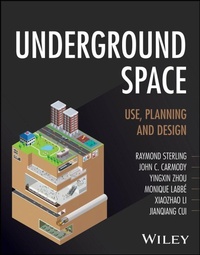
Underground Space
Use, Planning and Design
1st Edition
Published on 10. November 2025
Book
Paperback/Softback
480 pages
978-1-394-20961-3 (ISBN)
Description
Unlocking the Hidden Potential of Cities from the Ground Down
With cities worldwide facing pressures from rapid urbanization, climate change, and land scarcity, underground space has become a vital resource for sustainable and resilient urban development. Underground Space: Use, Planning and Design provides a comprehensive framework for planners, engineers, architects, and policymakers to understand and apply underground solutions and updates a landmark reference work on the topic. Combining many decades of research, practice, and global examples, this book offers authoritative guidance on how underground space can contribute to the creation of livable, future-ready cities.
Written by a team of experts from around the globe, Underground Space offers:
An understanding of the many reasons why underground space is used and when to choose to build underground.
Broad coverage of underground uses, from transport and urban utilities to underground architectural applications.
Recent advances made in three-dimensional urban underground planning.
Updated design approaches and human-centered considerations for the exterior and interior design, layout, lighting, and safety of underground spaces.
In-depth exploration of sustainability, resilience, and adaptability issues.
Insights from several decades of hands-on experience with modern underground designs.
Underground Space: Use, Planning and Design is an essential, up-to-date reference on the subject for architects, planners, and engineers in public agencies, private sectors, and research institutions. It is also valuable for use in courses on architectural design, urban planning, underground infrastructure, and infrastructure provision.
With cities worldwide facing pressures from rapid urbanization, climate change, and land scarcity, underground space has become a vital resource for sustainable and resilient urban development. Underground Space: Use, Planning and Design provides a comprehensive framework for planners, engineers, architects, and policymakers to understand and apply underground solutions and updates a landmark reference work on the topic. Combining many decades of research, practice, and global examples, this book offers authoritative guidance on how underground space can contribute to the creation of livable, future-ready cities.
Written by a team of experts from around the globe, Underground Space offers:
An understanding of the many reasons why underground space is used and when to choose to build underground.
Broad coverage of underground uses, from transport and urban utilities to underground architectural applications.
Recent advances made in three-dimensional urban underground planning.
Updated design approaches and human-centered considerations for the exterior and interior design, layout, lighting, and safety of underground spaces.
In-depth exploration of sustainability, resilience, and adaptability issues.
Insights from several decades of hands-on experience with modern underground designs.
Underground Space: Use, Planning and Design is an essential, up-to-date reference on the subject for architects, planners, and engineers in public agencies, private sectors, and research institutions. It is also valuable for use in courses on architectural design, urban planning, underground infrastructure, and infrastructure provision.
More details
Language
English
Place of publication
New York
United States
Target group
Professional and scholarly
Product notice
Paperback (trade)
Unsewn / adhesive bound
Dimensions
Height: 272 mm
Width: 216 mm
Thickness: 23 mm
Weight
1247 gr
ISBN-13
978-1-394-20961-3 (9781394209613)
Copyright in bibliographic data and cover images is held by Nielsen Book Services Limited or by the publishers or by their respective licensors: all rights reserved.
Schweitzer Classification
Other editions
Additional editions
E-Book
10/2025
1st Edition
Wiley
€100.99
Available for download
E-Book
10/2025
1st Edition
Wiley
€100.99
Available for download
Persons
Raymond Sterling is a Professor Emeritus (Civil Engineering) at Louisiana Tech University where he directed the Trenchless Technology Center from 1995-2009. From 1977-1995, he was on the faculty of the University of Minnesota where he was the founding Director of the Underground Space Center.
John C. Carmody (1947-2019) was an architect and the Associate Director of the Underground Space Center at the University of Minnesota. His major research interests included the planning, design, and construction of underground facilities, energy-efficient building design, building technology, and life safety in buildings.
Yingxin Zhou is Technical Director with Knights Synergy (S) Pte Ltd and Academy of Engineering Singapore and served as Head Engineering (Underground Facilities) with the Defence Science and Technology Agency, Singapore.
Monique Labbe is the recipient of the Pioneering Woman Architect ARVHA Prize in 2023 and runs Les Ateliers Monique LABBE. She created and chaired the AFTES Underground Space Committee. She initiated in 2009 and directs the Ville 10D-Ville d'Idees National Research Project on the urban use of the underground.
Xiaozhao Li is Director, Professor of the State Key Laboratory for Geo-Mechanics and Deep Underground Engineering, China University of Mining & Technology. He is also Founding Director of Yunlong Lake Laboratory for Deep Underground Science and Engineering.
Jianqiang Cui is a Senior Lecturer in Urban Planning at Griffith University, Brisbane, Australia. Her research interests lie in the fields of urban planning and design, transport planning and policy, environment and behaviour, and urban underground space.
John C. Carmody (1947-2019) was an architect and the Associate Director of the Underground Space Center at the University of Minnesota. His major research interests included the planning, design, and construction of underground facilities, energy-efficient building design, building technology, and life safety in buildings.
Yingxin Zhou is Technical Director with Knights Synergy (S) Pte Ltd and Academy of Engineering Singapore and served as Head Engineering (Underground Facilities) with the Defence Science and Technology Agency, Singapore.
Monique Labbe is the recipient of the Pioneering Woman Architect ARVHA Prize in 2023 and runs Les Ateliers Monique LABBE. She created and chaired the AFTES Underground Space Committee. She initiated in 2009 and directs the Ville 10D-Ville d'Idees National Research Project on the urban use of the underground.
Xiaozhao Li is Director, Professor of the State Key Laboratory for Geo-Mechanics and Deep Underground Engineering, China University of Mining & Technology. He is also Founding Director of Yunlong Lake Laboratory for Deep Underground Science and Engineering.
Jianqiang Cui is a Senior Lecturer in Urban Planning at Griffith University, Brisbane, Australia. Her research interests lie in the fields of urban planning and design, transport planning and policy, environment and behaviour, and urban underground space.
Author
Louisiana Tech University; Underground Space Center, University of Minnesota
Underground Space Center, University of Minnesota
Defence Science and Technology Agency, Singapore
Les Ateliers Monique LABB?, Architects, Urban Planners
China University of Mining & Technology
Griffith University, Brisbane, Australia
Content
List of Figures xiii
List of Tables xix
Preface xxi
Acknowledgments xxiii
About the Companion Website xxv
1 Introduction to Underground Space Use 1
2 Decision Making for Underground Space 21
3 Sustainability and Resilience Issues 47
4 Underground Space Classifications and Configurations 69
5 Historical Development and Current Use of Underground Space 87
6 Planning Issues for Underground Space 133
7 Urban Underground Space Planning Tools and Case Examples 155
8 Project-Related Planning 179
9 Designing Underground Spaces - Toward a New Paradigm 203
10 Psychological and Physiological Effects in Underground Space 225
11 Exterior and Entrance Design 257
12 Layout and Spatial Configuration 281
13 Interior Design Elements and Systems 313
14 Lighting 341
15 Life Safety 365
16 Underground Construction Technology Development and Its Implications 391
17 Managing Underground Space Facilities 403
Appendix A: Glossary of Terms, Abbreviations, and Acronyms 417
Appendix B: Effect of Land Cost on Choice for Underground Space Use 423
Appendix C: Database Formats for Cataloging Underground Space Uses 429
Appendix D: Worldwide Examples of Underground Space Uses 435
Index 437
List of Tables xix
Preface xxi
Acknowledgments xxiii
About the Companion Website xxv
1 Introduction to Underground Space Use 1
2 Decision Making for Underground Space 21
3 Sustainability and Resilience Issues 47
4 Underground Space Classifications and Configurations 69
5 Historical Development and Current Use of Underground Space 87
6 Planning Issues for Underground Space 133
7 Urban Underground Space Planning Tools and Case Examples 155
8 Project-Related Planning 179
9 Designing Underground Spaces - Toward a New Paradigm 203
10 Psychological and Physiological Effects in Underground Space 225
11 Exterior and Entrance Design 257
12 Layout and Spatial Configuration 281
13 Interior Design Elements and Systems 313
14 Lighting 341
15 Life Safety 365
16 Underground Construction Technology Development and Its Implications 391
17 Managing Underground Space Facilities 403
Appendix A: Glossary of Terms, Abbreviations, and Acronyms 417
Appendix B: Effect of Land Cost on Choice for Underground Space Use 423
Appendix C: Database Formats for Cataloging Underground Space Uses 429
Appendix D: Worldwide Examples of Underground Space Uses 435
Index 437