

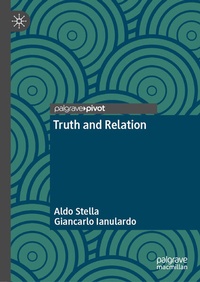
Truth and Relation
Description

This book explores two fundamental concepts in philosophy: truth and relation. These concepts indicate the unconditioned condition and the empirical-formal universe that truth unilaterally conditions, respectively. Indeed, truth conditions the empirical-formal universe without being conditioned by it. It is argued that the reduction of truth to various theories explaining its empirical use has led to the unconditioned nature of truth itself being lost. But if truth is not grasped for its absolute value, it is reduced to relation.
The book aims to show that the concept of relation - if understood as a static construct of two terms and a nexus - is a contradictory construct, since it reconciles the irreconcilable: dependence and independences of the related terms. Thus, only insofar as truth is absolute is it authentic truth, because it does not depend on anything else, but is autonomous and self-sufficient. Indeed, if truth were not absolute, it would be determined and, as such, would be defined by a limit that would place it in relation to something other than itself, i.e. non-truth. But this is contradictory as it would make truth reliant on what is not truth. Instead, no determination can ground itself: the circle of referring that requires the determination to refer beyond itself cannot be the ground, because it configures nothing other than an infinite regress.
In conclusion, the book shows that truth has to be understood not only as the end of a quest, but also as its condition, since it is only in virtue of absolute truth that the inadequacy and therefore the unintelligibility of all that is finite or relative are recognised.
Truth and Relation is essential reading for all scholars, researchers and advanced students of philosophy and, in particular, of metaphysics and epistemology.
Reviews / Votes
"This is a brilliant essay that compellingly defends the undeniability of absolute truth-something that can only be genuinely approached by those who intend to seek it. The position articulated in the essay stands in contrast to both the relativist conception of truth, which denies the existence of any absolute truth, and the dogmatic stance, which assumes that one's current understanding of the truth is already absolute. This can lead to the practical conclusion that absolute truth does not constrain, but rather entrusts and guides the seeker in their journey toward truth moved by the conviction that truth exists and can be approached, even if never fully grasped." (Domènec Mele´ is Emeritus Professor and the holder of the Chair of Business Ethics at IESE Business School, University of Navarra, Spain)
"A critical synthesis designed to shed metaphysical light on two key concepts: truth and relation. Classical history, cross-cutting themes passing from the objective to the subjective, from the immediate to the mediate, from the transcendent to the immanent, and taking up thinkers from all periods. Here is a work that is not inclined towards an interpretation against another but rejects both relativism and dogmatism. It is a perspective that integrates various approaches, towards an overcoming that ignores none of them, or even retains elements of them; the mind is ordered in search of a point that rebels against all determinations, as well as all absolutisation, and which borders on the ineffable. In this conception, one grasps that if truth is understood
outside relation
, it is all the more intelligible than if it is reached
through relation
, and that it is thus the relation that requires truth, and not the other way round. This is an authentic universalism." (Jean-Marc Trigeaud, Emeritus Professor at the University of Bordeaux, France)
More details
Other editions
Additional editions
Persons
Aldo Stella, former Professor of Philosophy at the University of Urbino, is Professor of Psychology at the University of Perugia, Italy.
Giancarlo Ianulardo is Senior Lecturer in Economics at the University of Exeter, UK
Content
1: Theories of truth and relationship.- 2: Truth and Relation.- 3: Truth and truths.- 4: The concept of relation and the emergence of truth.- 5: Conclusion.
