


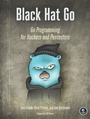
Black Hat Go
Go Programming For Hackers and Pentesters
Published on 4. February 2020
368 pages
978-1-59327-866-3 (ISBN)
Description

Like the best-selling Black Hat Python, Black Hat Go explores the darker side of the popular Go programming language. This collection of short scripts will help you test your systems, build and automate tools to fit your needs, and improve your offensive security skillset.
Black Hat Go explores the darker side of Go, the popular programming language revered by hackers for its simplicity, efficiency, and reliability. It provides an arsenal of practical tactics from the perspective of security practitioners and hackers to help you test your systems, build and automate tools to fit your needs, and improve your offensive security skillset, all using the power of Go.
You'll begin your journey with a basic overview of Go's syntax and philosophy and then start to explore examples that you can leverage for tool development, including common network protocols like HTTP, DNS, and SMB. You'll then dig into various tactics and problems that penetration testers encounter, addressing things like data pilfering, packet sniffing, and exploit development. You'll create dynamic, pluggable tools before diving into cryptography, attacking Microsoft Windows, and implementing steganography.
You'll learn how to:
• Make performant tools that can be used for your own security projects
• Create usable tools that interact with remote APIs
• Scrape arbitrary HTML data
• Use Go's standard package, net/http, for building HTTP servers
• Write your own DNS server and proxy
• Use DNS tunneling to establish a C2 channel out of a restrictive network
• Create a vulnerability fuzzer to discover an application's security weaknesses
• Use plug-ins and extensions to future-proof productsBuild an RC2 symmetric-key brute-forcer
• Implant data within a Portable Network Graphics (PNG) image.
Are you ready to add to your arsenal of security tools? Then let's Go!
Black Hat Go explores the darker side of Go, the popular programming language revered by hackers for its simplicity, efficiency, and reliability. It provides an arsenal of practical tactics from the perspective of security practitioners and hackers to help you test your systems, build and automate tools to fit your needs, and improve your offensive security skillset, all using the power of Go.
You'll begin your journey with a basic overview of Go's syntax and philosophy and then start to explore examples that you can leverage for tool development, including common network protocols like HTTP, DNS, and SMB. You'll then dig into various tactics and problems that penetration testers encounter, addressing things like data pilfering, packet sniffing, and exploit development. You'll create dynamic, pluggable tools before diving into cryptography, attacking Microsoft Windows, and implementing steganography.
You'll learn how to:
• Make performant tools that can be used for your own security projects
• Create usable tools that interact with remote APIs
• Scrape arbitrary HTML data
• Use Go's standard package, net/http, for building HTTP servers
• Write your own DNS server and proxy
• Use DNS tunneling to establish a C2 channel out of a restrictive network
• Create a vulnerability fuzzer to discover an application's security weaknesses
• Use plug-ins and extensions to future-proof productsBuild an RC2 symmetric-key brute-forcer
• Implant data within a Portable Network Graphics (PNG) image.
Are you ready to add to your arsenal of security tools? Then let's Go!
More details
Other editions
Additional editions
Book
01/2020
No Starch Press
€47.00
Available immediately
Persons
Tom Steele, Dan Kottmann, and Chris Patten share over 30 years in penetration testing and offensive security experience, and have delivered multiple Go training and development sessions.
Content
Chapter 1: Go Fundamentals and Concepts
Chapter 2: TCP and Go: Scanners and Proxies
Chapter 3: HTTP Clients: Remote Interaction with Tools
Chapter 4: HTTP Servers: Routing and Middleware
Chapter 5: Exploiting DNS: Recon and More
Chapter 6: SMB and NTLM: A Peek Down the Rabbit Hole
Chapter 7: Databases and Filesystems: Pilfering and Abusing
Chapter 8: Packet Processing: Living on the Wire
Chapter 9: Exploit Code: Writing and Porting
Chapter 10: Extendable Tools: Using Go Plugins and LUA
Chapter 11: Cryptography: Implementing and Attacking
Chapter 12: Windows: System Interaction and Analysis
Chapter 13: Steganography: Hiding Data
Chapter 14: Command and Control: Building a RAT
Chapter 2: TCP and Go: Scanners and Proxies
Chapter 3: HTTP Clients: Remote Interaction with Tools
Chapter 4: HTTP Servers: Routing and Middleware
Chapter 5: Exploiting DNS: Recon and More
Chapter 6: SMB and NTLM: A Peek Down the Rabbit Hole
Chapter 7: Databases and Filesystems: Pilfering and Abusing
Chapter 8: Packet Processing: Living on the Wire
Chapter 9: Exploit Code: Writing and Porting
Chapter 10: Extendable Tools: Using Go Plugins and LUA
Chapter 11: Cryptography: Implementing and Attacking
Chapter 12: Windows: System Interaction and Analysis
Chapter 13: Steganography: Hiding Data
Chapter 14: Command and Control: Building a RAT
