

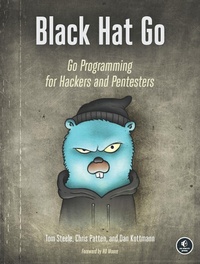
Black Hat Go
Go Programming For Hackers and Pentesters
Published on 24. January 2020
Book
Paperback/Softback
368 pages
978-1-59327-865-6 (ISBN)
Description
In Black Hat Go, you'll learn how to write powerful and effective penetration testing tools in Go, a language revered for its speed and scalability. Start off with an introduction to Go fundamentals like data types, control structures, and error handling; then, dive into the deep end of Go's offensive capabilities. Black Hat Go will show you how to build powerful security tools to pen test huge networks, fast.
Reviews / Votes
"It's been incredibly fun having these kinds of projects, where you're not just learning syntax, you're not just learning the mechanics of Go, but you have things to build that are kind of fun." -Johnny Boursiquot, Go Time PodcastMore details
Language
English
Place of publication
San Francisco
United States
Dimensions
Height: 233 mm
Width: 177 mm
Thickness: 23 mm
Weight
698 gr
ISBN-13
978-1-59327-865-6 (9781593278656)
Copyright in bibliographic data and cover images is held by Nielsen Book Services Limited or by the publishers or by their respective licensors: all rights reserved.
Schweitzer Classification
Other editions
Additional editions
E-Book
02/2020
No Starch Press
€38.99
Available for download
Persons
Tom Steele, Dan Kottmann, and Chris Patten share over 30 years in penetration testing and offensive security experience, and have delivered multiple Go training and development sessions.
Content
Chapter 1: Go Fundamentals and Concepts
Chapter 2: TCP and Go: Scanners and Proxies
Chapter 3: HTTP Clients: Remote Interaction with Tools
Chapter 4: HTTP Servers: Routing and Middleware
Chapter 5: Exploiting DNS: Recon and More
Chapter 6: SMB and NTLM: A Peek Down the Rabbit Hole
Chapter 7: Databases and Filesystems: Pilfering and Abusing
Chapter 8: Packet Processing: Living on the Wire
Chapter 9: Exploit Code: Writing and Porting
Chapter 10: Extendable Tools: Using Go Plugins and LUA
Chapter 11: Cryptography: Implementing and Attacking
Chapter 12: Windows: System Interaction and Analysis
Chapter 13: Steganography: Hiding Data
Chapter 14: Command and Control: Building a RAT
Chapter 2: TCP and Go: Scanners and Proxies
Chapter 3: HTTP Clients: Remote Interaction with Tools
Chapter 4: HTTP Servers: Routing and Middleware
Chapter 5: Exploiting DNS: Recon and More
Chapter 6: SMB and NTLM: A Peek Down the Rabbit Hole
Chapter 7: Databases and Filesystems: Pilfering and Abusing
Chapter 8: Packet Processing: Living on the Wire
Chapter 9: Exploit Code: Writing and Porting
Chapter 10: Extendable Tools: Using Go Plugins and LUA
Chapter 11: Cryptography: Implementing and Attacking
Chapter 12: Windows: System Interaction and Analysis
Chapter 13: Steganography: Hiding Data
Chapter 14: Command and Control: Building a RAT