

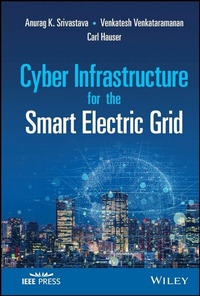
Cyber Infrastructure for the Smart Electric Grid
Description

As electric power systems undergo a transformative upgrade with the integration of advanced technologies to enable the smarter electric grid, professionals who work in the area require a new understanding of the evolving complexity of the grid.
Cyber Infrastructure for the Smart Electric Grid delivers a comprehensive overview of the fundamental principles of smart grid operation and control, smart grid technologies, including sensors, communication networks, computation, data management, and cyber security, and the interdependencies between the component technologies on which a smart grid's security depends. The book offers readers the opportunity to critically analyze the smart grid infrastructure needed to sense, communicate, compute, and control in a secure way.
Readers of the book will be able to apply the interdisciplinary principles they've learned in the book to design and build secure smart grid infrastructure. Readers will also benefit from the inclusion of:
* A thorough introduction to the key skills required by engineers to manage the evolving complexity of the electric grid
* An exploration of the interdependencies of smart grid infrastructure required to sense, communicate, compute, control, and manage data securely
* Software modules in .exe format for demonstrations and exercises
* An examination of the fundamental principles of smart grid operation and control
Perfect for professionals working in the electric utility industries at electric utilities, vendors, and the national labs, Cyber Infrastructure for the Smart Electric Grid will also earn a place in the libraries of senior undergraduate and graduate students studying electrical engineering and smart grids.
More details
Other editions
Additional editions
Persons
Anurag K. Srivastava, PhD, is the Raymond J. Lane Professor and Chairperson of the Lane Department of Computer Science and Electrical Engineering in the Benjamin M. Statler College of Engineering and Mineral Resources at West Virginia University. He is the director of the Smart Grid Resiliency and Analytics Lab (SGREAL) and an IEEE Fellow.
Venkatesh Venkataramanan, PhD, is a Researcher at the National Renewable Energy Laboratory, working on cyber-physical systems. He was previously with Washington State University and Massachusetts Institute of Technology.
Carl Hauser, PhD, is Emeritus Faculty in Computer Science at Washington State University. He received his PhD from Cornell University. Following 20 years in industry at IBM Research and Xerox Research he joined WSU where he conducted research on communications and cybersecurity for electric grid operations.
Content
1 Introduction to the Smart Grid 1
1.1 Overview of the electric power grid 1
1.2 What can go wrong in power grid operation 12
1.3 Learning from past events 14
1.4 Towards a smarter electric grid 18
1.5 Summary 20
1.6 Problems 20
1.7 Questions 22
2 Sense, communicate, compute and control in secure way 23
2.1 Sensing in smart grid 25
2.2 Communication infrastructure in smart grid 37
2.3 Computational infrastructure and control requirements in smart grid 38
2.4 Cyber security in smart grid 43
2.5 Summary 45
2.6 Problems 45
2.7 Questions 47
3 Smart Grid Operational Structure and Standards 49
3.1 Organization to ensure system reliability 53
3.2 Smart grid standards and interoperability 56
3.3 Operational structure in the rest of the world 58
3.4 Summary 58
3.5 Problems 59
3.6 Questions 60
4 Communication performance and factors that Affect it 63
4.1 Introduction 63
4.2 Propagation Delay 66
4.3 Transmission Delay 67
4.4 Queuing Delay and Jitter 69
4.5 Processing Delay 73
4.6 Delay in Multi-hop networks 73
4.7 Data Loss and Corruption 74
4.8 Summary 76
4.9 Exercises 76
5 Layered communication model 81
5.1 Introduction 81
5.2 Physical layer 86
5.3 Link layer: service models 87
5.4 Network layer: addressing and routing 92
5.5 Transport layer: datagram and stream protocols 100
5.6 Application layer 107
5.7 Glue protocols: ARP, DNS 109
5.8 Comparison between OST and TCP/IP models 112
5.9 Summary 113
5.10 Problems 113
5.11 Questions 115
6 Power system application-layer protocols 117
6.1 Introduction 117
6.2 SCADA protocols 118
6.3 ICCP 125
6.4 C37.118 127
6.5 Smart metering and distributed energy resources 129
6.6 Time synchronization 132
6.7 Summary 134
6.8 Problems 134
6.9 Questions 136
7 Utility IT infrastructures for control center and Fault-tolerant computing 137
7.1 Conventional control centers 137
7.2 Modern Control Centers 141
7.3 Future Control Centers 143
7.4 UML, XML, RDF,and CIM 145
7.5 Basics of Fault-tolerant computing 154
7.6 Cloud computing 157
7.7 Summary 159
7.8 Problems 160
7.9 Questions 161
8 Basic security concepts, cryptographic protocols, and access control 163
8.1 Introduction 163
8.2 Basic Cybersecurity Concepts and Threats to Power systems 164
8.3 The CIA Triad and Other Core Security Properties 168
8.4 Introduction to Encryption and Authentication 178
8.5 Cryptography in power systems 182
8.6 Access control 187
8.7 Summary 189
8.8 Problems 190
8.9 Questions 191
9 Network attacks and protection 193
9.1 Attacks to network communications 193
9.2 Mitigation mechanisms against network attacks 202
9.3 Network protection through rewalls 208
9.4 Intrusion detection 210
9.5 Summary 214
9.6 Problems 214
9.7 Questions 216
10 Vulnerabilities, and Risk Management 217
10.1 System vulnerabilities 217
10.2 Security mechanisms: Access control and Malware Detection 229
10.3 Assurance and Evaluation 233
10.4 Compliance: Industrial practice to implement NERC CIP 241
10.5 Summary 242
10.6 Problems 243
10.7 Questions 244
11 Smart grid case studies 245
11.1 Smart Grid Demonstration Projects 245
11.2 Smart grid metrics 249
11.3 Smart Grid Challenges: Attack case-studies 250
11.4 Mitigation using NIST Cybersecurity Framework 257
11.5 Summary 259
11.6 Problems 259
11.7 Questions 261
Index1
Introduction to the Smart Grid
The power grid has been evolving from a physical system to a "cyber-physical" system to sense, communicate, compute, and control with enhanced digitalization. The cyber-physical smart grid includes components from the physical power system, digital devices, and the associated communication infrastructure. To realize the vision of the smart grid, massive amounts of data need to be transferred from the field devices to the control devices or to the control centers. As more optimal algorithms are deployed for best possible control at a faster time scale, the communication infrastructure becomes critical to provide the required inputs. At the same time, increased number of "smart" devices in the grid also increase the attack surface for potential cyber attacks. It is necessary to study the power system's exposure to risks and vulnerabilities in the associated cyber system.
1.1 Overview of the Electric Power Grid
The electric power grid can be defined as the entire apparatus of wires and machines that connects the sources of electricity with the customers. A power grid is generally divided into four major components as shown in Figure 1.1:
- Generation
- Transmission
- Distribution
- Loads
Electricity was first generated, sold, and distributed locally in 1870s via direct current (DC) circuits over very small distances. As the demand for electricity became more widespread, the cost of construction and distribution of local generation and DC circuits to carry the power over long distances became prohibitively expensive. Hence, alternating current (AC) generation, transmission, and distribution became the standard that is used to this day. However, the infrastructure of the power grid is getting older - the average age of a transformer is greater than 50 years old and has already exceeded its expected lifetime. The electric grid faces several problems, including a problem with the oncoming retirement of at least 5% of the workforce and one of the lowest R&D expenditure as compared to other critical infrastructures.
Figure 1.1 Major components of the power grid.
Source: Energy Information Administration (EIA), public domain.
The situation is getting better, however, with increasing interest in national security and acknowledgment of the critical role that the power grid plays in the overall quality of life. In a full circle, localized generation using distributed energy resources (DERs) is making a comeback, with a combination of both AC and DC systems. Today's generation systems are a combination of different types of sources - including fossil fuels, natural gas, renewable resources, and nuclear energy. These generation systems are often located in remote areas for ease of doing business and for environmental reasons.
The power that is generated at the generating stations is brought to the consumers by a complex network of transmission lines. The North American power grid comprises of four major interconnections as shown in Figure 1.2:
- Western interconnection
- Eastern interconnection
- Quebec interconnection
- Electricity Reliability Council of Texas (ERCOT) interconnection
Figure 1.2 Interconnections in the North American Power Grid.
Source: North American Energy Reliability Corporation (NERC), public domain.
These interconnections are zones in which the electric utilities are electrically tied together, indicating that the areas are synchronized to the same frequency and power can flow freely in that area. The interconnections operate nearly independently of each other except for some high-voltage direct current (HVDC) interconnections between them. DC converter substations enable the synchronized transfer of power across interconnections regardless of the operating frequency as DC power is non-phase dependent.
The flow of electricity is instantaneous, indicating that the power that is being consumed is also being simultaneously generated. Commercially viable mechanisms for storing electricity for longer duration do not exist currently; hence, the power plants and the grid are constantly operating. The structure of the flow of electricity is illustrated in Figure 1.3, which shows the critical nature of the transmission system in bringing electricity from the generating plants to the customer's use.
Figure 1.3 Structure of electricity flow from generating stations to the consumer.
Power demand constantly fluctuates throughout the day depending on consumer behavior. There are various factors that create this changing behavior, including population density, work schedules, weather, and other activities. In addition, special activities that involve a large number of people also have to be considered, such as big sporting events or an impending weather event over a large area. Figure 1.4 shows a typical daily "load" curve as it is referred to, which shows how the electric load varies across a day depending on the activities throughout the day. The peak demand occurs in the early evening when people return from work and are engaged in family activities or dinner preparation. The power demand rises and falls throughout the day depending on other activities, such as a peak when people are getting ready for work or troughs when they are sleeping. These load curves are constantly monitored and predicted by the utilities and operators to plan for the operation of the grid, and they are updated at regular intervals to account for changes in behavior, such as the COVID-19 pandemic.
Figure 1.4 Load curves for a typical day.
Source: US Department of Energy, Office of Electricity Delivery and Energy Reliability.
The power distribution system is the last leg of the power delivery from the substations to the consumer. The three components of the power grid are usually defined by the voltage levels at which they operate at. Generation happens at generating stations at low voltages, following which the power is immediately transformed to much higher voltages on site. Generation plants send the power where they are stepped up till 20,000 V, following which they are fed to the transmission grid where they can be stepped up as high as 765,000 V, commonly written and referred to as 765 kV. The power is stepped up to these very high values to reduce losses in transmission, which are directly proportional to the current and inversely proportional to the voltage. The distribution system substation is considered to be at the 13.2 kV level (or could be higher), following which the voltage is stepped down to be sent to the consumers. This structure is illustrated in Figure 1.5.
Figure 1.5 Voltage levels in the power grid.
Energy control centers have traditionally been the decision centers for the electric generation and transmission centers. There are enabled by the wide area measurements fed to the control centers by the SCADA (Supervisory Control And Data Acquisition) and other measurement systems. The control center operator(s) is a key part of the overall operation of the grid with various responsibilities including but not limited to the following:
- Monitor and react to key system performance indices such as voltage, frequency, power quality, and other metrics (such as reliability metrics).
- Respond to emergencies and alerts - the control system operator has to handle the alerts from various algorithms and applications running at the control center. In addition, they also deal with emergencies such as trees hitting transmission lines or fires because of malfunctioning equipment.
- Ensure system reliability by scheduling maintenance on equipment in anticipation of failures.
- Respond to larger customer requests such as industries or other infrastructures. This could be a larger consumer who is testing their on-site back-up generation or infrastructural loads such as the transit system.
- Coordinate with other stakeholders such as generation companies, transmission operators, utilities, and maintenance crews among others to ensure seamless operation.
- Ensure that system operation is compliant with system regulations put in place by authorities such as FERC and NERC at all times.
In short, the control system is responsible for ensuring that electricity is being generated, transmitted, and distributed to the consumers in a safe and reliable manner. It coordinates all system operations with the other stakeholders by monitoring the performance and reacting to problems, ensuring that its operation is compliant with regulations at every instance.
1.1.1 Power Grid Operation
The power system is operated with support from a set of power "applications," which are monitor and control algorithms embedded into software tools based on the laws of physics. These algorithms allow the operator to understand the condition of the power grid at that moment and enable the operator to take decisions that can control the grid as desired. There are several power system applications that are critical...
