

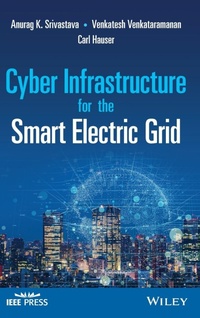
Cyber Infrastructure for the Smart Electric Grid
1st Edition
Published on 15. December 2022
Book
Hardback
192 pages
978-1-119-46075-6 (ISBN)
Description
Explore a thorough treatment of the foundations of smart grid sensing, communication, computation, and control
As electric power systems undergo a transformative upgrade with the integration of advanced technologies to enable the smarter electric grid, professionals who work in the area require a new understanding of the evolving complexity of the grid.
Cyber Infrastructure for the Smart Electric Grid delivers a comprehensive overview of the fundamental principles of smart grid operation and control, smart grid technologies, including sensors, communication networks, computation, data management, and cyber security, and the interdependencies between the component technologies on which a smart grid's security depends. The book offers readers the opportunity to critically analyze the smart grid infrastructure needed to sense, communicate, compute, and control in a secure way.
Readers of the book will be able to apply the interdisciplinary principles they've learned in the book to design and build secure smart grid infrastructure. Readers will also benefit from the inclusion of:
A thorough introduction to the key skills required by engineers to manage the evolving complexity of the electric grid
An exploration of the interdependencies of smart grid infrastructure required to sense, communicate, compute, control, and manage data securely
Software modules in .exe format for demonstrations and exercises
An examination of the fundamental principles of smart grid operation and control
Perfect for professionals working in the electric utility industries at electric utilities, vendors, and the national labs, Cyber Infrastructure for the Smart Electric Grid will also earn a place in the libraries of senior undergraduate and graduate students studying electrical engineering and smart grids.
As electric power systems undergo a transformative upgrade with the integration of advanced technologies to enable the smarter electric grid, professionals who work in the area require a new understanding of the evolving complexity of the grid.
Cyber Infrastructure for the Smart Electric Grid delivers a comprehensive overview of the fundamental principles of smart grid operation and control, smart grid technologies, including sensors, communication networks, computation, data management, and cyber security, and the interdependencies between the component technologies on which a smart grid's security depends. The book offers readers the opportunity to critically analyze the smart grid infrastructure needed to sense, communicate, compute, and control in a secure way.
Readers of the book will be able to apply the interdisciplinary principles they've learned in the book to design and build secure smart grid infrastructure. Readers will also benefit from the inclusion of:
A thorough introduction to the key skills required by engineers to manage the evolving complexity of the electric grid
An exploration of the interdependencies of smart grid infrastructure required to sense, communicate, compute, control, and manage data securely
Software modules in .exe format for demonstrations and exercises
An examination of the fundamental principles of smart grid operation and control
Perfect for professionals working in the electric utility industries at electric utilities, vendors, and the national labs, Cyber Infrastructure for the Smart Electric Grid will also earn a place in the libraries of senior undergraduate and graduate students studying electrical engineering and smart grids.
More details
Language
English
Place of publication
Hoboken
United States
Publishing group
John Wiley and Sons Ltd
Target group
Professional and scholarly
Dimensions
Height: 229 mm
Width: 152 mm
Thickness: 13 mm
Weight
449 gr
ISBN-13
978-1-119-46075-6 (9781119460756)
Copyright in bibliographic data and cover images is held by Nielsen Book Services Limited or by the publishers or by their respective licensors: all rights reserved.
Schweitzer Classification
Other editions
Additional editions
Anurag K. Srivastava | Venkatesh Venkataramanan | Carl Hauser
Cyber Infrastructure for the Smart Electric Grid
E-Book
11/2022
1st Edition
Wiley
€117.99
Available for download
Anurag K. Srivastava | Venkatesh Venkataramanan | Carl Hauser
Cyber Infrastructure for the Smart Electric Grid
E-Book
11/2022
1st Edition
Wiley
€117.99
Available for download
Person
ANURAG K. SRIVASTAVA, PhD, is an Associate Professor at the School of Electrical Engineering and Computer Science at Washington State University. He is also the Director of the Smart Grid Demonstration and Research Lab (SGDRIL) within the Energy System Innovation Center (ESIC). Dr. Srivastava is a senior member of the IEEE, secretary of IEEE PES PEEC committee, co-chair of the microgrid working group, and secretary of PES voltage stability working group. Dr. Srivastava is an associate editor of the IEEE Transactions on Smart Grid, editor of IET Generation, Transmission and Distribution, an IEEE distinguished lecturer, and the author of more than 200 technical publications.
CARL HAUSER, PhD, is an Associate Professor of Computer Science in the School of Electrical Engineering and Computer Science (EECS) at Washington State University (WSU). He holds degrees in computer science from Washington State University (B.S., 1975) and Cornell University (M.S., 1977, and Ph.D., 1980). His research interests include concurrent programming models and mechanisms, networking, and distributed computing systems.
DAVID BAKKEN, PhD, is a Professor of Computer Science at the Washington State University (WSU). He holds a BS degree in mathematics (1985), and degrees in computer science from WSU (BS 1985) and the University of Arizona (MS 1990 PhD 1994). His research interests include wide-area data delivery mechanisms for power grids, new kinds of middleware, and fault-tolerant distributed computing.
HAHN, PhD, is an assistant professor in the Department of Electrical Engineering and Computer Science at Washington State University. His research interests include cyber-security of the smart grid and cyber-physical systems (CPS), including intrusion detection, risk modeling, vulnerability assessment, and secure system architectures. He received the M.S. and Ph.D. degrees from the Iowa State University in 2006 and 2013.
CARL HAUSER, PhD, is an Associate Professor of Computer Science in the School of Electrical Engineering and Computer Science (EECS) at Washington State University (WSU). He holds degrees in computer science from Washington State University (B.S., 1975) and Cornell University (M.S., 1977, and Ph.D., 1980). His research interests include concurrent programming models and mechanisms, networking, and distributed computing systems.
DAVID BAKKEN, PhD, is a Professor of Computer Science at the Washington State University (WSU). He holds a BS degree in mathematics (1985), and degrees in computer science from WSU (BS 1985) and the University of Arizona (MS 1990 PhD 1994). His research interests include wide-area data delivery mechanisms for power grids, new kinds of middleware, and fault-tolerant distributed computing.
HAHN, PhD, is an assistant professor in the Department of Electrical Engineering and Computer Science at Washington State University. His research interests include cyber-security of the smart grid and cyber-physical systems (CPS), including intrusion detection, risk modeling, vulnerability assessment, and secure system architectures. He received the M.S. and Ph.D. degrees from the Iowa State University in 2006 and 2013.