


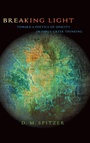
Breaking Light
Description

Discloses the ways in which opacity and relation in the thought of Thales, Anaximandros, and Anaximenes depart from the predominant understanding of philosophy as clarity.
In Breaking Light D. M. Spitzer discloses the ways in which opacity and relation orient the thought of Thales, Anaximandros, and Anaximenes. In so doing, Breaking Light departs from a predominant understanding of philosophy as constituted by the principle of clarity-a principle already operative in Plato's and Aristotle's interpretations of the shadowy figures from the Greek east identified as the first philosophers, the Milesians. Drawing on opacity and relation as articulated by Martinican thinker Édouard Glissant and enhanced by the insights of Martin Heidegger and contemporary feminisms in the (trans-)continental tradition(s), Breaking Light lets the central terms orienting Milesian thinking-¿d¿¿, ¿pe¿¿¿¿, ¿¿¿-radiate with the energies of provisionality, uncertainty, and abundance-of opacity. A comparative approach attends to figures like Pherekydes and texts from Egypt and the Near East that are understudied in the continental traditions.
More details
Other editions
Additional editions
Person
D. M. Spitzer is Lecturer of Arts and Humanities at Pennsylvania State University, Mont Alto. He is the author of Parmenides and Translation: Figures of Motion, Figures of Being and the editor of Studies in Ancient Greek Philosophy: In Honor of Professor Anthony Preus.
Content
Acknowledgments
Notes, Editions, and Abbreviations
Introduction: Breaking Light
1. Divining: Thalean ¿d¿¿
2. Spanning: Anaximandrean ¿pe¿¿¿¿
3. Hovering: Anaximenean ¿¿¿
Conclusion: Breaking Light, Unclosing Opacity
Bibliography
Index
