

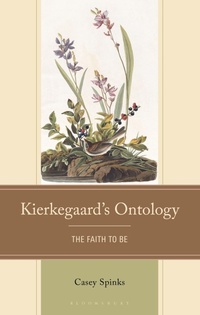
Kierkegaard's Ontology
The Faith to be
1st Edition
Published on 5. February 2026
240 pages
979-8-216-26406-4 (ISBN)
Description

What is it to be? And what is it to be a Christian? Casey Spinks suggests these two questions belong together when readers attend to Kierkegaard's authorship, and such attention calls for the task of uncovering Kierkegaard's fundamental ontology.
This book argues that the heart of that ontology is to be found in the religious discourses of his Second Authorship. Using the devotional discourse The Lily of the Field and the Bird of the Air as his guide, Spinks argues that Kierkegaard offers a distinct Christian sense of being: faith. In particular, in his Second Authorship, he moves from irony to earnestness, and identifies silence, obedience, and joy as ontologically significant categories. This Christian ontology fundamentally opposes the rationalist ontology of G.W.F. Hegel-as well as any other philosophical ontology based on autonomous reason or human subjectivity. As a result, Kierkegaard proves to be a unique Christian figure in the history of Western metaphysics, one with forceful relevance to contemporary questions of first philosophy and first theology.
This book argues that the heart of that ontology is to be found in the religious discourses of his Second Authorship. Using the devotional discourse The Lily of the Field and the Bird of the Air as his guide, Spinks argues that Kierkegaard offers a distinct Christian sense of being: faith. In particular, in his Second Authorship, he moves from irony to earnestness, and identifies silence, obedience, and joy as ontologically significant categories. This Christian ontology fundamentally opposes the rationalist ontology of G.W.F. Hegel-as well as any other philosophical ontology based on autonomous reason or human subjectivity. As a result, Kierkegaard proves to be a unique Christian figure in the history of Western metaphysics, one with forceful relevance to contemporary questions of first philosophy and first theology.
More details
Series
Edition
1. Auflage
Language
English
Place of publication
New York
United States
Publishing group
Bloomsbury Publishing Plc
Target group
College/higher education
ISBN-13
979-8-216-26406-4 (9798216264064)
Copyright in bibliographic data and cover images is held by Nielsen Book Services Limited or by the publishers or by their respective licensors: all rights reserved.
Schweitzer Classification
Other editions
Additional editions
Book
04/2026
Rowman & Littlefield
€118.10
Shipment within 3-4 weeks
Person
Casey Spinksis teaching postdoctoral fellow of religion at Baylor University, USA.
Content
Preface
Acknowledgments
A Note on Abbreviations
Part One: Introduction
Being and the Essentially Christian
Part Two: Being an Ontological Writer
Chapter Two: (Not) Being a Knower
Chapter Three: Being Edified
Part Three: Being-In-Itself: Silence
Chapter Four: Being Silent
Chapter Five: Against Being Bound to Human Speech
Part Four: Being-For-Itself: Obedience
Chapter Six: Being Obedient
Chapter Seven: Against Being a Master
Part Five: Being-In-And-For-Itself: Joy
Chapter Eight: Being Joy
Chapter Nine: Against Being in Despair
Part Six: Conclusion
The End of the Path of Thinking
Bibliography
Index
Acknowledgments
A Note on Abbreviations
Part One: Introduction
Being and the Essentially Christian
Part Two: Being an Ontological Writer
Chapter Two: (Not) Being a Knower
Chapter Three: Being Edified
Part Three: Being-In-Itself: Silence
Chapter Four: Being Silent
Chapter Five: Against Being Bound to Human Speech
Part Four: Being-For-Itself: Obedience
Chapter Six: Being Obedient
Chapter Seven: Against Being a Master
Part Five: Being-In-And-For-Itself: Joy
Chapter Eight: Being Joy
Chapter Nine: Against Being in Despair
Part Six: Conclusion
The End of the Path of Thinking
Bibliography
Index
