

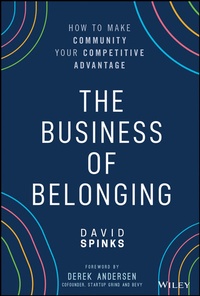
The Business of Belonging
Description

'A tactical primer for any business embarking on the critical work of actively building community.'-Seth Godin, Author, This is Marketing
'This book perfectly marries the psychology of communities, with the hard-earned secrets of someone who's done the real work over many years. David Spinks is the master of this craft.'-Nir Eyal, bestselling author of Hooked and Indistractable
The rise of the internet has brought with it an inexorable, almost shockingly persistent drive toward community. From the first social networks to the GameStop trading revolution, engaged communities have shown the ability to transform industries. Businesses need to harness that power. As business community expert David Spinks shows in The Business of Belonging: How to Make Community your Competitive Advantage, the successful brands of tomorrow will be those that create authentic connection, giving customers a sense of real belonging and unlocking unprecedented scale as a result.
In his career of over 10 years in the business of building community, Spinks has learned what a winning community strategy looks like. From the fundamental concepts-including how community drives measurable business value and what the appropriate metrics are-to high-level community design and practical engagement techniques, The Business of Belonging is an epic journey into the world of community building.
This book is for decision makers who want to better understand the value and opportunity of community, and for community professionals who want to level up their strategy. Featuring a foreword by Startup Grind and Bevy cofounder Derek Andersen, it will give you a step-by-step model for strategically planning, creating, facilitating, and measuring communities that drive business growth. Attracting and retaining community members who are also loyal customers, brand evangelists, and leaders-that's the goal for today's connected businesses, and this book is the map to getting there.
David Spinks is Cofounder of CMX, a 20,000 member organization dedicated to helping community professionals thrive. David is also the VP of Community at Bevy, an enterprise software platform that powers event-driven community programs and virtual conferences, following its acquisition of CMX in 2019. David has personally advised and trained hundreds of organizations in community strategy, including Facebook, Waze, Salesforce, Airbnb, and Google.
More details
Other editions
Additional editions
Person
Content
Introduction xiii
Becoming a Community Professional xv
Building the Community Industry xvi
The Community Era Has Arrived xviii
Notes xix
Chapter 1 Why Community is the New Competitive Advantage 1
A Customer Community is Born 1
The Rise of Community-Driven Business 3
Giving Customers a True Sense of Community 6
The Unrivaled Scalability of Community 8
Community is an Extension of Your Team 10
The Power of Owning a Topic in People's Minds 12
The One Thing They Can't Copy 13
Good for Business, Good for Humanity 14
Notes 17
Chapter 2 The Fundamentals of Community Strategy 19
The Three Levels of Community Strategy 19
The SPACES Model: The Six Business Outcomes of Community 22
Metrics and the Attribution Challenge 35
Finding Your Community Focus 36
Growth Engines vs. Cost Centers 39
Choosing a Measurement Framework 42
The Community Investment Journey 45
Notes 53
Chapter 3 Creating a Social Identity 55
The Social Identity Cycle 55
Who is Your Community Built For? 60
Who Doesn't Belong? 63
Investing in Diversity, Equity, and Inclusion from Day One 65
What is Your Community's Personality? 68
How Can You Make Your Members Feel "Cool"? 70
Should Your Community Have a Unique
Identity from Your Company Brand? 72
Finding Sub-Identities within Your Community 74
Defining Identity by Levels of Contribution 76
Notes 78
Chapter 4 Mapping the Community Participation Journey 79
The Commitment Curve 79
The Four Levels of Participation 81
How to Attract Members to Your Community 86
Creating Intentional Barriers to Entry 89
Designing a Compelling Onboarding Experience 90
How to Move Members Up the Commitment Curve 92
Activating Successful Community Leaders 94
Notes 96
Chapter 5 Validation, Rewards, and Incentives 97
Creating Habits with Rewards 97
Extrinsic vs. Intrinsic Motivations 99
Avoid Replacing Social Norms with Market Norms 101
SNAP! A Framework for Effective Extrinsic Rewards 102
The Thing about Gamification 105
Come for the Utility, Stay for the Unity 107
Measuring Community Health and Engagement Using the Social Identity Cycle 108
Notes 114
Chapter 6 Designing Community Spaces and Experiences 115
The Two Kinds of Community Experiences 115
Repetition, Repetition, Repetition 117
The 7Ps of Community Experience Design 120
Curating the Right People for the Right Purpose 123
Aligning Size with Purpose 124
Choosing Community Software Platforms 126
Should You Host Your Community on a Free Social Network? 129
Designing Spaces That Make People Feel Seen 130
Starting with a BANG! 131
Creating Peak Moments 133
Facilitating Small-Group Discussions 135
Tell Your Members How to Participate 138
How to Get Members to Be Open and Vulnerable 140
Keep Your Rules Short and Simple to Start 143
My Three Go-To Community Rules 145
Using Metrics to Optimize Community Spaces and Experiences 148
Notes 151
Chapter 7 Activating Community Engagement 153
Engagement is a Constant Experiment 153
Personal Invitations and "Doing Things That Don't Scale" 154
Ask for Permission 157
Don't Fear the Crickets 158
Talk Funny 160
How to Spark Great Debates 162
Moderation is Never Personal 164
Default to Transparency and Admit Your Mistakes 166
Use Your Authentic Voice 167
Keep Your Energy High and Positive 169
Go Forth and Build Community! 173
Bibliography 175
About the Author 177
Acknowledgments 179
Index 181
Chapter 1
Why Community Is the New Competitive Advantage
What does it actually mean for a business to build community? It's such a broad term that's used in so many different ways, it's always difficult to nail down. In every conversation I have with a company asking for advice on their community strategy, I always kick off by asking, "Why are you investing in community?" The majority of the time, this is the first time anyone at the company has had to articulate an answer to that question.
So we're going to start there. In this chapter, I'm going to give you some working definitions of community, we'll talk about the history of businesses investing in community, and I'll help you understand why it's becoming such a prominent part of the conversation today. I'll also share some big-picture concepts that explain why community is such a powerful force for businesses. We're starting high-level, and will get more and more specific as we move through the book.
Let's start off with some history.
A Customer Community Is Born
Business has been moving in the direction of community for a long time now. In fact, if you go looking for the very first time a business built a community team, you'd have to go back to the early days of the internet.
Apple pioneered a new wave of computing. But did you know it was also the very first company to have a community team and build a customer community program?
There weren't many places for people to talk to each other online when Ellen Petry Leanse joined the company in 1981 as a communications specialist, just five years after the company was founded. In 1985, after the Mac launched, Apple was dealing with frustration at the hands of its users - especially those who had committed to the Apple II in the years before the Mac. As the company pivoted toward the Mac in 1984, they felt abandoned, and most of the feedback received from customers came in the form of printed letters mailed to their office.
Leanse would respond to these letters directly and started noticing that a lot of the letters had a code on them. When she asked the customers about the codes, she learned that they were access codes for BBS groups (bulletin board systems). Unbeknownst to Apple, their customers were already gathering online on one of the earliest forms of internet forums, and talking about their products.
Leanse saw an opportunity. She advocated - against resistance, since "going online" was uncharted territory for any tech enterprise at that time - for establishing their own BBS node and sharing information from Apple directly with its user communities. Suddenly they were connected with a global community of customers.
It was an uphill battle for Leanse. If you think engaging in online communities is unfamiliar territory for businesses today, you can imagine what it felt like back then. Participating in communities with customers just wasn't something businesses did. Even Apple, who's well known for breaking the mold, was hesitant, largely viewing users as a "cost," not a benefit.
Ellen fought for making a real investment in community. She would spend a lot of time talking to customers, gathering their feedback, and sharing it internally. After a lot of advocacy, she found a believer in Apple's CEO, John Sculley, who backed taking the voice of users seriously. With his support, the "Apple User Group Connection" was born, led by Leanse. "I was fortunate enough to be chosen to make this connection, and I couldn't have done it alone - but I did fight for it alone", said Leanse. "no one knew anything about it until after I started sharing with users and harnessing the power of their input."
The AUGC was a hit, bringing together Apple users from around the world and providing a channel for their voice to be heard. Sculley would host digital discussions in the user groups, sharing updates with users and listening to their feedback. It opened up the curtains in a way businesses just didn't do at that time, and it helped Apple turn the corner on improving customer sentiment.
"We felt it start to humanize the company at a time when technology was all about the machine," says Leanse.
It was a revolutionary mentality for a business to adopt at the time, and a preview of what was to come.
The Rise of Community-Driven Business
Apple was early to identify an important trend that would accelerate over the next few decades: the growing power of the customer.
Back when customers couldn't talk to each other or research products (unless they were more technical and could use tools like BBS groups), companies didn't have to prioritize customer support. If customers had a bad experience, they wouldn't be able to tell too many other people about it.
That all changed when customers could suddenly talk to each other online using social networks. They could now share reviews of products, "word of mouth" was accelerated, and positive or negative sentiment could spread like wildfire.
This led to the huge customer service trend, led by companies like Zappos and Amazon. In his book Delivering Happiness, Zappos CEO Tony Hsieh recalled the radical perspective they had on growing the business. "Our philosophy [was] to take most of the money we would have spent on paid advertising and invest it into customer service and the customer experience instead, letting our customers do the marketing for us through word of mouth."1
This was unheard of at the time, and it worked! Zappos would grow to be the internet's largest shoe retailer, and it sparked a revolution in how businesses would look at customers. Putting the customer first became a competitive advantage.
This trend grew as social networks continued to give consumers more power and access. Companies started hiring full content and social media teams to build trust and to connect more personally with customers. "Inbound marketing" and "customer success" was born to proactively invest in helping customers succeed. Businesses started making it a priority to help customers more successfully use their products, improve their skills, and grow in their careers, knowing that a more successful customer is a more loyal customer.
But it was still very much one-to-one and "one-to-many" communication. It would be a company rep talking to a customer directly, or creating content that would be distributed to a large audience. What most companies were failing to do, save for a few exceptions like Apple, was create spaces for "many-to-many" communication. With one-to-one, you're limited by how many people you can form deep trust and connection with. With one-to-many communication, you can reach more people, but will lack depth. With many-to-many communication, there is no limit.
That's why we're now seeing customer support and content marketing give way to a new era of customer relationships: the customer community.
This next phase is all about helping customers and other stakeholders connect to each other. Companies are setting themselves apart by tapping into the collective energy, knowledge, and contributions of your most passionate customers, fans, and partners. When people feel like they're a part of a community it becomes their home. They don't want to leave. And they'll step up to contribute and grow the community in ways you can't imagine.
There are few better examples of companies who have tapped into the power of community than Salesforce. Erica Kuhl spent the majority of her 17 years at Salesforce building the community program from the ground up. Kuhl once described herself to me as a "bulldog" who would not give up on something she believed in. She certainly didn't when it came to community. Much like Ellen Leanse at Apple, the company didn't "get it," and she fought a long, uphill battle to get leadership to understand what it meant to build community and why it was such a big opportunity. Lucky for Salesforce, they trusted her and gave her a chance to prove it.
She knew that the only true way to get buy-in was with data, and she made it a priority to show how community could impact the bottom line. Whenever she took on a new community project, she made sure it would be something she could measure, and tie back to ROI.
Over the years she was able to show how community reduced support costs, increased product adoption, and increased customer spend and retention. She would become Salesforce's first VP of Community and community would get woven into the fabric of every product at Salesforce. There are now over 3,000,000 members in the Salesforce Trailblazer community supporting and educating each other in how to better use the product and grow in their careers. Recent research conducted by the company showed that 82 percent of its customers found that the community increased the ROI of their investment in Salesforce's tools, and 93 percent said that it helped them find new products and tools they could use in the Salesforce product suite.
Every day, we're seeing more examples of companies driving incredible results by building community. One recent study showed that over half of the Fortune Global 50 and the 50 highest-valued startups in the world are investing in community programs.2
Newer companies that have risen in the community-driven business era have...
