

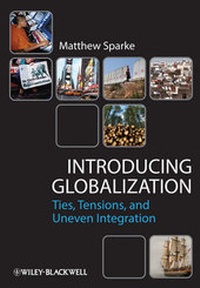
Introducing Globalization
Ties, Tensions, and Uneven Integration
Published on 5. December 2012
512 pages
978-1-118-24111-0 (ISBN)
Description

Designed specifically for introductory globalization courses,Introducing Globalization helps students to develop informedopinions about globalization, inviting them to become participantsrather than just passive learners.
* Identifies and explores the major economic, political andsocial ties that comprise contemporary global interdependency
* Examines a broad sweep of topics, from the rise oftransnational corporations and global commodity chains, to globalhealth challenges and policies, to issues of worker solidarity andglobal labor markets, through to emerging forms of global mobilityby both business elites and their critics
* Written by an award-winning teacher, and enhanced throughout bynumerous empirical examples, maps, tables, an extendedbibliography, glossary of key terms, and suggestions for furtherreading and student research
* Supported by additional web resources - available uponpublication at www.wiley.com/go/sparke- including hot links to news reports, examples ofglobalization and other illustrative sites, and archived examplesof student projects
Engage with fellow readers of Introducing Globalizationon the book's Facebook page at www.facebook.com/IntroducingGlobalization,or learn more about this topic by enrolling in the free Courseracourse Globalization and You at www.coursera.org/course/globalization
Reviews / Votes
"A comprehensive overview of the topic of globalization... it is clearly written and provides a good framework for students...a fine contribution to the emerging body of scholarship that seeks to weigh the arguments about globalization's spatiality." AAG Review of Books "Sparke models inquiry into taken-for-granted concepts or events through rich understanding and questioning. More importantly, he reframes spatial theory as the starting point of social studies conversations about globalization. Rather than accept the inevitability of globalization, he depicts the inevitability of inequity. He examines how inequities become actualized in lives through geopolitical and geoeconomic infrastructure. He encourages us to reconsider the relationships between disciplines, contending that disciplined inquiry enables simplistic understanding. He allows geography and spatial theory to be a way of understanding the world, a lens that resonates across the social studies. The book importantly segments a variety of explanatory moments to allow readers without a strong economics background to understand economic principles. It is a lack of economic understanding that makes global policy discussions unintelligible to the general public. In the process, he ultimately constructs the globally minded citizen. While his brand of global thinking (and citizenship) has a problematic Western perspective, it also utilizes a critical lens that requires awareness of these contradictions and their implications for ourselves and others. The spatial thinking highlighted throughout this review relies on thinking across the disciplines to attend to how, where, and why places are constructed independently and interdependently across scales and time. Rather than assuming that places are knowable, rejecting the three myths encourages questions about what has been made invisible, how new places come to exist, the kinds of interactions that occur therein, and how they reify and amend cultural and other discourses." (Theory & Research in Social Education, 19 February 2015) "Finally, a globalization text that takes its subjectseriously yet simultaneously explores the myths that surround it.Matt Sparke relates the two 'levels' or ways ofthinking about globalization as a material phenomenon and as apolitical project. This not only makes for a refreshingly noveltake on globalization, one that other introductory books manifestlyfail to achieve as they go one way or the other... it does so in anaccessible manner."--John Agnew,UCLA "This text is written by an extremely well qualifiedgeographer who has experienced globalization in all itsmulti-faceted dimensions and has taught generations of his studentsabout its inherent tensions and divisions. Its coverage isextensive and yet detailed; its well-researched content constantlychallenges us to think critically about globalization; and itsend-of-chapter exercises are great fun to work with. These are allthe hallmarks of a superb text. I recommend itwholeheartedly!"--Henry Yeung, National Universityof Singapore "Written with passion, lucidity, and rigor, [this is a]rare text, making accessible to a generation of globally-orientedstudents the complex and urgent debates about globalization and theempirical and analytical research that can inform suchdebates."--Ananya Roy, University of California,BerkeleyMore details
Other editions
Additional editions
Book
01/2013
Wiley
€33.90
Shipment within 15-20 days

Book
01/2013
1st Edition
Wiley
€121.75
Shipment within 15-20 days
Person
Matthew Sparke is Professor of Geography andInternational Studies at the University of Washington, where healso serves as the Director of the undergraduate program in GlobalHealth. He has authored over 60 scholarly publications,including the book In the Space of Theory (2005), but he isalso dedicated to teaching about globalization as well as writingabout it. He has multiple awards for his work as a teacher,including the lifetime Distinguished Teaching award from theUniversity of Washington.
Content
List of Figures vii
List of Tables ix
Preface xi
1 Globalization 1
2 Discourse 27
3 Commodities 57
4 Labor 99
5 Money 139
6 Law 181
7 Governance 227
8 Space 279
9 Health 337
10 Responses 389
Glossary 417
Index 473
