

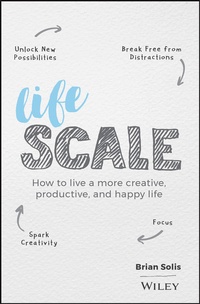
Lifescale
Description

It's time to reclaim our lives. It's time to take control.
Lifescale is a journey of self-discovery and growth. It's about getting back into balance and remastering our destinies. Author Brian Solis knows first-hand. He struggled with distraction and all of its ill-effects. To get his life back, he developed a set of techniques, exercises, and thought experiments designed to tame the chaos, and positively and productively navigate our day-to-day lives. Instead of falling victim to the never-ending cycle of newsfeeds, Likes, addictive apps, and boredom scrolling (aka the endless scroll), we can learn to manage our time and inspire our own lives in a way that will bring meaning back--without sacrificing the benefits that our devices bring us.
In Lifescale, Brian has done the legwork to pull together scientific findings and practical tools into one book. Readers--especially those who are distracted--will connect with the humor, pathos, and inspiration inside. Using this book's simple but powerful lessons, we can:
* Identify sources of distraction and turn attention toward creativity and productivity
* Understand and resist the manipulative techniques that turn us into digital addicts
* Find meaning and purpose to guide our time in more meaningful ways
* Visualize future success to successfully dive into deep work and stop procrastinating
* Break bad habits, establish rituals, and establish routines that help you achieve goals
* Nurture imagination and learn to express ourselves more artistically
* Maximize productivity with simple but effective strategies
* Focus for extended periods and make breaks more restorative
* Foster a strong sense of purpose in life and identify the steps needed to bring it to life every day
* Smile more and build self-esteem
With the renewed perspective Lifescale offers, we can finally learn to prioritize what matters, and live our digital and physical lives with intention and true happiness.
More details
Other editions
Additional editions
Content
Chapter 2
Awaken
The Gift of Awareness Is a Gift We First Give Ourselves, then Everyone Else
"Raise your awareness and share your uniqueness to the world."
- Amit Ray
Digital distraction is not something we were prepared for. Generations of education, parenting, management, and absorbing everyday ethics and norms couldn't have prepared us for the onslaught of information, showers of attention, celebration of self-interest and selfishness, and the flooding of egocentric emotions.
We didn't mean to become addicted. As with cigarettes in the early days, we didn't understand that our digital indulgences were made to be addictive, and we didn't have information about the health effects-on our bodies, emotions, and psyches.
The Path to Distraction: How Did We Get Here?
I'm sure you have sometimes caught yourself in the mindless pattern of an "endless scroll," where you, without even thinking, scrolled and scrolled and scrolled, viewing and reacting to content, not because you wanted to, but because you couldn't help yourself. There's a reason for that.
Our attention is traded as a commodity and the more of it we spend on any given platform or device, the more these hosts can sell it for.
As a geek apologist who championed Web 2.0, social media, and mobile apps, I was a hopeless optimist. Through my work I advised organizations, governments, institutions, and individuals on ways to best use these technologies for good. Over time, however, novices, opportunists, spammers, scammers, and eventually, villains, found insidious ways to gobble up our attention and capitalize on it. Some intentionally, and others unintentionally, exploited discoveries about how we could be manipulated to spend more and more time with their enticements.
Mark Zuckerberg, Steve Jobs, Twitter founders Evan Williams and Jack Dorsey, Snapchat founder Evan Spiegal, and the other leaders of web innovation played an intentional and influential role in capitalizing on human vulnerabilities. There are two ways to readily influence behavior: (1) manipulate it or (2) inspire it. The technology companies have chosen, for the most part, to manipulate it.
The attention economy has been wildly lucrative. No wonder; our attention is finite, which creates limited supply and great demand. Netflix CEO Reed Hastings once said the company's number one competitor was sleep. "And, we're winning!" he proudly exclaimed to shareholders.1 The attention economy is no mere metaphor; our attention is traded as a commodity and the more of it we spend on any given platform or device, the more those hosts can sell it for.
Justin Rosenstein, one of the four Facebook designers behind the "Like" button, explained the potential and danger of social rewards in an interview with Vice.2 "The main intention I had was to make positivity the path of least resistance. And I think it succeeded in its goals, but it also created large unintended negative side effects. In a way, it was too successful."
Persuasive design is a methodology that focuses on influencing human behavior through a product or service's characteristics.3 Many of today's digital methodologies were honed and taught by B.J. Fogg, a behavior scientist who is the founder and director of the Stanford Behavior Design Lab. He's also been called the millionaire maker as his work has inspired many of his students to create some of the world's addictive, and therefore more lucrative apps, games, and networks.4 Defenders of these approaches state that they can also have positive effects on behavior, such as training people to take medicine regularly, develop weight loss habits, or learn new skills or subjects. However, it seems that harm is potentially outweighing good. In April 2018, 50 psychologists signed a letter to the American Psychological Association accusing psychologists working at tech companies of using persuasive design and to ask the APA to take an ethical stance on behalf of children.5
Developers knowingly use persuasive casino tricks and many exploitive design techniques that are directly linked to addiction in the games, networks, apps, and devices we use. These hidden "manipulation techniques" are used to hold our attention so it can be monetized.6
To influence behavioral change, you need motivation, ability, and triggers. For example, in social media, motivation can come in the form of people's need for attention, engagement, and social connection or on the other side, as the fear of missing out, or FOMO. Triggers include likes, comments, and connection requests. Research has shown that these triggers release delightful hits of chemical stimulants in our brains, such as oxytocin, serotonin, dopamine, and endorphins.
Did you know slot machines make more money in the United States than baseball, movies, and theme parks combined? According to NYU professor Natasha Dow Schull, author of Addiction by Design, slot machines are designed to addict. In her research, she found that people get "problematically involved" with slot machines three to four times faster than other forms of gambling.7
Slot machines are so addictive because they employ another psychological technique for enrapturing us, called intermittent variable rewards.8 When you pull a lever, you hope to win a prize or reward. This is an intermittent action linked to a variable reward. The variable here is that you may win or, most likely, you may not win. The designer's goal is to keep you playing that machine in the hopes that you're going to win.
Former Google engineer Tristan Harris explains, "You pull a lever and immediately receive either an enticing reward (a match, a prize!) or nothing. Addictiveness is maximized when the rate of reward is most variable."9 Software designers have incorporated this trick into all sorts of their products.
When you open your favorite app, check your email, and endlessly scroll or swipe, you're subconsciously trying to "win" something. But ask yourself, what exactly are you trying to win?
The manipulation is more obvious in the design of video games, which employ this as well as other addictive tactics. They offer all sorts of overt prizes for navigating their gauntlet of obstacles, but the real prize driving addiction to them is self-esteem. Richard Freed is a child and adolescent psychologist and the author of Wired Child: Reclaiming Childhood in a Digital Age.10 He's discovered that video games are so addictive for boys because they have a particularly strong developmental drive to rack up accomplishments. All of the hidden cash boxes and points rewards they get, he explains, are designed "to make them feel like they are mastering something." The irony being that, as he says, this leads to "bad [gaming] habits and statistically poor academic performance."11
Another psychological hijack is social reciprocity. If someone pays you a compliment, for example, you feel the need to return the compliment. Or, if you ask for a favor, at some point, you will return that favor. If someone says, "Thank you," you feel compelled to respond with, "You're welcome." This can play out in digital life, as well. If you send an email, it's discourteous if the recipient doesn't reply right away. If you follow someone online, it's disrespectful (and even hurtful) if they don't follow you back.
When you open your favorite app, check your email, and endlessly scroll or swipe, you're subconsciously trying to "win" something.
This is why networks, for example, notify you when someone tags you in a post or lets you know when someone "read" your message. Or, when you send a message, you can see the wavering dots when someone is replying to you. And in some apps, you can see how long it's been since you've interacted with someone. You feel anticipation and pressure to stay engaged, to respond, to check back, to interact.
The anticipation of the experience is sometimes more powerful (and dangerous) than the experience itself. These engagement tricks or hacks are driving more usage than enjoyment. All the while, your attention is for sale. This is presumably why Bill Gates and Steve Jobs raised their kids tech-free.12
The technology companies have been engaged in a form of psychological warfare, competing in every way they can think of for our attention by exploiting our minds' weaknesses. It's only getting more competitive and, as a result, more dangerous. Ramsay Brown, the COO of start-up Dopamine Tech, admitted in an interview that his team uses artificial intelligence and neuroscience to make you even more addicted to your phone.13
"We use AI and neuroscience to increase your usage . . . make apps more persuasive . . . it's not an accident. It's a conscious design decision. We're designing minds. The biggest tech companies in the world are always trying to figure out how to juice people."
In 2017 and 2018, the proverbial you-know-what hit the fan about all of this manipulation. Suddenly, all of technology's secrets were...
