

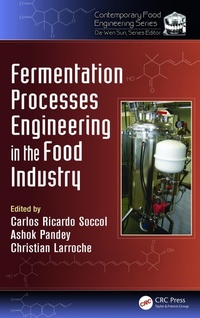
Fermentation Processes Engineering in the Food Industry
1st Edition
Published on 27. March 2013
510 pages
978-1-4398-8768-4 (ISBN)
Description

With the advent of modern tools of molecular biology and genetic engineering and new skills in metabolic engineering and synthetic biology, fermentation technology for industrial applications has developed enormously in recent years. Reflecting these advances, Fermentation Processes Engineering in the Food Industry explores the state of the art of the engineering technology aspects of fermentation processes in diverse food sectors.
The book describes the benefits of fermented foods in human health in both dairy and non-dairy products and beverages. It examines applications of microalgae in the food industry and explains the application of metabolic engineering in the production of fermented food ingredients. Exploring a host of important topics in engineering fermentation processes, the book covers topics such as:
Methods and techniques for the isolation, improvement, and preservation of the microbial cultures used in the food fermentation industry
The fundamentals of fermentation processes, modes of fermentation, and the principles of upstream operation
Physical and chemicals factors that affect fermentation processes
Different types of fermenters employed in submerged and solid-state fermentation
Unitary operations for solid-liquid separation, concentration, and drying of fermented foods
Instrumentation and control of industrial fermentation processes
The final chapter discusses the potential application of a biorefinery concept to add value to food industry wastes and presents a case study describing an integrated project in which the concept was applied.
An essential reference for all food sector professionals, this volume surveys critical trends in the food, beverage, and additive industry and explores the sustainability of these processes.
The book describes the benefits of fermented foods in human health in both dairy and non-dairy products and beverages. It examines applications of microalgae in the food industry and explains the application of metabolic engineering in the production of fermented food ingredients. Exploring a host of important topics in engineering fermentation processes, the book covers topics such as:
Methods and techniques for the isolation, improvement, and preservation of the microbial cultures used in the food fermentation industry
The fundamentals of fermentation processes, modes of fermentation, and the principles of upstream operation
Physical and chemicals factors that affect fermentation processes
Different types of fermenters employed in submerged and solid-state fermentation
Unitary operations for solid-liquid separation, concentration, and drying of fermented foods
Instrumentation and control of industrial fermentation processes
The final chapter discusses the potential application of a biorefinery concept to add value to food industry wastes and presents a case study describing an integrated project in which the concept was applied.
An essential reference for all food sector professionals, this volume surveys critical trends in the food, beverage, and additive industry and explores the sustainability of these processes.
More details
Series
Edition
1. Auflage
Language
English
Place of publication
Baton Rouge
United States
Publishing group
Taylor & Francis Inc
Target group
College/higher education
Food engineers working on fermentation bioreactors, food scientists, and industry personnel in the fields of food fermentation, food biotechnology, and product development and regulators and government researchers in US FDA, USDA, and UK FSA regulatory agencies.
Illustrations
95 s/w Abbildungen, 22 s/w Tabellen
95 b/w images and 22 tables
File size
8,36 MB
ISBN-13
978-1-4398-8768-4 (9781439887684)
Copyright in bibliographic data and cover images is held by Nielsen Book Services Limited or by the publishers or by their respective licensors: all rights reserved.
Schweitzer Classification
Other editions
Additional editions
Carlos Ricardo Soccol | Ashok Pandey | Christian Larroche
Fermentation Processes Engineering in the Food Industry
Book
10/2016
CRC Press
€133.69
Shipment within 10-20 days
Carlos Ricardo Soccol | Ashok Pandey | Christian Larroche
Fermentation Processes Engineering in the Food Industry
Book
03/2013
1st Edition
CRC Press
€340.45
Shipment within 15-20 days
Persons
Carlos Ricardo Soccol is the research group leader of the Department of Bioprocess Engineering and Biotechnology (DEBB) at the Federal University of Parana, Brazil. He has 20 years of experience in biotechnological research and development of bioprocesses with industrial application. His research interests are in science and food technology, with emphasis on agroindustrial and agroalimentary biotechnology, bioprocess engineering, solid-state fermentation, submerged fermentation, bioseparations, industrial bioprocesses, enzyme technology, tissue culture, bioindustrial projects, and bioproduction.
Ashok Pandey
is deputy director and head of the Center for Biofuels and Biotechnology Division the National Sugar Institute, Kanpur, India. Professor Pandey's current research areas are in bioprocesses and product development, mainly focused on agro-industrial solid waste utilization for the production of biofuels, biopolymers, and industrial enzymes.Christian Larroche
is the director of Polytech Clermont-Ferrand, Graduate School of Engineering of University Blaise Pascal. His research interests are in the areas of applied microbiology and biochemical engineering, focusing on the study and development of special processes for the use of microorganisms. This includes fungal spores produced by solid-state cultivation and their use as protein (enzyme) reservoirs in biotransformations.
Ashok Pandey
is deputy director and head of the Center for Biofuels and Biotechnology Division the National Sugar Institute, Kanpur, India. Professor Pandey's current research areas are in bioprocesses and product development, mainly focused on agro-industrial solid waste utilization for the production of biofuels, biopolymers, and industrial enzymes.Christian Larroche
is the director of Polytech Clermont-Ferrand, Graduate School of Engineering of University Blaise Pascal. His research interests are in the areas of applied microbiology and biochemical engineering, focusing on the study and development of special processes for the use of microorganisms. This includes fungal spores produced by solid-state cultivation and their use as protein (enzyme) reservoirs in biotransformations.
Content
Applications of Metabolic Engineering in the Production of Fermented Foods and Food Ingredients. Isolation, Improvement, and Preservation of Microbial Cultures. Physical and Chemical Factors Affecting Fermentation in Food Processing. Upstream Operations of Fermentation Processes. Theoretical Tools to Predict Physicochemical Properties of Industrial Foods and Cultivation Media. Characterization of Bioreactors Using Computational Fluid Dynamics. Laboratory and Industrial Bioreactors for Submerged Fermentations. Laboratory and Industrial Bioreactors for Solid-State Fermentation. Downstream Operations of Fermented Products. Instrumentation and Control of Industrial Fermentative Processes. Fermented Foods and Human Health Benefits of Fermented Functional Foods. Industrial Fermentation for Production of Alcoholic Beverages. Production of Dairy Products. Dairy and Nondairy Probiotic Products and Beverages. Bioadditives Produced by Fermentation. Microalgae for Food Production. Biorefinery Concept Applied to Valorization of Agro-Food Coproducts and Wastes: Integrated Process for Waste Recycling and Effluent Treatment. Index.
