

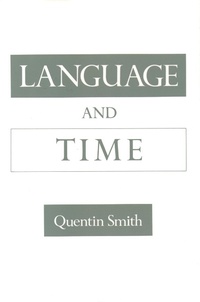
Language and Time
1st Edition
Published on 1. August 2002
273 pages
978-0-19-534818-7 (ISBN)
Description

This book offers a defense of the tensed theory of time, a critique of the New Theory of Reference, and an argument that simultaneity is absolute. Although Smith rejects ordinary language philosophy, he shows how it is possible to argue from the nature of language to the nature of reality. Specifically, he argues that semantic properties of tensed sentences are best explained by the hypothesis that they ascribe to events temporal properties of futurity, presentness, or pastness and do not merely ascribe relations of earlier than or simultaneity. He criticizes the New Theory of Reference, which holds that "now" refers directly to a time and does not ascribe the property of presentness. Smith does not adopt the old or Fregean theory of reference but develops a third alternative, based on his detailed theory of de re and de dicto propositions and a theory of cognitive significance. He concludes the book with a lengthy critique of Einstein's theory of time. Smith offers a positive argument for absolute simultaneity based on his theory that all propositions exist in time. He shows how Einstein's relativist temporal concepts are reducible to a conjunction of absolutist temporal concepts and relativist nontemporal concepts of the observable behavior of light rays, rigid bodies, and the like.
More details
Other editions
Additional editions

Quentin Smith
Language and Time
Book
09/1993
Oxford University Press Inc
€40.31
Article exhausted; check different version
Content
- Intro
- Contents
- I. The Argument for the Tensed Theory of Time
- 1. The Translation Method and the Tensed and Tenseless Theories of Time
- 1.1. The Translation Method
- 1.2. The Old Tenseless Theory of Time
- 1.3. The New Tenseless Theory of Time
- 1.4. The A Priori Version of the Nonsemantic Tenseless Theory of Time
- 1.5. The A Posteriori Version of the Nonsemantic Tenseless Theory of Time
- 2. The Untranslatability of A-Sentences by Tenseless Date-Sentences
- 2.1. The Date Theory of A-Sentences
- 2.2. The Truth Conditions of A-Sentence-Tokens and Tenseless Date-Sentences
- 2.3. The Confirmation Conditions of A-Sentence-Tokens and Tenseless Date-Sentences
- 2.4. The Entailment Relations of A-Sentence-Tokens and Tenseless Date-Sentences
- 2.5. The Logical Identities of A-Sentence-Tokens and Tenseless Date-Sentences
- 2.6. A Similarity Between A-Sentence-Tokens and Tenseless Date-Sentences: Intersubstitutivity in Extensional Contexts
- 3. The Untranslatability of A-Sentences by Tenseless Token-Reflexive Sentences
- 3.1. The Old and New Token-Reflexive Theories of A-Sentences
- 3.2. The Truth Conditions of A-Sentences and Tenseless Token-Reflexive Sentences
- 3.3. The Confirmation Conditions of A-Sentences and Tenseless Token-Reflexive Sentences
- 3.4. The Entailment Relations of A-Sentences and Tenseless Token-Reflexive Sentences
- 3.5. The Logical Identities of A-Sentences and Tenseless Token-Reflexive Sentences
- 3.6. The Psychological Theory of A-Sentences
- 4. The Tensed Theory of A-Sentences
- 4.1. The Transition to Positive Arguments for the Tensed Theory of Time
- 4.2. Outline of the Argument That A-Sentences Express A-Propositions
- 4.3. The Tensed Explanation of the Tenseless Token-Reflexive Rules of A-Sentence-Tokens
- 4.4. The Tensed Explanation of the Tenseless Token-Independent Rules Governing the Propositions Expressed by A-Sentence-Tokens
- 4.5. The Tensed Explanation of A-Indexicals and their Relation to A-Nonindexicals
- 4.6. The Tensed Theory of Temporal Quasi Indicators
- 4.7. The Cognitive Significance of A-Indexicals
- II. The Argument for Presentism
- 5. Presentness as a Logical Subject of A-Sentences
- 5.1. The Theory of Presentism
- 5.2. A Preliminary Analysis of Property Ascription
- 5.3. The Conveyance Relation
- 5.4. Two Species of the Prepositional Relation
- 5.5. Direct and Indirect Property Ascription
- 5.6. States of Affairs
- 5.7. Presentness as a Metaphysical Subject of All A-States-of-Affairs
- 5.8. The "No-Property" Tensed Theory of Time
- 5.9. McTaggart's Paradox
- 6. Presentness as a Logical Subject of Tenseless Sentences
- 6.1. All Subjects but Presentness Are Local Logicometaphysical Subjects
- 6.2. Tenseless Singular and Existential Sentences Other Than B-Sentences
- 6.3. B-Sentences
- 6.4. Synthetic Generalizations
- 6.5. Tautological and Analytic Sentences
- 6.6. Non-English Sentences
- 7. Absolute Presentness and the Special Theory of Relativity
- 7.1. The Special Theory of Relativity
- 7.2. Metaphysical Time and Special-Theory-Relativity-Time
- 7.3. The Reductionist Nature of the Special Theory of Relativity Temporal Definitions
- 7.4. The Primitiveness and Absoluteness of Metaphysical Time
- 7.5. All Mental Events Exist in Metaphysical Time
- 7.6. All Physical Events Are in Metaphysical Time
- 7.7. Metaphysical Time Is the Only Possible Time
- 7.8. Metaphysical Time Distinguished from Other Candidates for "Absolute Time
- 8. Conclusion
- 8.1. Summary of the Argument for Presentism
- 8.2. Ethical Implications of the Argument for Presentism: The Presentist Attitude
- Index
- A
- B
- C
- D
- E
- F
- G
- H
- I
- J
- K
- L
- M
- N
- O
- P
- Q
- R
- S
- T
- V
- W
- Y
- Z
