

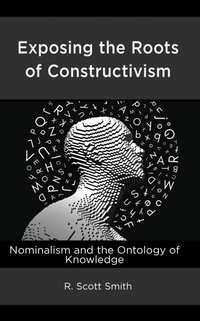
Exposing the Roots of Constructivism
Nominalism and the Ontology of Knowledge
1st Edition
Published on 20. October 2022
1 pages
978-1-9787-8168-9 (ISBN)
Description

Constructivism dominates over other theories of knowledge in much of western academia, especially the humanities and social sciences. In Exposing the Roots of Constructivism: Nominalism and the Ontology of Knowledge, R. Scott Smith argues that constructivism is linked to the embrace of nominalism, the theory that everything is particular and located in space and time. Indeed, nominalism is sufficient for a view to be constructivist.
However, the natural sciences still enjoy great prestige from the "fact-value split." They are often perceived as giving us knowledge of the facts of reality, and not merely our constructs. In contrast, ethics and religion, which also have been greatly influenced by nominalism, usually are perceived as giving us just our constructs and opinions.
Yet, even the natural sciences have embraced nominalism, and Smith shows that this will undermine knowledge in those disciplines as well. Indeed, the author demonstrates that, at best, nominalism leaves us with only interpretations, but at worst, it undermines all knowledge whatsoever. However, there are many clear examples of knowledge we do have in the many different disciplines, and therefore those must be due to a different ontology of properties. Thus, nominalism should be rejected. In its place, the author defends a kind of Platonic realism about properties.
However, the natural sciences still enjoy great prestige from the "fact-value split." They are often perceived as giving us knowledge of the facts of reality, and not merely our constructs. In contrast, ethics and religion, which also have been greatly influenced by nominalism, usually are perceived as giving us just our constructs and opinions.
Yet, even the natural sciences have embraced nominalism, and Smith shows that this will undermine knowledge in those disciplines as well. Indeed, the author demonstrates that, at best, nominalism leaves us with only interpretations, but at worst, it undermines all knowledge whatsoever. However, there are many clear examples of knowledge we do have in the many different disciplines, and therefore those must be due to a different ontology of properties. Thus, nominalism should be rejected. In its place, the author defends a kind of Platonic realism about properties.
More details
Edition
1. Auflage
Language
English
Place of publication
United States
Publishing group
Bloomsbury Publishing Plc
Target group
Professional and scholarly
Illustrations
1 tables;
ISBN-13
978-1-9787-8168-9 (9781978781689)
Copyright in bibliographic data and cover images is held by Nielsen Book Services Limited or by the publishers or by their respective licensors: all rights reserved.
Schweitzer Classification
Other editions
Additional editions
Book
10/2022
Lexington Books
€104.30
Shipment within 3-4 weeks
Person
R. Scott Smith is professor of philosophy and ethics at Biola University.
Content
Introduction
Chapter 1: Tropes and Some Ontological Prerequisites for Knowledge
Chapter 2: Austere and Metalinguistic Nominalism, and Our Knowledge of Reality
Chapter 3: Nominalism and the History of Constructivism in Western Philosophy
Chapter 4: Nominalism and the Practice of Science
Chapter 5: Nominalism and Moral Knowledge
Chapter 6: Nominalism and Academic Religion
Chapter 7: Nominalism Across Other Academic Disciplines
Chapter 8: If Not Nominalism, Then What?
Chapter 1: Tropes and Some Ontological Prerequisites for Knowledge
Chapter 2: Austere and Metalinguistic Nominalism, and Our Knowledge of Reality
Chapter 3: Nominalism and the History of Constructivism in Western Philosophy
Chapter 4: Nominalism and the Practice of Science
Chapter 5: Nominalism and Moral Knowledge
Chapter 6: Nominalism and Academic Religion
Chapter 7: Nominalism Across Other Academic Disciplines
Chapter 8: If Not Nominalism, Then What?
