

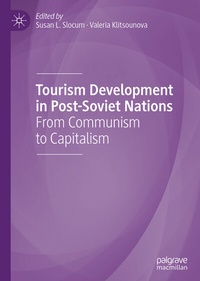
Tourism Development in Post-Soviet Nations
Description

Former communist countries face unique issues in developing and marketing tourism businesses, communities, and attractions because of centralized polices that discouraged international influences. While soviet economies relied on state policies to facilitate community development, the success of capitalism lies in access to a variety of resources, such as the environment, fiscal services, infrastructure, and market knowledge at the local level. Moreover, communal societies potentially possess social capital that can provide unique economic development opportunities. This book incorporates a regional perspective that widens the tourism development debate to include theoretical analyses, applied research, and case studies that document the broader successes and challenges that affect tourism stakeholders and addresses the necessary elements that facilitate a comprehensive tourism development strategy in emerging and transitioning former communist countries.
Reviews / Votes
"The book's chief merit is that it provides valuable information and perspectives on both the Soviet and post-Soviet eras. . the book is a strong contribution to the literature and a solid reference for students of tourism development in Eurasia." (Halil Burak Sakal, Europe-Asia Studies, December 8, 2020)
More details
Other editions
Additional editions
Persons
Susan L. Slocum is Associate Professor in the Department of Tourism and Event Management at George Mason University, USA. She studies sustainable tourism development and policy, specifically working with farmers and rural communities in the UK, Tanzania, Belarus, and the Intermountain Western United States. She is the co-author of six books and numerous journal articles, including two textbooks.
Valeria Klitsounova is Associate Professor at Belarusian State University, Belarus and Chair of the Board for the Belarusian Association of Agro-Ecotourism NGO "Country Escape." Valeria has published 3 books, including a textbook about agro-ecotourism.
Content
1. Introduction.- 2. Rural Tourism as a Tool for Sustainable Development - Lessons Learned in Estonia.- 3. From Communism to Capitalism: The Transition of Bulgarian Tourism Sector and Contemporary Discourses.- 4. From Centrally-Driven Variations to Market-Driven Development: Models of Urban Tourism Evolution in Poland.- 5. Institutional Challenges in the Development of Tourism in Kazakhstan.- 6. Tourism Development and Policy in Slovakia.- 7. Post-Socialist Tourism Trajectories in Budapest: From Under-tourism to Over-tourism.- 8. Troubled Sustainability: Coastal Tourism in Bulgaria - 20 Years Later.- 9. From Tourist Guides to Cultural Immersion Facilitators: Sustainable Tourism and Redefining Destination Image in Slovenia.- 10. Networking, Clustering and Creativity as a Tool for Tourism Development in Rural Areas of Belarus.- 11. Rural Tourism Product Development: The Polish Experience.- 12. Nature-based Tourism Development as a Tool of Community Transformation from Communism to Capitalism in Georgia.- 13. Conclusion.
