

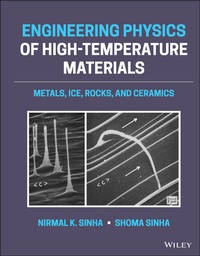
Engineering Physics of High-Temperature Materials
Description

Discover a comprehensive exploration of high temperature materials written by leading materials scientists
In Engineering Physics of High-Temperature Materials: Metals, Ice, Rocks, and Ceramics distinguished researchers and authors Nirmal K. Sinha and Shoma Sinha deliver a rigorous and wide-ranging discussion of the behavior of different materials at high temperatures. The book discusses a variety of physical phenomena, from plate tectonics and polar sea ice to ice-age and intraglacial depression and the postglacial rebound of Earth's crust, stress relaxation at high temperatures, and microstructure and crack-enhanced Elasto Delayed Elastic Viscous (EDEV) models. At a very high level, Engineering Physics of High-Temperature Materials (EPHTM) takes a multidisciplinary view of the behavior of materials at temperatures close to their melting point. The volume particularly focuses on a powerful model called the Elasto-Delayed-Elastic-Viscous (EDEV) model that can be used to study a variety of inorganic materials ranging from snow and ice, metals, including complex gas-turbine engine materials, as well as natural rocks and earth formations (tectonic processes). It demonstrates how knowledge gained in one field of study can have a strong impact on other fields.
Engineering Physics of High-Temperature Materials will be of interest to a broad range of specialists, including earth scientists, volcanologists, cryospheric and interdisciplinary climate scientists, and solid-earth geophysicists. The book demonstrates that apparently dissimilar polycrystalline materials, including metals, alloys, ice, rocks, ceramics, and glassy materials, all behave in a surprisingly similar way at high temperatures. This similarity makes the information contained in the book valuable to all manner of physical scientists.
Readers will also benefit from the inclusion of:
* A thorough introduction to the importance of a unified model of high temperature material behavior, including high temperature deformation and the strength of materials
* An exploration of the nature of crystalline substances for engineering applications, including basic materials classification, solid state materials, and general physical principles
* Discussions of forensic physical materialogy and test techniques and test systems
* Examinations of creep fundamentals, including rheology and rheological terminology, and phenomenological creep failure models
Perfect for materials scientists, metallurgists, and glaciologists, Engineering Physics of High-Temperature Materials: Metals, Ice, Rocks, and Ceramics will also earn a place in the libraries of specialists in the nuclear, chemical, and aerospace industries with an interest in the physics and engineering of high-temperature materials.
More details
Other editions
Additional editions
Persons
Nirmal K. Sinha, Retired, Institute for Aerospace Research, National Research Council of Canada, Ottawa, Ontario, Canada.
Shoma Sinha, Queen's Partnerships and Innovation, Queen's University, Kingston, Ontario, Canada.
Content
Acknowledgments xiii
Engineering Physics of High-Temperature Materials xv
1 Importance of a Unified Model of High-Temperature Material Behavior 1
1.1 The World's Kitchens - The Innovation Centers for Materials Development 1
1.1.1 Defining High Temperature Based on Cracking Characteristics 4
1.2 Trinities of Earth's Structure and Cryosphere 7
1.2.1 Trinity of Earth's Structure 7
1.2.2 Trinity of Earth's Cryospheric Regions 7
1.3 Earth's Natural Materials (Rocks and Ice) 8
1.3.1 Ice: A High-Temperature Material 9
1.3.2 Ice: An Analog to Understand High-Temperature Properties of Solids 10
1.4 Rationalization of Temperature: Low and High 12
1.5 Deglaciation and Earth's Response 12
1.6 High-Temperature Deformation: Time Dependency 13
1.6.1 Issues with Terminology: Elastic, Plastic, and Viscous Deformation 13
1.6.2 Elastic, Delayed Elastic, and Viscous Deformation 13
1.7 Strength of Materials 16
1.8 Paradigm Shifts 18
1.8.1 Paradigm Shift in Experimental Approach 18
1.8.2 Breaking Tradition for Creep Testing 19
1.8.3 Exemplification the Novel Approach 19
1.8.4 Romanticism for a Constant-Structure Creep Test 23
References 25
2 Nature of Crystalline Substances for Engineering Applications 29
2.1 Basic Materials Classification 30
2.2 Solid-state Materials 31
2.2.1 Structure of Crystalline Solids 31
2.2.2 Structure of Amorphous Solids 33
2.3 General Physical Principles 34
2.3.1 Solidification of Materials 34
2.3.2 Phase Diagrams 35
2.3.3 Crystal Imperfections 37
2.4 Glass and Glassy Phase 40
2.4.1 Glass Transition 40
2.4.2 Structure of Real Glass 41
2.4.3 Composition of Standard Glass 41
2.4.4 Thermal Tempering 42
2.4.5 Material Characteristics 43
2.5 Rocks: The Most Abundant Natural Polycrystalline Material 44
2.5.1 Sedimentary Rocks 44
2.5.2 Metamorphic Rocks 45
2.5.3 Igneous Rocks 45
2.6 Ice: The Second Most Abundant Natural Polycrystalline Material 45
2.7 Ceramics 47
2.8 Metals and Alloys 48
2.8.1 Iron-base Alloys 48
2.8.2 Nickel-base Alloys 50
2.8.3 Titanium-base Alloys 53
2.8.4 Mechanical Metallurgy 54
2.9 Classification of Solids Based on Mechanical Response at High Temperatures 55
References 56
3 Forensic Physical Materialogy 59
3.1 Introduction 59
3.1.1 Material Characterization 60
3.2 Polycrystalline Solids and Crystal Defects 61
3.2.1 Etch-Pitting Technique - A Powerful Tool 63
3.3 Structure and Texture of Natural Hexagonal Ice, Ih 67
3.4 Section Preparation for Microstructural Analysis 69
3.4.1 Thin Sectioning of Ice 69
3.4.2 Large 300mm Diameter Polariscope 69
3.4.3 Sectioning for Forensic Analysis of Compression Failure 70
3.5 Etching of Prepared Section Surfaces 71
3.5.1 Surface Etching 72
3.6 Sublimation Etch Pits in Ice, Ih 72
3.7 Etch-Pitting Technique for Dislocations 75
3.7.1 Simultaneous Etching and Replicating 76
3.7.2 Etching Processes and Their Applications 77
3.8 Chemical Etching and Replicating of Ice Surfaces 79
3.9 Displaying Dislocation Climb by Etching 81
3.10 Thermal Etching: An Unexploited Materialogy Tool 82
References 88
4 Test Techniques and Test Systems 91
4.1 On the Strength of Materials and Test Techniques 91
4.1.1 Issues with Stress-Strain (s-e) Diagrams at High Temperatures 93
4.1.2 Fundamentals of Displacement Rate, Strain Rate, and Stress Rate Tests 95
4.1.3 Time - An Important Parameter at High Temperatures 96
4.2 Static Modulus and Dynamic Elastic Modulus 97
4.3 Thermal Expansion Over a Wide Range of Temperature 97
4.4 Creep and Fracture Strength 98
4.5 Bending Tests 99
4.5.1 Three-Point Bending 99
4.5.2 Four-Point Bending 99
4.5.3 Cantilever Beam Bending 102
4.6 Compression Tests - Uniaxial, Biaxial, and Triaxial 103
4.6.1 Uniaxial Compression Tests 103
4.6.2 Biaxial or Confined Compression Tests 103
4.6.3 Triaxial or Multiaxial Compression and Tension Tests 103
4.7 Tensile and/or Compression Test System 104
4.7.1 Tests with Single Top-Lever Loading Frame 104
4.7.2 Universal Testing Machine and Systems: Introduction to SRRT Methodology 105
4.8 Stress Relaxation Tests (SRTs) 107
4.8.1 Necessity for Stress Relaxation Properties 108
4.8.2 Basic Principle of SRTs 109
4.9 Cyclic Fatigue 110
4.9.1 Low-Cycle Fatigue (LCF) and High-Cycle Fatigue (HCF Tests) 110
4.9.2 Uncharted Characteristics of Delayed Elasticity in Cyclic Loading 112
4.9.3 Cyclic Loading of Snow and Thermal Cycling on Asphalt Concrete 113
4.10 Acoustic Emission (AE) and/or Microseismic Activity (MA) 114
4.11 Tempering of Structural and Automotive Glasses 116
4.12 Specimen Size and Geometry: Depending on Material Grain Structure 119
4.13 In Situ Borehole Tests: Inspirations from Rock Mechanics 119
References 123
5 Creep Fundamentals 129
5.1 Overview 130
5.2 On Rheology and Rheological Terminology 132
5.3 Forms of Creep and Deformation Maps 132
5.3.1 Generalization for Polycrystalline Materials 132
5.3.2 Nabarro-Herring Creep 133
5.3.3 Coble Creep 133
5.3.4 Harper-Dorn Creep 133
5.3.5 Ashby-Verrall Creep 133
5.3.6 Deformation Mechanism Maps 134
5.4 Grain-Boundary Shearing or Sliding 134
5.5 Creep Curves - Classical Primary, Secondary, and Tertiary Descriptions 135
5.5.1 Elasticity and Annealing of Glass 136
5.5.2 Phenomenological Rheology of Glass 137
5.5.3 Normalized Creep - Another Presentation of Rheology of Glass 140
5.6 Phenomenology of Primary Creep in Metals, Ceramics, and Rocks 144
5.7 Primary Creep in Ice: Launching SRRT Technique and EDEV Model 148
5.8 Grain-Boundary Shearing (gbs) and Grain-Size Dependent Delayed Elasticity 151
5.9 Generalization of EDEV Model: Introduction of Grain-Size Effect 153
5.10 Logarithmic Primary Creep: An Alternative Form of the EDEV Model 157
5.11 Shifting Paradigms: Emphasizing Primary Creep of Polycrystalline Materials 158
5.12 SRRT for Primary Creep and EDEV Model of a Titanium-Base Superalloy (Ti-6246) 158
5.13 SRRT for Primary Creep and EDEV Model for a Nickel-Base Superalloy (Waspaloy) 162
5.14 SRRT for Primary Creep of a Nickel-Rich Iron-Base Alloy (Discaloy) 169
5.15 SRRTs for Primary Creep and EDEV Model of a Nickel-Base Superalloy (IN-738LC) 170
5.16 EDEV-Based Strain-Rate Sensitivity of High-Temperature Yield Strength 175
5.16.1 Constant Strain-Rate Yield 176
5.16.2 Yield Strength of Ti-6246 at 873 K (0.45 Tm) 178
5.16.3 Yield Strength of Waspaloy at 1005 K (0.62 Tm) 178
5.17 Single-Crystal (SX) Superalloy Delayed Elasticity and ¿/¿ Interface Shearing 185
5.18 Creep, Steady-State Tertiary Stage, and Elasto-Viscous (EV) Model for Single Crystals 191
5.19 Creep Fracture and EV Model for CMSX-10 SXs 194
5.20 Fracture and Inhomogeneous Deformation 198
5.21 Dynamic Steady-State Tertiary Creep of Several Nickel-Base SXs 200
5.21.1 MAR-M-247 Single Crystal 200
5.21.2 CMSX-3 Single Crystal 201
5.21.3 CMSX-4 Single Crystal with Rhenium 202
5.21.4 CMSX-4 Single Crystal 202
5.21.5 TMS-75 Single Crystal 203
5.21.6 SRR99 Single Crystal 205
References 205
6 Phenomenological Creep Failure Models 215
6.1 Creep and Creep Failure 215
6.2 Steady-State Creep 216
6.3 Commonly Used Creep Experiments and Strength Tests 217
6.3.1 Constant Stress and Constant Deformation (CD) Rate Tests 217
6.3.2 A Short Glimpse of Creep Tests 220
6.3.3 Power Law for Creep 220
6.3.4 Larsen and Miller Concept 223
6.3.5 Monkman and Grant (M-G) Relationship 223
6.3.6 Rabotnov-Kachanov Concept for Creep Fracture 224
6.3.7 Breaking Tradition - ¿-Projection Concept 224
6.4 Modeling Very Long-Term Creep Rupture from Short-Term Tests 225
6.4.1 Traditional Approaches for Power-Generation Operations 225
6.4.2 Captivating and Entrenched Focus on Minimum Creep Rate 226
6.5 High-Temperature Low-Cycle Fatigue (HT-LCF) and Dwell Fatigue 226
6.6 Crucial Tests on Rate Sensitivity of High-Temperature Strength 227
6.7 Rational Approach Inspired by the Principle of "Hindsight 20/20" 232
References 233
7 High-Temperature Grain-Boundary Embrittlement and Creep 237
7.1 Fracture and Material Failure 237
7.1.1 Griffith's Model for Crack Propagation 239
7.1.2 Crack Nucleation Mechanisms at Low Homologous Temperatures 240
7.1.3 Acoustic Emissions and Cracks 241
7.1.4 A Novel Treatment of AE and Cracks in Ice Engineering 242
7.2 Grain Size Effects on Strength 245
7.2.1 Popular Low-Temperature Concept of Strength 245
7.2.2 Problems with Estimating Grain Size 245
7.2.3 Inapplicability of the Hall-Petch Relation at High Temperatures 246
7.3 Grain-Boundary Shearing (gbs) Induced Crack Initiation 246
7.3.1 Groundwork for a High-Temperature Crack-Initiation Hypothesis 248
7.3.2 Gold's Classic Studies on Creep Cracking by Visual Observations 249
7.3.3 Forensic Microstructural Examinations of First Creep Cracks 251
7.3.4 First Grain-Facet-Sized Cracks and Critical Delayed Elastic Criterion 252
7.3.5 Critical Time and Stress for Onset of Creep Fracture 254
7.3.6 Critical Strain for First Cracks (or Fracture Failure) 255
7.3.7 Apparent Activation Energy for First Cracks and Fracture 257
7.3.8 Kinetics of Creep Cracking 258
References 260
8 Microstructure and Crack-Enhanced Elasto - Delayed-Elastic - Viscous Models 265
8.1 Physics-Based Holistic Model Approach 265
8.1.1 On Transient Creep and the Shape of Creep Curves 266
8.1.2 On "Limiting Transient Creep Strain" (eT) 267
8.1.3 On the Traditions of Creep Testing and Shifting Paradigms 268
8.2 Kinetics of Microcracking and Structural Damage 271
8.3 Microcrack-Enhanced EDEV Model 271
8.4 EDEV-Based Algorithm for Constant Strain Rate, Encompassing Cracking 273
8.4.1 EDEV-Based Stress-Strain Diagrams 275
8.5 Constant Stress, Crack-Enhanced Creep: EDEV Predictions 279
8.5.1 Apparent Brittle-Ductile Transition in Constant Stress Creep 281
8.5.2 Power-Law Breakdown for Minimum Creep Rate 283
8.5.3 Grain-Size Effects on Creep with Crack Formation 284
8.5.4 Creep Dilatation in Polycrystalline Columnar-Grained and Equiaxed Solids 287
8.5.5 Crack Damage at Minimum Creep Rate and Upper Yield 291
8.5.6 Strain-Rate Sensitivity of Initial Deformation, Dilatancy, and Residual Strength 293
8.6 Cyclic Fatigue 293
8.6.1 Low-Cycle Constant Strain Rate Loading 294
8.6.2 Low-Cycle, High-Strain Fatigue: Repeated Constant Load 295
8.7 Crack Healing or Closure of w-Type Voids Generating r-Type Cavities 295
References 298
9 Stress Relaxation at High Temperatures 303
9.1 The Role of Stress Relaxation Tests at High Temperatures 303
9.1.1 Traditional SRTs 304
9.1.2 Phenomenology of Stress Relaxation 306
9.1.3 Capabilities and Inadequacies of SRT for Creep Estimation 308
9.1.4 Rationalization of SRT Processes 309
9.1.5 SRT on Coarse-Grained Materials 310
9.1.6 New Approaches for Examining Applicability of SRT for Fine-Grained Materials 313
9.1.7 Grain-Size-Based Optimization of Initial Strain, e0, for SRT 317
9.2 Constitutive Equations without Effect of Grain Size 318
9.2.1 Constitutive Equation for Uniaxial Creep at High Temperatures 318
9.2.2 SR Based on Constitutive Equation 321
9.2.3 Type-A Engineering Prediction for SRT 321
9.3 Temperature and Grain-Size Effects on SR 327
9.3.1 EDEV Constitutive Equation Incorporating Grain Size and Temperature 327
9.3.2 EDEV-Based SRT Algorithm for Grain-Size and Temperature Dependency 328
9.3.3 Lack of Grain-Size-Dependent Data on Primary Creep of Engineering Materials 328
9.4 Forecasting Grain-Size Effects on SR in Pure Ice Based on EDEV Equation 328
9.4.1 Basis of Calculation for Ice 329
9.4.2 Effect of Strain, e0 (Constant Temperature and Grain Size) 329
9.4.3 Effect of Temperature (Constant Strain and Grain Size) 331
9.4.4 Effect of Grain Size (Constant Strain and Temperature) 331
9.4.5 Strain (e0) Dependence of Strain Components (Constant Temperature and Grain Size) 332
9.4.6 Grain-Size Effect on Strain Components During SRT (Constant Strain and Temperature) 332
9.4.7 Comments on SRTs Related to Ice and Field Experience 332
9.5 High-Temperature Forming, Delayed Spring-Back, and Grain-Size Effects on SR in Metals 335
References 339
10 Ice Age and Intraglacial Depression and Postglacial Rebound of Earth's Crust 343
10.1 Tectonic Plates, Lake Ice, and High-Temperature Materials: What Is the Connection? 343
10.2 On Glaciers and Oceanic Ice Cover: Past and Present 345
10.2.1 Rise of Canada - Postglacial Uplift 346
10.2.2 Postglacial Adjustments of North America's Landscape 346
10.3 Dow's Lake Studies 347
10.3.1 Dow's Lake Ice Sheet: Crowd Load/Unload During Winter of 1985 347
10.3.2 Swimming Pool Loading Experiment on Dow's Lake Ice in 1986 351
10.4 Elasto - Delayed-Elastic (EDE) Theory for Plates 356
References 362
11 Plate Tectonics and Polar Sea Ice 365
11.1 Retrospective Introduction 365
11.2 Earth and Plate Tectonics 368
11.2.1 On Sea Ice: Analog for Tectonic Plates 369
11.2.2 Trinity of Tectonic Plates 371
11.2.3 Trinity of Tectonic Plate Boundaries 371
11.3 Scale of Observations 372
11.3.1 Messengers of Earth Below and Sky Above 376
11.4 Vertical Temperature Profiles of Earth and Ice Sheet 378
11.5 Time-Temperature Shift Function 381
11.6 Nonlinear, Grain-Size-Dependent Delayed Elasticity (Anelasticity) of Mantle 382
11.7 Stress Field of Earth's Crust 385
11.8 Koyna and Warna Dams in India and Reservoir-Triggered Seismicity (RTS) 386
11.9 Movement of Tectonic Plates, Indentation, and Fracture 391
11.10 Looking Forward 394
References 395
Index 401
Engineering Physics of High-Temperature Materials
Preface
The development of knowledge in all branches of science and engineering has been so varied and rapid during the last century that it has become extremely difficult, if not impossible, for investigators to pay attention to different fields outside of their own expertise. As time progresses, each and every branch of scientific endeavor is getting subdivided and micro- divided, with specific jargon developing even within micro units, making it even more difficult to communicate with each other across specialties. The physics and engineering of high-temperature materials is one such special area, and yet it touches many fields in many ways.
There is an ever-growing number of human-made materials like ceramics, metallic alloys, and superalloys used specifically in high-temperature applications in areas such as the nuclear, chemical and aerospace industries. This may also include materials developed by design on the basis of nanotechnology and grain-boundary engineering for very specific uses. Then, there are rocks of geophysical interest (such as with respect to tectonics and post-glacial uplifting) existing at high temperatures within the depths of Earth and floating on magma, and ice (freshwater and saline sea ice) floating in its molten state in lakes and oceans. It would be impossible to cover all the complicated phenomena of different materials in a single book. However, the principal strengths of a book like the present one is the manner in which it covers many different materials all together. This could also be a weakness if descriptions are not clear enough to facilitate an understanding of the complicated physics and mechanics in widely differing materials. Some difficulties can be overcome by restricting topics relevant only to inorganic crystalline materials that would include the most abundant materials on Earth - ice and rocks, in addition to manu-made (gender-neutral term derived from Manushya in Sanskrit) and manufactured metallic-based engineering materials used in various industries such as aerospace, power generation, and nuclear technology. Further obstacles can be removed by concentrating on materials at or used at high homologous temperatures greater than about one-third of the melting point, T m in Kelvin. In this manner, it is indeed possible to draw attention to a common string that unites most, if not all, apparently different polycrystalline materials and topics. Many time-honored, empirically derived relations will be explained on the basis of a simple, microstructure-sensitive, Elasto - Delayed-Elastic - Viscous (EDEV) model.
High-temperature materials science and engineering sounds like a specialized branch of applied science, but it can actually be considered as one of the most general areas of modern science and technology. This book is prepared with the intention of making it known that apparently dissimilar polycrystalline materials, such as metals, alloys, ice, rocks, and ceramics - and even glassy materials - behave in a very similar manner at high temperatures. This book, therefore, is aimed at a variety of experts, such as metallurgists to metal physicists, glaciologists to ice engineers, solid-earth geophysics, earth scientists to volcanologists, and cryospheric and interdisciplinary climate scientists. The critical question addressed is, what is really meant by "high temperature," and why? What is the microstructural-based rationale for defining high temperatures?
Materials scientists (materialogists) universally agree that temperatures, T, above about one-third of the melting point, T m in degrees Kelvin, are high. For metals and alloys, it is unanimously recognized that T > 0.4T m is unquestionably categorized as high-temperature because intergranular cracks (called wedge or w-type) along the grain-boundaries (comparable to the size of grain facets) are predominantly observed at such temperatures, particularly in polycrystals. Grain-boundary spherical or elliptical voids (called cavitation or r-type) are also commonly noticed features in deformed or fractured materials. To this list of readily observable microstructural features, we consider a very special aspect of high-temperature deformation and failure processes - that, to-date, has not derived much attention from materialogists in general. It is the recoverable delayed elastic strain (des) in addition to elastic and viscous (matrix dislocation creep) deformation. For example, complex aerospace alloys exhibit a significant amount of delayed elastic effect not only during the primary or transient stages, but also during the tertiary creep regime. Progress made in ice mechanics, experimental as well as theoretical, have proved to be a fertile ground for explorations toward understanding the onset of interfacial failure processes in polycrystalline materials during the primary creep and eventual failures at high temperatures. The modern knowledge summarized in this book demonstrates that delayed elastic strain can be measured precisely at any stage of high-temperature deformation through the careful design of experimental techniques (e.g., Chapter 4). This is illustrated in Figure P.1.
As mentioned earlier, a constitutive model, named as the Elasto - Delayed-Elastic - Viscous (EDEV) model, was developed that recognizes delayed elasticity (that can be measured experimentally for quantitative verifications) as one of the most important aspects of high-temperature engineering materialogy. As this text will show, it has been demonstrated that delayed elastic strain plays crucial roles in governing every aspect of primary (often called transient) creep curves and engineering stress-strain diagrams and strain-rate-dependent strength (such as 0.2% offset yield and ultimate strength) properties. Finally, and very importantly, grain-facet size cracks are initiated during primary creep, when des reaches a critical stage (Chapters 5, 6). The kinetics of microcracking and crack-enhanced viscous (or dislocation) creep, essence of the EDEV model, leads to tertiary or accelerating stages in constant-stress creep or constant strain-rate deformation (Chapters 7, 8). The processes of grain-boundary shearing (often referred to as sliding in the literature) induce recoverable delayed elastic strains. The grain-boundary shearing mechanisms also govern the initial-strain (or initial-constrain) sensitivity of stress-relaxation (SR) at high homologous temperatures, as presented in Chapter 9. The crack-enhanced EDEV model, therefore, provides a physics-based elucidation for the phenomenological observations on a huge number of engineering materials. And the methodology is very simple. Material characteristics for creep, and the kinetics of grain-facet size cracking during creep, like those provided in Table 7.1 for ice, can be obtained for other materials by performing the appropriate strain relaxation and recovery test (SRRT) (Chapter 4), including the use of acoustic emission (AE) technology, and emphasizing, of course, evaluation of recoverable delayed elastic response.
Engineering design is most often based on "effective" elastic response, yield strength such as 0.1 or 0.2% offset yield stress, and/or design curves summarizing stress-time-temperature dependence of some specified strain. All these characteristics are strain-rate sensitive and have been shown to be governed by primary or transient creep at high temperatures. It is shown in this book that primary creep is linked strongly to observable and precisely quantifiable delayed elastic phenomena, and that it is of utmost importance not only for characterizing the propagation of seismic waves in rocks (well recognized by geophysicists and volcanologists), but also for the prediction of strain-rate-sensitive 0.2% offset yield strengths, extremely important for design engineers. This book fills this gap in materials science in a significant manner.
Figure P.1 Delayed elastic strain (des) recovery. (a) constant-stress creep of nickel-base Waspaloy forgings at 1005K and 724 MPa; (b) constant strain-rate strength test of directionally solidified (DS) ice at 263K (0.96T m) and strain rate of 3 × 10⁻⁵ s-1, as described in Chapters 4 and 6.
Source: (a) N.K. Sinha, unpublished; (b) Sinha (1988a) with permission from Springer Nature.
There are a number of excellent books published in the past with a primary emphasis on metals and alloys. These publications have received wide-ranging attention from metallurgists over the last 50 years or more. However, none of these well-known publications have (to the authors' knowledge) provided any information on grain-size-dependent nucleation and the kinetics of grain-facet size microcracking activities and crack-enhanced matrix creep, which starts during early stages of primary (transient) creep, leading to minimum creep rates and tertiary stages. Minimum creep rates are evolved properties and are in fact predictable. Minimum creep rate does not necessarily mean steady-state creep due only to the...
