

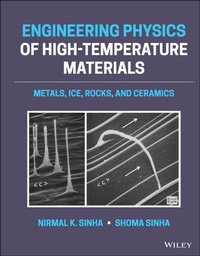
Engineering Physics of High Temperature Materials
Metals, Ice, Rocks and Ceramics
1st Edition
Published on 23. May 2022
Book
Hardback
300 pages
978-1-119-42048-4 (ISBN)
Description
ENGINEERING PHYSICS OF HIGH-TEMPERATURE MATERIALS
Discover a comprehensive exploration of high temperature materials written by leading materials scientists
In Engineering Physics of High-Temperature Materials: Metals, Ice, Rocks, and Ceramics distinguished researchers and authors Nirmal K. Sinha and Shoma Sinha deliver a rigorous and wide-ranging discussion of the behavior of different materials at high temperatures. The book discusses a variety of physical phenomena, from plate tectonics and polar sea ice to ice-age and intraglacial depression and the postglacial rebound of Earth's crust, stress relaxation at high temperatures, and microstructure and crack-enhanced Elasto Delayed Elastic Viscous (EDEV) models. At a very high level, Engineering Physics of High-Temperature Materials (EPHTM) takes a multidisciplinary view of the behavior of materials at temperatures close to their melting point. The volume particularly focuses on a powerful model called the Elasto-Delayed-Elastic-Viscous (EDEV) model that can be used to study a variety of inorganic materials ranging from snow and ice, metals, including complex gas-turbine engine materials, as well as natural rocks and earth formations (tectonic processes). It demonstrates how knowledge gained in one field of study can have a strong impact on other fields.
Engineering Physics of High-Temperature Materials will be of interest to a broad range of specialists, including earth scientists, volcanologists, cryospheric and interdisciplinary climate scientists, and solid-earth geophysicists. The book demonstrates that apparently dissimilar polycrystalline materials, including metals, alloys, ice, rocks, ceramics, and glassy materials, all behave in a surprisingly similar way at high temperatures. This similarity makes the information contained in the book valuable to all manner of physical scientists.
Readers will also benefit from the inclusion of:
* A thorough introduction to the importance of a unified model of high temperature material behavior, including high temperature deformation and the strength of materials
* An exploration of the nature of crystalline substances for engineering applications, including basic materials classification, solid state materials, and general physical principles
* Discussions of forensic physical materialogy and test techniques and test systems
* Examinations of creep fundamentals, including rheology and rheological terminology, and phenomenological creep failure models
Perfect for materials scientists, metallurgists, and glaciologists, Engineering Physics of High-Temperature Materials: Metals, Ice, Rocks, and Ceramics will also earn a place in the libraries of specialists in the nuclear, chemical, and aerospace industries with an interest in the physics and engineering of high-temperature materials.
More details
Language
English
Place of publication
Hoboken
United States
Publishing group
John Wiley and Sons Ltd
Target group
Professional and scholarly
Dimensions
Height: 278 mm
Width: 218 mm
Thickness: 24 mm
Weight
1338 gr
ISBN-13
978-1-119-42048-4 (9781119420484)
Copyright in bibliographic data and cover images is held by Nielsen Book Services Limited or by the publishers or by their respective licensors: all rights reserved.
Schweitzer Classification
Other editions
Additional editions
Nirmal K. Sinha | Shoma Sinha
Engineering Physics of High-Temperature Materials
Metals, Ice, Rocks, and Ceramics
E-Book
02/2022
1st Edition
Wiley
€169.99
Available for download
Nirmal K. Sinha | Shoma Sinha
Engineering Physics of High-Temperature Materials
Metals, Ice, Rocks, and Ceramics
E-Book
02/2022
1st Edition
Wiley
€174.99
Available for download
Persons
Nirmal K. Sinha, Retired, Institute for Aerospace Research, National Research Council of Canada, Canada
Shoma Sinha, Partnerships and Innovation, Queen's University, Canada
Content
Dedication and Acknowledgements
Preface
Chapter 1: Importance of a Unified Model of High Temperature Material Behaviour
1.1 The World's Kitchens - The Innovation centres for Materials Development
1.1.1 Defining high temperature based on cracking characteristics
1.2 Trinities of Earth's structure and Cryosphere
1.2.1 Trinity of Earth's structure
1.2.2 Trinity of Earth's Cryosphereic Regions
1.3 Earth's Natural Materials (rocks, ice)
1.3.1 Ice: A High Temperature Material
1.3.2 Ice: an analogue to understand high-temperature properties of solids
1.4 Rationalization of temperature: low and high
1.5 Deglaciation and earth's response
1.6 High temperature deformation: time dependency
1.6.1 Issues with terminology: elastic, plastic and viscous deformation
1.6.2 Elastic, delayed elastic and viscous deformation
1.7 Strength of Materials
1.8 Paradigm Shifts
1.8.1 Paradigm shift in experimental approach
1.8.2 Breaking tradition for creep testing
1.8.3 Exemplifying the novel approach
1.8.4 Romanticism for constant-structure creep test
References for Chapter 1
List of Figure Captions
Chapter 2: Nature of Crystalline Substances for Engineering Applications
2.1 Basic materials classification
2.2 Solid State Materials
2.2.1 Structure of crystalline solids
2.2.2 Structure of amorphous solids
2.3 General Physical Principles
2.3.1 Solidification of Materials
2.3.2 Phase diagrams
2.3.3 Crystal imperfections
2.4 Glass and Glassy phase
2.4.1 Glass Transition
2.4.2 Structure of Real Glass
2.4.3 Composition of Standard Glass
2.4.4 Thermal Tempering
2.4.5 Material characteristics
2.5 Rocks: The most abundant natural polycrystalline material
2.5.1 Sedimentary Rocks
2.5.2 Metamorphic Rocks
2.5.3 Igneous Rocks
2.6 Ice: The second most abundant natural polycrystalline material
2.7 Ceramics
2.8 Metals and alloys
2.8.1 Iron-based Alloys
2.8.2 Nickel-based Alloys
2.8.3 Titanium-based Alloys
2.8.4 Mechanical Metallurgy
2.9 Classification of solids based on mechanical response at high temperatures
References cited in Chapter 2
List of Figure Captions
Chapter 3: Forensic physical materialogy
3.1 Introduction
3.1.1 Material characterization
3.2 Polycrystalline solids and crystal defects
3.2.1 Etch-pitting - a powerful tool
3.3 Structure and texture of natural hexagonal ice, Ih
3.4 Section preparation for microstructural analysis
3.4.1 Thin sectioning of ice
3.4.2 Large 300mm diameter polariscope
3.4.3 Sectioning for forensic analysis of compression failure
3.5 Etching of prepared section surfaces
3.5.1 Surface etching
3.6 Sublimation etch pits in ice, Ih
3.7 Etch pit technique for dislocations
3.7.1 Simultaneous etching and replicating
3.7.2 Etching processes and its applications
3.8 Chemical etching and replicating ice surfaces
3.9 Displaying dislocation climb by etching
3.10 Thermal etching: An unexploited materialogy tool
References for Chapter 3
List of Figure Captions
Chapter 4: Test Techniques and Test Systems
4.1 On the Strength of Materials and Test Techniques
4.1.1 Issues on Stress-Strain (sigma-epsilon) diagrams at high-temperatures
4.1.2 Fundamentals of displacement-rate, strain-rate and stress-rate tests
4.1.3 Time - an important parameter at high-temperatures
4.2 Static and dynamic elastic modulus
4.3 Thermal Expansion over a wide range of temperature
4.4 Creep and fracture strength
4.5 Bend tests
4.5.1 Three-point
4.5.2 Four-point
4.5.3 Cantilever beam tests
4.6 Compression tests - uniaxial, biaxial, triaxial
4.6.1 Uniaxial compression
4.6.2 Biaxial or confined compression
4.6.3 Triaxial or multi-axial compression and tension
4.7. Tensile and/or compression test system
4.7.1 Tests with single top-lever loading frame
4.7.2 Universal testing machine and systems: introduction to SRRT methodology
4.8 Stress-relaxation tests (SRT)
4.8.1 Necessity for stress relaxation properties
4.8.2 Basic principle of SRT
4.9 Cyclic fatigue
4.9.1 Low-cycle fatigue (LCF) and high-cycle fatigue (HCF) tests
4.9.2 Uncharted characteristics of delayed elasticity in cyclic loading
4.9.3 Cyclic loading of snow and thermal cycling on asphalt concrete
4.10 Acoustic emission (AE) and/or microseismic activity (MA)
4.11 Tempering of structural and automotive glasses
4.12 Specimen size and geometry: Depending on material grain-structure
4.13 In-situ bore-hole tests: Inspirations from rock mechanics
References for Chapter 4
Chapter 5: Creep Fundamentals
5.1 Overview
5.2 On rheology and rheological terminology
5.3 Forms of Creep and Deformation maps
5.3.1 Generalization for Polycrystalline Materials
5.3.2 Nabarro and Herring creep
5.3.3 Coble creep
5.3.4 Harper-Dorn creep
5.3.5 Ashby-Verrall creep
5.3.6 Deformation mechanism maps
5.4 Grain boundary sliding (GBS) and shearing (gbs)
5.5 Creep curves - classical primary, secondary and tertiary descriptions
5.5.1 Elasticity and annealing of glass
5.5.2 Phenomenological rheology of glass
5.5.3 Normalized creep - another presentation of rheology of glass
5.6 Phenomenology of primary creep in metals, ceramics and rocks
5.7 Primary creep in ice: launching SRRT technique and EDEV model
5.8 Grain-boundary shearing (gbs) and grain-size dependent delayed elasticity
5.9 Generalization of EDEV model: Introduction of grain-size effect
5.10 Logarithmic primary creep: An alternative form of the EDEV model
5.11 Shifting paradigms: Emphasising primary creep of polycrystalline materials
5.12 SRRT for primary creep and EDEV model of a titanium-based superalloy (Ti-6246)
5.13 SRRT for primary creep and EDEV model for a nickel-based superalloy (Waspaloy)
5.14 SRRT for primary creep of a nickel-rich iron-based alloy (Discaloy)
5.15 SRRTs for primary creep and EDEV model of a nickel-based superalloy (IN-738LC)
5.16 EDEV-based strain-rate sensitivity of high-temperature yield strength
5.16.1. Constant strain-rate yield
5.16.2 Yield strength of Ti-6246 at 873K (0.45Tm)
5.16.3 Yield strength of Waspaloy at 1005K (0.62 Tm)
5.17 Single-crystal (SX) superalloy delayed elasticity and gamma/gamma' interface shearing
5.18 Creep, steady-state tertiary stage and elasto-viscous (EV) model for single-crystals
5.19 Creep-fracture and EV model for CMSX-10 single-crystals
5.20 Fracture and inhomogeneous deformation
5.21 Dynamic steady-state tertiary creep of several nickel-base SX
5.21.1 MAR-M-247 Single Crystal
5.21.2 CMSX-3 Single crystal
5.21.3 CMSX-4 Single Crystal
5.21.4 CMSX-4 Single Crystal
5.21.5 TMS-75 Single Crystal
5.21.6 SRR99 Single Crystal
References for Chapter 5
List of Figure Captions
Chapter 6. Phenomenological creep failure models
6.1 Creep and Creep failure
6.2 Steady-state creep
6.3 Commonly used creep experiments and strength tests
6.3.1 Constant stress (CS) and constant deformation-rate (CD) tests
6.3.2 A short glimpse at creep tests
6.3.3 Power-law for creep
6.3.4 Larsen and Miller concept
6.3.5 Monkman and Grant (M-G) relationship
6.3.6 Rabotnov-Kachanov concept for creep fracture
6.3.7 Breaking tradition - q Projection Concept
6.4 Modelling very long-term creep rupture from short-term tests
6.4.1 Traditional approaches for power-generation operations
6.4.2 Captivating and entrenched focus on minimum creep rate
6.5 High temperature low-cycle fatigue (HT-LCF) and dwell- fatigue
6.6 Crucial tests on rate-sensitivity of high-temperature strength
6.7. Rational approach inspired by the principle of 'hind sight 20/20'
References used in Chapter 6
List of Figure Captions
Chapter 7: High-temperature grain-boundary embrittlement and creep
7.1 Fracture and material failure
7.1.1 Griffith's model for crack propagation
7.1.2 Crack nucleation mechanisms at low homologous temperatures
7.1.3 Acoustic Emissions and cracks
7.1.4 A novel treatment of AE and cracks in ice engineering
7.2 Grain size effects on strength
7.2.1 Popular low-temperature concept of strength
7.2.2 Problems with estimating grain size
7.2.3 Inapplicability of the Hall-Petch relation at high temperatures
7.3 Grain-boundary shearing (gbs) induced crack initiation
7.3.1 Groundwork for a high-temperature crack-initiation hypothesis
7.3.2 Gold's classic studies on creep cracking by visual observations
7.3.3 Forensic microstructural examinations of first creep cracks
7.3.4 First grain-facet size cracks and critical delayed elastic criterion
7.3.5 Critical time and stress for onset of creep fracture
7.3.6 Critical strain for first cracks (or fracture failure)
7.3.7 Apparent activation energy for first cracks and fracture
7.3.8 Kinetics of creep cracking
References for Chapter 7
List of Figure Captions
Chapter 8: Microstructure and Crack-enhanced EDEV models
8.1 Physics-based Holistic Model Approach
8.1.1 On transient creep and the shape of creep curves
8.1.2 On 'limiting transient creep strain', eT
8.1.3 On the traditions of creep testing and shifting paradigms
8.2 Kinetics of microcracking and structural damage
8.3 Microcrack-enhanced EDEV model
8.4 EDEV-based algorithm for constant strain rate, encompassing cracking
8.4.1 EDEV-based stress-strain diagrams
8.5 Constant stress, crack-enhanced creep: EDEV predictions
8.5.1 Apparent brittle-ductile transition in constant-stress creep
8.5.2 Power-law breakdown for minimum creep rate
8.5.3 Grain-size effects on creep with crack formation
8.5.4 Creep-dilatation in polycrystalline columnar-grained and equiaxed solids
8.5.5 Crack-damage at minimum creep rate and upper-yield
8.5.6 Strain-rate sensitivity of initial deformation, dilatancy and residual strength
8.6 Cyclic Fatigue
8.6.1 Low-cyclic constant strain-rate loading
8.6.2 Low-cycle high-strain fatigue: repeated constant load
8.7 Crack-healing or closure of w-type voids generating r-type cavities
References for Chapter 8
List of Figure Captions
Chapter 9: Stress Relaxation at High-Temperatures
9.1 The Role of Stress Relaxation Tests at High Temperatures
9.1.1 Traditional Stress Relaxation Tests
9.1.2 Phenomenology of stress relaxation
9.1.3 Capabilities and Inadequacies of SRT for Creep Estimation
9.1.4 Rationalization of SRT processes
9.1.5 SRT on coarse-grained materials
9.1.6 New approaches for examining applicability of SRT for fine-grained materials
9.1.7 Grain-size based optimization of initial strain, epsilono, for SRT
9.2 Constitutive equations without effect of grain-size
9.2.1 Constitutive equation for uniaxial creep at high temperatures
9.2.2 Stress relaxation based on constitutive equation
9.2.3 Type-A engineering prediction for SRT
9.3 Temperature and grain size effects on stress relaxation
9.3.1 EDEV constitutive equation incorporating grain size and temperature
9.3.2 EDEV-based SRT algorithm for grain size and temperature dependency
9.3.4 Lack of grain-size dependent data on primary creep of engineering materials
9.4 Forecasting grain-size effects on SR in pure ice, based on EDEV equation
9.4.1 Basis of calculation for ice
9.4.2 Effect of strain, epsilono (constant temperature and grain size)
9.4.3 Effect of temperature (constant strain and grain size)
9.4.4 Effect of grain size (constant strain and temperature)
9.4.5 Strain (epsilono) dependence of strain components (constant temperature and grain size)
9.4.6 Grain-size effect on strain components during SRT (constant strain and temperature)
9.4.7 Comments on SRTs related to ice and field experience
9.5 High-temperature forming, delayed spring-back and grain-size effects on SR in metals
References used in Chapter 9
List of Figure Captions
Chapter 10: Ice-age and Intraglacial depression and Postglacial rebound of Earth's crust
10.1 Tectonic Plates, Lake Ice and High Temperature Materials: What's the Connection?
10.2 On glaciers and oceanic ice cover: Past and present
10.2.1 Rise of Canada - Postglacial uplift
10.2.2 Postglacial adjustments of North America's landscape
10.3 Dows Lake Studies
10.3.1 Dows Lake ice sheet: Crowd-load/unload during winter of 1985
10.3.2 Swimming pool loading experiment on Dows Lake ice, 1986
10.4 Elasto-Delayed-Elastic (EDE) theory for Plates
References for Chapter 10
List of Figure Captions
Chapter 11: Plate tectonics and Polar sea ice
11.1 Retrospective introduction
11.2 Earth and plate tectonic
11.2.1 On sea ice: analogue for tectonic plates
11.2.2 Trinity of tectonic plates
11.2.3 Trinity of tectonic plate boundaries
11.3 Scale of observations
11.3.1 Messengers of earth below and sky above
11.4 Vertical temperature profiles of earth and ice sheet
11.5 Time-temperature shift function
11.6 Nonlinear, grain-size dependent delayed-elasticity (anelasticity) of mantle
11.7 Stress field of Earth's crust
11.8 Koyna-Warna dams, India and reservoir triggered seismicity (RTS)
11.9 Movement of tectonic plates, indentation and fracture
11.10 Looking forward
References for Chapter 11
List of Figure Captions
Index