

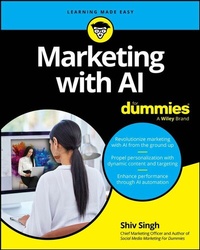
Marketing with AI For Dummies
Description

Stay ahead in the marketing game by harnessing the power of artificial intelligence
Marketing with AI For Dummies is your introduction to the revolution that's occurring in the marketing industry, thanks to artificial intelligence tools that can create text, images, audio, video, websites, and beyond. This book captures the insight of leading marketing executive Shiv Singh on how AI will change marketing, helping new and experienced marketers tackle AI marketing plans, content, creative assets, and localized campaigns. You'll also learn to manage SEO and customer personalization with powerful new technologies.
- Peek at the inner workings of AI marketing tools to see how you can best leverage their capabilities
- Identify customers, create content, customize outreach, and personalize customer experience with AI
- Consider how your team, department, or organization can be retooled to thrive in an AI-enabled world
- Learn from valuable case studies that show how large organizations are using AI in their campaigns
This easy-to-understand Dummies guide is perfect for marketers at all levels, as well as those who only wear a marketing hat occasionally. Whatever your professional background, Marketing with AI For Dummies will usher you into the future of marketing.
More details
Other editions
Additional editions
Person
Shiv Singh is a future-focused business executive who has developed and executed cutting-edge marketing strategies, tools, and techniques for some of the world's largest brands. He is also the trailblazing author of Social Media Marketing For Dummies and Savvy, Navigating Fake Companies, Leaders & News. Along the way, he has served as VP and Global Social Media Lead for Razorfish, Head of Digital for PepsiCo Beverages, SVP Innovation Go-to-Market for Visa, and most recently, as the Chief Marketing and Customer Experience Officer for LendingTree, where he managed a media budget of $650 million and led a team of 150 marketers.
Content
- Intro
- Title Page
- Copyright Page
- Table of Contents
- Introduction
- About This Book
- Foolish Assumptions
- Icons Used in This Book
- Beyond the Book
- Where to Go from Here
- Part 1 Getting Started with Marketing with AI
- Chapter 1 A Brief History of AI
- Early Technological Advances
- Alan Turing and Machine Intelligence
- The Turing Test in 1950
- The Turing test: 1960s and beyond
- The Dartmouth Conference of 1956
- Machine Learning and Expert Systems Emerge
- Meeting machine learning
- Examining expert systems
- An AI Winter Sets In
- The Stanford Cart: From the '60s to the '80s
- More AI Developments in the 1980s
- Rapid Advancements of AI in the 1990s and Beyond
- Watching machine learning grow up
- Playing a pivotal chess match
- Tracking the deep learning revolution
- Demonstrating intuition in the age of AI
- Creating content with generative AI
- Chapter 2 Exploring AI Business Use Cases
- Automating Customer Service
- Serving customers by using chatbots
- Resolving customer issues with virtual assistants
- Seeking out trends and solutions with sentiment analysis
- Enhancing Product and Technology with AI
- Streamlining product validation
- Simulating user experience testing
- Writing code
- Detecting and resolving software bugs
- Testing software and creating documentation
- Accelerating Research and Development
- Generating and exploring ideas
- Extracting insights from data
- Optimizing product designs and production processes
- Giving Marketing an AI Boost
- Creating coherent, consistent content
- Personalizing marketing messages
- Managing digital advertising
- Streamlining search engine optimization (SEO)
- Optimizing Sales with AI
- Driving profitability
- Nurturing leads
- Forecasting sales
- Adding AI to Legal Activities
- Analyzing documentation for legal research
- Evaluating and drafting contracts
- Performing due diligence
- Managing intellectual property
- Chapter 3 Launching into the AI Marketing Era
- Ready or Not: AI Is Your New Marketing Copilot
- Putting performance marketers at risk
- Competing with creative directors
- Watching AI Upend the Corporate World
- Taking Foundational Steps Toward AI Marketing
- Addressing the marketing dichotomy
- Assessing progress with the AI checklist
- Adopting a Strategic Framework for Entering the AI Era
- Going for liftoff
- Initiating atmospheric ascent
- Reaching escape velocity
- Dominating deep space
- Part 2 Exploring Fundamental AI Structures and Concepts
- Chapter 4 Collecting, Organizing, and Transforming Data
- Defining Data in the Context of AI
- Considering the quality of data
- Getting an appropriate quantity of data
- Choosing Data Collection Methods for Marketing with AI
- Identifying data sources and methods
- Minding data privacy and ethics
- Putting Your Marketing Data in Its Place
- Understanding Data via Manual and Automated Systems
- Preparing the Data for Use by AI Algorithms and Models
- Perfecting data by cleaning
- Transforming data
- Splitting data into subsets
- Trimming down data
- Handling imbalanced and irrelevant data
- Chapter 5 Making Connections: Machine Learning and Neural Networks
- Examining the Process of Machine Learning
- Understanding Neural Networks
- Layers of a neural network
- Challenges with neural networks
- Supervised and Unsupervised Learning
- Following the path of supervised learning
- Embracing the freedom of unsupervised learning
- Exploring Reinforcement Learning
- Reinforcement learning in e-mail marketing
- Weighing explorations against exploits
- Mastering Sequences and Time Series
- Seeing how neural networks excel at time series analysis
- Embracing time series features, challenges, and tools
- Developing Vision and Image Processing in AI
- Exploiting the power of convolutional neural networks (CNNs)
- Looking deeper: Advanced vision techniques
- Tools for Machine Learning and Neural Networks
- Participating with Python
- Diving into deep learning platforms
- Chapter 6 Adding Natural Language Processing and Sentiment Analysis
- Demystifying the Backbone of NLP
- Exploring linguistics for NLP
- Seeing the big picture with statistical NLP
- Why linguistics and NLP both matter
- Elevating NLP with Machine Learning
- Integrating NLP and machine learning
- Adapting to the emotional spectrum
- Examining Transformers and Attention Mechanisms
- Unpacking Sentiment Analysis
- Catching the feeling
- Understanding language nuances
- Integrating social media analytics
- Challenges for NLP and Sentiment Analysis
- Engaging Best Practices for Using NLP and Sentiment Analysis
- Chapter 7 Collaborating via Predictions, Procedures, Systems, and Filtering
- Understanding Predictive Analytics
- Using predictive analytics in various industries
- Building predictive models
- Best practices for predictive analytics
- Putting AI Procedures into Practice
- The AI System Development Lifecycle
- Understanding Filtering in AI
- Knowing where you encounter filtering
- AI filtering in recommendation systems
- Chapter 8 Getting Comfortable with Generative AI
- Changing the Game with Generative AI
- Knowing core generative AI concepts and techniques
- Reviewing the training process for generative AI models
- Getting to Know GPT Models
- Training the models is intensive
- Exploring the models' operation
- Creating New Text, Images, and Video
- Generating text
- Creating images
- Producing video
- Introducing Major Consumer-Facing Generative AI Models
- Addressing the Challenges of Using Generative AI Models
- Seeing the technical challenges and limitations
- Exposing ethical and societal consequences
- Part 3 Using AI to Know Customers Better
- Chapter 9 Segmentation and Persona Development
- Exploring Behavioral Segmentation Elements
- Sourcing the Right Customer Data
- Seeing How AI Performs Segmentation
- Refining, Validating, and Enhancing Segmentation Models
- Two aspects of AI model refinement
- Validation techniques
- Aligning Persona Development
- Verifying the authentic core of AI-created personas
- Ethical considerations in persona development
- Leveraging AI Personas for All Business Efforts
- Driving the customer experience
- Directing marketing with personas
- Aligning product offerings with personas
- Employing Synthetic Customer Panels
- Creating synthetic panels
- Embracing the opportunities
- Managing the risks
- Chapter 10 Lead Scoring, LTV, and Dynamic Pricing
- Working Together: Three Core Concepts
- Identifying potential leads
- Maximizing customer potential
- Adapting to market conditions on the fly
- Scoring Leads with the Help of AI
- Instilling precision with AI solutions
- Leveraging machine learning algorithms
- Achieving precision through predictive analytics
- Enhancing customer interfaces (and experiences) with AI
- Validating AI-powered lead scoring via empirical evidence
- Enhancing data analysis with AI tools
- Finding companies that offer AI-infused lead-scoring capabilities
- Calculating Lifetime Value to Affect Lead Scoring
- Allowing for predictive customer analysis
- Finding companies that offer AI-infused LTV calculations
- Turning Lead Scoring and LTV Insights into Dynamic Pricing
- Chapter 11 Churn Modeling and Measurement with AI
- Getting the Scoop on Churn Modeling
- Building your churn model
- Validating, calibrating, and integrating your churn model
- Improving churn insights with generative AI
- Combating churn with customer retention strategies
- Personalizing customer interactions
- Enhancing customer support
- Implementing loyalty programs
- Conducting regular feedback and follow-up initiatives
- Using exit surveys and win-back campaigns
- Ramping Up Your Measurement Operations
- Letting AI drive data collection and monitoring
- Optimizing measurement operations with AI techniques
- Incorporating visualization and reporting solutions
- Checking Out Tools for Churn Modeling and Measurement Operations
- Part 4 Transforming Brand Content and Campaign Development
- Chapter 12 Using AI for Ideation and Planning
- Engaging AI to Ideate on Behalf of Human Beings
- Deciding whether AI Hallucinations Are a Feature or a Bug
- Bringing in unexpected ideas and concepts
- Branching out with non-traditional storytelling
- Facilitating testing and experimentation
- Staying the course with generative AI
- Following Practical Steps for Idea Generation with AI
- Starting with the right prompts
- Stepping through an AI-for- ideation exercise
- Deciding on AI Ideation Tools to Use
- Chapter 13 Perfecting Prompts for Conversational Interfaces
- Reviewing Use Cases for Conversational Interfaces
- Writing Strong Prompts to Guide AI Responses
- Setting the voice and tone
- Defining a role
- Identifying the AI's task
- Specifying the format
- Good and Bad Marketing Prompt Design Examples
- Refining and Iterating Strong Prompts
- Fighting AI Bias in Prompt Writing
- Using Prompt Design Apps
- Chapter 14 Developing Creative Assets
- Trying Out an AI-Generated Where's Waldo? Illustration
- Exploring an Approach for Creating Visual Assets with AI
- Minding the integrity of your customers, data, and teams
- Examining an example scenario
- Enhancing Existing Creative Assets
- Enhancing and restoring images
- Enhancing and clarifying audio
- Analyzing and editing video
- Adding and modifying content
- Fine-Tuning Creativity with AI Tools and Techniques
- Crafting descriptions for image creation
- Automating creative production
- Tips and tricks for producing attention-grabbing creative assets
- Choosing AI Tools for Creating Visual Assets
- Chapter 15 Search Engine Optimization (SEO) in the AI Era
- Describing Search Generative Experiences (SGEs)
- Enhanced interpretation of queries
- Personalized search results
- Strategies for SEO Success in the AI Era
- Enhancing the User Experience with AI
- Maximizing Your SEO Efforts
- Streamlining keyword and metadata research
- Automating content optimization
- Building SEO links
- Harnessing predictive SEO
- Knowing the AI Tools to Use with SEO
- Chapter 16 Performing A/B Testing with AI
- Examining the Fundamentals of A/B Testing
- Reviewing the process of A/B testing
- Designing and implementing AI-driven testing
- Initiating the testing process
- Deploying machine learning models
- Infusing the testing process with integrity
- Surveying A/B Testing Extensions
- Taking advantage of split testing
- Maximizing multivariate testing
- Tracing a path with multi-page testing
- Gathering AI Tools for A/B Testing
- Chapter 17 Fine-Tuning Content with Localization and Translation
- Exploiting AI for Localization and Translation
- Capturing cultural context
- Harnessing multilingual large language models
- Applying AI's capabilities
- Checking out AI tools you can use
- Adopting Core Strategies for Localization
- Leveraging machine learning
- Adopting AI-driven cultural adaptation tools
- Enhancing personalization and localization efficiency
- Controlling quality when using AI
- Examining Real-Time Localization and Translation Solutions
- Seeing how real-time solutions work
- Recognizing the benefits of real-time solutions
- Applying real-time solutions in marketing
- Part 5 Targeting Growth Marketing and Customer Focus with AI
- Chapter 18 Applying AI to Performance Marketing
- Examining Google Performance Max
- Smart Bidding and asset creation
- Marketing outreach
- Creating your Performance Max campaign
- Exploring Meta Advantage+ Campaigns
- Looking at campaign features
- Reaping campaign benefits
- Taking form: App and shopping campaigns
- Features of the app campaigns
- Precise targeting with shopping campaigns
- Deriving your Advantage+ campaign
- Inspecting Amazon Ads
- Meeting the types of Amazon Ads
- Zeroing in on targeting mechanisms
- Paying and measuring performance
- Creating and running Amazon Ads
- Taking Stock of TikTok Advertising
- Following TikTok ad formats
- Exploring targeting capabilities
- TikTok ad campaign logistics
- AI Tools for Performance Marketing
- Chapter 19 E-mail and SMS Marketing with AI
- Tracking E-mail and SMS Marketing
- Recognizing the breadth of use
- Personalizing direct message marketing
- Adding the Power of AI to E-mail and SMS Marketing
- Incorporating predictive analytics to engage customers
- Tracking metrics and forecasting customer behavior
- Infusing e-mail campaigns with AI
- Infusing SMS campaigns with AI
- AI-Powered E-mail and SMS Marketing Tools
- Chapter 20 Diving into Personalized Marketing
- Adapting Marketing to Meet Consumer Personalization Preferences
- Bringing in the past
- Responding in real time or future time
- Providing customer service, consistency, and privacy
- Examining Personalization Concepts
- Describing elements of personalization
- Recognizing AI's many roles
- Unlocking the Deeper Value of Personalization with Generative AI
- Making Personalization Operational with AI
- Establish clear objectives and metrics
- Institute data management
- Build detailed customer profiles
- Deploy predictive analytics
- Generate personalized content
- Test and optimize continuously
- Incorporate customer feedback
- Ensure compliance and ethical standards
- Train teams and manage change
- Plan for scalability
- AI Tools to Help with Personalization
- Chapter 21 Leading Your Business in the AI Era
- Following Steps for Integrating AI into Your Business
- Building AI Capability within Marketing
- Examining the approach of the U.S. federal government
- Framing your approach to AI in marketing
- AI procurement policies
- Executive alignment on AI strategy
- Function-specific AI policies
- Function-specific use cases
- Progress metrics and assessment frameworks
- Leadership and organizational structure
- Stakeholder protection measures
- Talent development
- Integrating Marketing with the Rest of the Enterprise
- Recognizing marketing's vulnerability
- Embracing the AI transformation
- Transform before you're transformed
- Practice, practice, practice
- Adopt asymmetrical networking
- Cut through the noise and embrace informative AI resources
- Don't forget about marketing fundamentals
- Organizing for the Future
- Shifting culture to adopt AI
- Adapting organizational structure to embrace AI
- Chapter 22 Addressing Ethical, Legal, and Privacy Concerns with AI
- Operating Principles for Ethical AI
- Transparency
- Accountability
- Privacy protection
- Fairness
- Human-centric AI
- System safety and security
- Social responsibility
- Using All Data Responsibly
- Using private data responsibly
- Using public data responsibly
- Practicing responsible data use
- Fighting Bias in Data and Results
- Protecting Copyright and Intellectual Property
- Avoiding infringement
- Declaring ownership
- Safeguarding your own creations
- Facing the Deepfake Problem
- Society's approach to deepfakes
- What marketers can do to fight deepfakes
- Saving Human Beings from Artificial Intelligence
- Adopting human-centered AI design
- Establishing clear ethical guidelines for using AI
- Continuous learning and skill development
- Participating in regulatory compliance and advocacy
- Implementing oversight mechanisms
- Part 6 The Part of Tens
- Chapter 23 Tens Pitfalls to Avoid When Marketing with AI
- Ignoring Qualitative Insights
- Depending Solely on Generated Personas
- Relying Only on AI for Creative Briefs
- Bypassing Human Creativity
- Losing Your Brand Voice
- Neglecting Emerging Media Channels
- Over-Optimizing for Short-Term Goals
- Creeping Customers Out
- Ignoring the Value of the Human Touch
- Relying Solely on AI for ROI Analysis
- Chapter 24 Ten Future AI Developments to Watch For
- Quantum Computing-Aided AI
- Autonomous Creative Campaigns
- Cognitive AI Systems for Deep Insights
- AI-Driven Virtual Reality Experiences
- Neural Interface for Marketing Insights
- AI-Curated Personal Digital Realities
- Synthetic Media for Dynamic Content
- Predictive World Modeling
- AI as a Customer Behavior Simulator
- Molecular-Level Product Customization
- Index
- EULA
Chapter 1
A Brief History of AI
IN THIS CHAPTER
Tracking AI from conception to fruition
Watching machines fool people and beat the experts
Seeing advanced AI capabilities in everyday life
To fully grasp the role of artificial intelligence (AI) in business, I begin by helping you trace its fascinating history. This background exploration not only illuminates AI's vast advancements, but also highlights its utility in business and marketing.
The earliest conceptions of artificial intelligence date back to Greek mythology, where Talos - an 8-foot-tall giant constructed of bronze - stood guard over the island of Crete to protect it from pirates and other invaders. Talos would throw boulders at ships and patrol the island each day. As the legend goes, Talos was eventually defeated when a plug near his foot was removed, allowing the ichor (blood of the gods) to flow out from the single vein in his body.
From that point forward, tales of automated entities flourished in mythology, captivating the minds of scientists, mathematicians, and inventors. Modern science and technology have realized some of these mythological concepts through recent advancements. In this chapter, I introduce you to those advancements, including the Turing test, machine learning, expert systems, and generative AI.
Early Technological Advances
Scientists trace the dawn of automation back to the 17th century and the invention of the pascaline, a mechanical calculator. Constructed by French inventor Blaise Pascal between 1642 and 1644, this groundbreaking device featured a controlled carry mechanism that facilitated the arithmetic operations of addition and subtraction by effectively carrying the 1 to the next column. This calculator worked especially efficiently when dealing with large numbers. Following in Pascal's footsteps, Wilhelm Leibniz, a German mathematician, invented a calculator in 1694 that expanded upon the concept of the pascaline by enabling all four basic arithmetic operations - addition, subtraction, multiplication, and division (not just addition and subtraction). These devices first offered a glimpse into the potential for mechanical reasoning.
Fast-forward to the early 1800s, and you encounter the Jacquard system, developed by Joseph-Marie Jacquard of France, which used interchangeable punched cards to dictate the weaving of cloth and the design of intricate patterns. These punched cards laid the groundwork for future developments in computing. Near the mid-1800s, British inventor Charles Babbage unveiled the first computational device known as the analytical engine. Employing punch cards, this machine could perform a variety of calculations involving multiple variables, and it featured a reset function when it completed its task. Importantly, it also incorporated temporary data storage for more advanced computations - a feature crucial for any artificial intelligence (AI) system.
By the late 1880s, the development of the tabulating machine - designed by American inventor Herman Hollerith specifically to process data for the 1890 U.S. Census - helped the development of AI reach another milestone. This electro-mechanical device utilized punched cards to store and aggregate data, effectively enhancing the analytical engine's storage capabilities through the inclusion of an accumulator. Remarkably, modified iterations of the tabulating machine remained operational until as recently as the 1980s.
Alan Turing and Machine Intelligence
Many people regard Alan Turing, a British mathematician, logician, and computer scientist, as the founding father of theoretical computer science, and he paved the way for further AI breakthroughs. During World War II, he served at Bletchley Park, the United Kingdom's codebreaking establishment; and he played a pivotal role in decrypting messages encoded by the German Enigma machine (a code-generating device). Scholars and historians credit his work at Bletchley Park with both shortening the war and saving millions of lives.
Turing's key innovation at Bletchley was the development of the Bombe, a machine that significantly accelerated the code-breaking process used to decode messages from the Enigma machine. The Enigma used a series of rotating disks to transform plain text messages into encrypted cipher text. The complexity of this encryption device and the coded messages it generated came in part from the fact that Enigma users changed the machine's settings daily. The United Kingdom and all the Allies found cracking the code within the 24-hour window - before the settings were altered again - exceedingly difficult. The Bombe automated the process of identifying Enigma settings, sorting through various potential combinations far more rapidly than any human could. This automation enabled the British to regularly decode German communications.
Although the details of this code-breaking device remained classified for many years, the Bombe stands as one of the earliest examples of technology outperforming humans in tasks that traditionally required human intelligence, executing them more efficiently and accurately.
The Turing Test in 1950
Soon after World War II, in a paper published in 1950 titled "Computing Machinery and Intelligence," Turing introduced the idea of defining a standard by which we can call a machine intelligent. He designed the experiment (now called the Turing test) to answer the question, "Can machines think?" The fundamental premise of the experiment said that if a computer can participate in a dialogue with a human in such a way that an observer can't tell which participant is human and which is computer, then you can consider that computer intelligent.
Turing's test proposed that a human evaluator assess dialogues between a human and a machine that was designed to generate human-like responses. The evaluator knows that one of the participants is a machine, but not which one. To eliminate any bias from vocal cues, Turing proposed that the test giver limit the interactions to a text-only medium. If the evaluator found it challenging to distinguish between the machine and the human participant, the machine passed the test. The evaluation didn't focus on the correctness of the machine's answers, but on how indistinguishable its responses were from a human's. In fact, the test's criteria didn't make any reference to the accuracy of the answers.
The Turing test: 1960s and beyond
In 1966, well after Alan Turing's death, German-American scientist Joseph Weizenbaum created ELIZA, the first program that some say appeared to pass the Turing test. Many sources refute that it could pass the Turing test, but it was technically capable of making some humans believe that they were talking to human operators. The program worked by studying a user's typed comments for keywords and then executing a rule that transformed the user's comments, resulting in the program returning a new sentence. In effect, the ELIZA, like many programs since then, mimicked an understanding of the world without actually possessing any real-world knowledge.
Taking this development a step further, in 1972, Kenneth Colby, an American psychiatrist, created PARRY, which he described as ELIZA with attitude. Experienced psychiatrists tested PARRY in the early 1970s by using a variation of the Turing test. They analyzed text from real patients and from computers running PARRY. The psychiatrists correctly identified the patients only 52 percent of the time, a statistic consistent with random guessing.
Even to this day, the Turing test gives the world a concise, easily understandable method of assessing whether a piece of technology has intelligence or not. By limiting the test to text-based interactions that require natural language query (conversational English), anyone could easily understand the nature of the test when Turing first introduced it. And by separating out the accuracy of the response from the question of identification, it focused the test on evaluating what truly makes humans more human.
Computers have advanced by leaps and bounds since the time that Alan Turing first proposed the Turing test. But consider this timeline regarding the ongoing development of intelligent technology:
- As recently as 2021, chatbots that much of the world had access to struggled to pass the Turing test consistently. Services such as Siri from Apple, Alexa from Amazon, and Google's Assistant could speak to us in natural language but would quickly get stumped with some of the most basic of questions. For example, the question "Describe yourself using only colors and shapes?" may prompt the answer "Okay, I found this on the web for describing colors and shapes. ."
- As of 2023, major chat interfaces from the likes of OpenAI, Google, and others, can pass the Turing test. This quick change shows how technological advancements in the field of AI happen in fits and starts, with so much having changed dramatically in just 24 months.
The Dartmouth Conference of 1956
The academic community often considers the Dartmouth Conference of 1956 as the birth of artificial intelligence (AI) as a distinct field of research. Held during the summer of that year at Dartmouth College in Hanover, New Hampshire, the conference brought together luminaries...
