

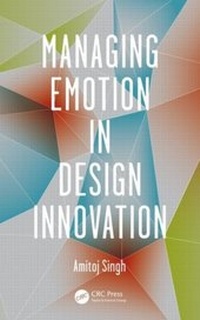
Managing Emotion in Design Innovation
1st Edition
Published on 28. August 2013
228 pages
978-1-4665-6751-1 (ISBN)
Description

This book presents an emotion centered research framework titled "emoha" for design innovation. It defines emoha and underlines the importance of the developed framework in culturalization of technology and thereby design innovation. The book explains the detailed research on product styling which leads to the creation of "Emoha" and how to use it in product design.
Reviews / Votes
"Perhaps we are entering a new historic period, where more and more ideas and innovations are coming out of Asia as opposed to the traditional thinking of innovation from the West, manufacturing from the East. It's refreshing to see a brand new design theory coming out of India, the emoha model launched by writer Amitoj Singh, and I am sure that this will be one of the first modern tools of many more to come."--Kristine Oustrup, CEO & Creative Director, Business Innovation Culture, Singapore
"Drawing upon years of experience working in the careful and detailed empirical case study to uncover some general principles of innovative, emotional product design, he explores the use and role of motorcycles in India (the most ubiquitous mode of transportation) in relation to the needs, concerns, and emotions of different demographics and the implications for motorcycle styling and design. ... An interesting and intelligent use of mixed (quantitative and qualitative) methods to explore the affective and design-relevant characteristics of a large demographically heterogeneous sample of motorcycle/rider dyads. ... Dr. Singh's impressive large-scale empirical study of the relation between motorcycle design and motorcycle users in the huge Indian motorcycle market, enables him to develop a thoughtful emotion-centered design model that focuses on the importance of the relation between the emotive needs of consumers and the emotive qualities of products for product styling in general."
--Andrew Ortony, Northwestern University, Chicago, Illinois, USA
"India is seen as a promising market since BRICs and BOP became familiar among the design industry. But design in India has been mainly discussed only in the course of BOP design or vernacular exotic design, despite the fact that there is a larger contemporary middle-class market than in most developed countries. This book is uniquely giving good frameworks to understand the relationship between Indian consumers and modern products from the aspect of design and emotion."
--Itsuro Shibata, Managing Director, GK Industrial Design Inc. Tokyo, Japan
"Dr Singh's book presents an original and comprehensive review of approaches and methods for the study of emotion related to product design. This overview, from subjective self-reporting methods to computerized tools for measurement of facial expressions, eye movements and psychophysiological signals, is a valuable resource for researchers and designers of motorbikes and other emotion-laden products."
--Lucas Noldus, Noldus Information Technology BV, Wageningen, The Netherlands
"Dr. Amitoj Singh has put great effort in portraying the importance of emotion in design. He has also done a great job of formulating a method which will be very helpful in getting some qualitative data out of the user and also figure out something conclusive from it. The differentiation created for the type of motorcycles and the users is very interesting and the overall study of motorcycling in India is also very impressive. This work will prove to be very useful for professional designers and will also be a very good study material for upcoming designers."
--S.Sivakumar, Head-Industrial Design, Royal Enfield Motorcycles, Chennai, India
"It's an emotion-centered world, and Dr. Amitoj Singh dissects it for us in a way that product design will never again exclude, the study of the emotional dimension of users."
--Eva de Lera, Evadelera.com, Barcelona, Spain
"This book is an exciting addition to the growing field of design and emotion studies. Its focus on motorbike design in India is enlightening and unique. Its development of the concept of "emoha" (emotion, attachment, dynamic experience) offers a foundation for designer's worldwide. Its guiding concern for the kinds of emotional harmony in society that innovative design might achieve is refreshing. Designing for emotions is not easy; this book offers a systematic approach that is readily available for others to use."
--Dr Keith Russell, Design, Communication & IT, University of Newcastle - Australia
"Based on the rigor and depth of the case study the book creates a compelling argument for the value of the emoha framework. As the author states, one case study is a good foundation for the value of exploring further direction, but multiple cases are required for confirmation. The strong analytical approach of the book in describing the emotional qualities of the product will engage new people in the emotional elements of design."
--Bruce MacGregor, IDEO
"Dr. Singh takes into account both the design and emotional/cultural research of others laying a good foundation for his thesis, but he does not get bogged down with unnecessary theory or unrelated statistics. He moves through the process with a very systematic and purposeful style creating a study which is very readable and logical in supporting his underlying proposition that emotions play an important role in design. This will increasingly be true as India continues to develop and the world becomes increasingly postmodern."
--David Peace, Shanti Consulting
"The book advances scholarly discourse as well as offering a novel approach to embedding consumer-inspired emotive cues in new product development. The case study is explored in great depth and will become an essential and recommended reading on the subject. This book represents an important epistemological contribution to available practical and context-responsive design methodologies by deploying pertinent qualitative and quantitative instruments to solve real-life challenges of enhancing consumer satisfaction through innovative knowledge driven product design."
--Prof. Mugendi K. M'Rithaa, Cape Peninsula University of Technology (CPUT), Cape Town, South Africa "Perhaps we are entering a new historic period, where more and more ideas and innovations are coming out of Asia as opposed to the traditional thinking of innovation from the West, manufacturing from the East. It's refreshing to see a brand new design theory coming out of India, the emoha model launched by writer Amitoj Singh, and I am sure that this will be one of the first modern tools of many more to come."
--Kristine Oustrup, CEO & Creative Director, Business Innovation Culture, Singapore
"Drawing upon years of experience working in the careful and detailed empirical case study to uncover some general principles of innovative, emotional product design, he explores the use and role of motorcycles in India (the most ubiquitous mode of transportation) in relation to the needs, concerns, and emotions of different demographics and the implications for motorcycle styling and design. ... An interesting and intelligent use of mixed (quantitative and qualitative) methods to explore the affective and design-relevant characteristics of a large demographically heterogeneous sample of motorcycle/rider dyads. ... Dr. Singh's impressive large-scale empirical study of the relation between motorcycle design and motorcycle users in the huge Indian motorcycle market, enables him to develop a thoughtful emotion-centered design model that focuses on the importance of the relation between the emotive needs of consumers and the emotive qualities of products for product styling in general."
--Andrew Ortony, Northwestern University, Chicago, Illinois, USA
"India is seen as a promising market since BRICs and BOP became familiar among the design industry. But design in India has been mainly discussed only in the course of BOP design or vernacular exotic design, despite the fact that there is a larger contemporary middle-class market than in most developed countries. This book is uniquely giving good frameworks to understand the relationship between Indian consumers and modern products from the aspect of design and emotion."
--Itsuro Shibata, Managing Director, GK Industrial Design Inc. Tokyo, Japan
"Dr Singh's book presents an original and comprehensive review of approaches and methods for the study of emotion related to product design. This overview, from subjective self-reporting methods to computerized tools for measurement of facial expressions, eye movements and psychophysiological signals, is a valuable resource for researchers and designers of motorbikes and other emotion-laden products."
--Lucas Noldus, Noldus Information Technology BV, Wageningen, The Netherlands
"Dr. Amitoj Singh has put great effort in portraying the importance of emotion in design. He has also done a great job of formulating a method which will be very helpful in getting some qualitative data out of the user and also figure out something conclusive from it. The differentiation created for the type of motorcycles and the users is very interesting and the overall study of motorcycling in India is also very impressive. This work will prove to be very useful for professional designers and will also be a very good study material for upcoming designers."
--S.Sivakumar, Head-Industrial Design, Royal Enfield Motorcycles, Chennai, India
"It's an emotion-centered world, and Dr. Amitoj Singh dissects it for us in a way that product design will never again exclude, the study of the emotional dimension of users."
--Eva de Lera, Evadelera.com, Barcelona, Spain
"This book is an exciting addition to the growing field of design and emotion studies. Its focus on motorbike design in India is enlightening and unique. Its development of the concept of "emoha" (emotion, attachment, dynamic experience) offers a foundation for designer's worldwide. Its guiding concern for the kinds of emotional harmony in society that innovative design might achieve is refreshing. Designing for emotions is not easy; this book offers a systematic approach that is readily available for others to use."
--Dr Keith Russell, Design, Communication & IT, University of Newcastle - Australia
"Based on the rigor and depth of the case study the book creates a compelling argument for the value of the emoha framework. As the author states, one case study is a good foundation for the value of exploring further direction, but multiple cases are required for confirmation. The strong analytical approach of the book in describing the emotional qualities of the product will engage new people in the emotional elements of design."
--Bruce MacGregor, IDEO
"Dr. Singh takes into account both the design and emotional/cultural research of others laying a good foundation for his thesis, but he does not get bogged down with unnecessary theory or unrelated statistics. He moves through the process with a very systematic and purposeful style creating a study which is very readable and logical in supporting his underlying proposition that emotions play an important role in design. This will increasingly be true as India continues to develop and the world becomes increasingly postmodern."
--David Peace, Shanti Consulting
"The book advances scholarly discourse as well as offering a novel approach to embedding consumer-inspired emotive cues in new product development. The case study is explored in great depth and will become an essential and recommended reading on the subject. This book represents an important epistemological contribution to available practical and context-responsive design methodologies by deploying pertinent qualitative and quantitative instruments to solve real-life challenges of enhancing consumer satisfaction through innovative knowledge driven product design."
--Prof. Mugendi K. M'Rithaa, Cape Peninsula University of Technology (CPUT), Cape Town, South Africa
More details
Language
English
Place of publication
Baton Rouge
United States
Publishing group
Taylor & Francis Inc
Target group
Professional and scholarly
Illustrations
56 s/w Abbildungen, 42 s/w Tabellen
56 b/w images and 42 tables
File size
29,84 MB
ISBN-13
978-1-4665-6751-1 (9781466567511)
Copyright in bibliographic data and cover images is held by Nielsen Book Services Limited or by the publishers or by their respective licensors: all rights reserved.
Schweitzer Classification
Other editions
Additional editions
Amitoj Singh
Managing Emotion in Design Innovation
Book
08/2013
1st Edition
CRC Press
€186.20
Shipment within 15-20 days
Person
Amitoj Singh is a pioneering PhD holder in the discipline of industrial design from India. His groundbreaking research has led to the development of the emotion-centered framework for product design. He is deeply interested in blending his rich industry experience and academic rigor to develop breakthrough and innovative products, services, and systems. Currently, he is leading product innovation projects at Samsung India Electronics Pvt. Ltd. Before joining Samsung, he was working as an assistant professor in the Industrial Design Program at IIT Delhi. He has various international publications and patents (applied) to his credit. His specializations include emotion-centered design, design research and strategy, and disruptive innovation management.
Content
Introduction. Literature-Oriented Research Framework. Evolution of Research Methodology. The Sociocultural Segmentation of Biking. Emotive Quality of Biking Segments. Emotion-Centered Research Framework for Design Innovation.
