

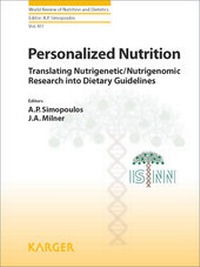
Personalized Nutrition
Translating Nutrigenetic/Nutrigenomic Research into Dietary Guidelines.
1st Edition
Published on 3. May 2010
180 pages
978-3-8055-9428-8 (ISBN)
Available for download
Description

Awareness of the influence of our genetic variation to dietary response (nutrigenetics) and how nutrients may affect gene expression (nutrigenomics) is prompting a revolution in the field of nutrition. Nutrigenetics/Nutrigenomics provide powerful approaches to unravel the complex relationships among nutritional molecules, genetic variants and the biological system. This publication contains selected papers from the '3rd Congress of the International Society of Nutrigenetics/Nutrigenomics' held in Bethesda, Md., in October 2009. The contributions address frontiers in nutrigenetics, nutrigenomics, epigenetics, transcriptomics as well as non-coding RNAs and posttranslational gene regulations in various diseases and conditions. In addition to scientific studies, the challenges and opportunities facing governments, academia and the industry are included. Everyone interested in the future of personalized medicine and nutrition or agriculture, as well as researchers in academia, government and industry will find this publication of the utmost interest for their work.
More details
Other editions
Additional editions
Simopoulos | Milner
Personalized Nutrition
Translating Nutrigenetic/Nutrigenomic Research into Dietary Guidelines.
Book
05/2010
1st Edition
S. Karger
€114.50
Article exhausted; check different version
Persons
Content
1 - Cover [Seite 1]
2 - Contents [Seite 6]
3 - List of Contributors [Seite 8]
4 - Preface [Seite 12]
5 - Opportunities and Challenges in Nutrigenetics/Nutrigenomics and Health [Seite 22]
5.1 - Why Nutrigenetics/Nutrigenomics? [Seite 22]
5.2 - Opportunities [Seite 23]
5.3 - Challenges [Seite 25]
5.4 - How to Deal with the Challenges [Seite 27]
5.5 - References [Seite 27]
6 - Genome-Wide Association Studies and Diet [Seite 29]
6.1 - Monogenic Disorders and Complex Disease [Seite 30]
6.2 - Enabling Technologies in GWAS [Seite 31]
6.3 - GWAS: Why Are They Important? [Seite 31]
6.4 - Use of Gene Chips and GWAS Datasets in Personalized Health Predictions [Seite 32]
6.5 - Gene-Diet Interactions: Crohn's Disease [Seite 33]
6.6 - Acknowledgments [Seite 34]
6.7 - References [Seite 34]
7 - Copy Number Variation, Eicosapentaenoic Acid and Neurological Disorders [Seite 36]
7.1 - Ethyl-EPA [Seite 36]
7.2 - Huntington's Disease [Seite 37]
7.3 - Myalgic Encephalomyelitis [Seite 38]
7.4 - Conclusions [Seite 39]
7.5 - References [Seite 39]
8 - Nutrigenetics: A Tool to Provide Personalized Nutritional Therapy to the Obese [Seite 42]
8.1 - Observational Studies Evidencing Gene-Nutrient Interactions on Weight Gain [Seite 43]
8.2 - Intervention Studies Concerning Genetic Modification Effects on Weight Loss and Maintenance [Seite 46]
8.3 - Nutritional Studies Concerning Gene-Dependent Effects on Obesity-Related Manifestations [Seite 49]
8.4 - Conclusions [Seite 51]
8.5 - References [Seite 51]
9 - Xenobiotic Metabolizing Genes, Meat-Related Exposures, and Risk of Advanced Colorectal Adenoma [Seite 55]
9.1 - Materials and Methods [Seite 56]
9.2 - Results [Seite 57]
9.3 - Discussion [Seite 59]
9.4 - Acknowledgments [Seite 62]
9.5 - References [Seite 64]
10 - Strategies to Improve Detection of Hypertension Genes [Seite 67]
10.1 - Subject Selection [Seite 68]
10.2 - Selecting an Intervention [Seite 69]
10.3 - Study Time Windows [Seite 69]
10.4 - Tissue versus Central Phenotype Measurement [Seite 70]
10.5 - Intervention Studies [Seite 72]
10.6 - Improving Genome-Wide Association Results [Seite 73]
10.7 - Summary [Seite 74]
10.8 - Acknowledgments [Seite 74]
10.9 - References [Seite 75]
11 - Diet, Nutrition and Modulation of Genomic Expression in Fetal Origins of Adult Disease [Seite 77]
11.1 - Epidemiology [Seite 78]
11.2 - Experiments of Nature [Seite 79]
11.3 - Cancer Risk and Early Life [Seite 80]
11.4 - Growth and Development [Seite 81]
11.5 - Size and Body Composition at Birth [Seite 83]
11.6 - Developmental Plasticity [Seite 84]
11.7 - Animal Models [Seite 84]
11.8 - Epigenetics and Cancer [Seite 88]
11.9 - Conclusion [Seite 88]
11.10 - References [Seite 90]
12 - Choline: Clinical Nutrigenetic/Nutrigenomic Approaches for Identification of Functions and Dietary Requirements [Seite 94]
12.1 - Challenges for Clinical Nutrigenetics/Nutrigenomics [Seite 94]
12.2 - Other Considerations before Undertaking Clinical Nutrigenetics/Nutrigenomics [Seite 96]
12.3 - Prototype Experiment in Nutrigenetics/Nutrigenomics: Studies on Choline Deficiency [Seite 96]
12.4 - Choline Metabolism [Seite 96]
12.5 - Consequences of Dietary Choline Deficiency in Humans [Seite 97]
12.6 - Genetic Variation in Dietary Requirements for Choline [Seite 99]
12.7 - Choline and Neural Development [Seite 99]
12.8 - Choline Deficiency Alters Gene Expression via Epigenetic Mechanisms [Seite 100]
12.9 - Long-Lasting Consequences of Prenatal Choline Availability [Seite 100]
12.10 - Implications for Human Brain Development [Seite 101]
12.11 - Acknowledgments [Seite 101]
12.12 - References [Seite 101]
13 - Dietary Polyphenols, Deacetylases and Chromatin Remodeling in Inflammation [Seite 105]
13.1 - Polyphenols: An Overview [Seite 106]
13.2 - Modulation of Inflammation by Polyphenols [Seite 106]
13.3 - Deacetylases and Inflammation [Seite 108]
13.4 - Modulation of Deacetylases by Dietary Polyphenols [Seite 109]
13.5 - Conclusions [Seite 112]
13.6 - Acknowledgments [Seite 113]
13.7 - References [Seite 113]
14 - Dietary Manipulation of Histone Structure and Function [Seite 116]
14.1 - Use of Histone Deacetylase Inhibitors in Cancer Prevention [Seite 117]
14.2 - Dietary Inhibitors of Histone Deacetylases [Seite 118]
14.3 - Future Directions and Conclusions [Seite 120]
14.4 - Acknowledgments [Seite 121]
14.5 - References [Seite 122]
15 - Changes in Human Adipose Tissue Gene Expression during Diet-Induced Weight Loss [Seite 124]
15.1 - Obesity [Seite 124]
15.2 - Obesity Treatment [Seite 125]
15.3 - Adipose Tissue [Seite 125]
15.4 - Expression Profiling of Human Adipose Tissue during Diet-Induced Weight Loss [Seite 126]
15.5 - Serum Amyloid A Expression in Human Adipose Tissue and Association with Metabolic Disease [Seite 129]
15.6 - CIDE Family [Seite 130]
15.7 - A Local Activin B Signaling System in Adipose Tissue? [Seite 131]
15.8 - Conclusions [Seite 132]
15.9 - Acknowledgments [Seite 132]
15.10 - References [Seite 132]
16 - Toxicogenomics and Studies of Genomic Effects of Dietary Components [Seite 136]
16.1 - Reference Materials and Methods to Improve and Monitor Laboratory Proficiency in Microarray Assays [Seite 137]
16.2 - Identification of Factors that Increase Biological Noise in Gene Expression Studies [Seite 138]
16.3 - Phenotypic Anchoring to Supply a Biological Context for Interpreting Gene Expression Data [Seite 140]
16.4 - Reference Sets that Aid in the Interpretation of Adverse versus Adaptive Effects [Seite 141]
16.5 - Conclusions [Seite 142]
16.6 - Disclaimer [Seite 142]
16.7 - References [Seite 142]
17 - Dietary Methyl Deficiency, microRNA Expression and Susceptibility to Liver Carcinogenesis [Seite 144]
17.1 - Materials and Methods [Seite 145]
17.2 - Results and Discussion [Seite 146]
17.3 - Disclaimer [Seite 150]
17.4 - References [Seite 150]
18 - Redox Dysregulation and Oxidative Stress in Schizophrenia: Nutrigenetics as a Challenge in Psychiatric Disease Prevention [Seite 152]
18.1 - Redox/Glutathione Dysregulation Is a Vulnerability Factor in Schizophrenia [Seite 155]
18.2 - Pathophysiological Mechanisms [Seite 157]
18.3 - Developmental Animal Models with Redox Dysregulation [Seite 159]
18.4 - Therapeutic and Preventive Perspectives [Seite 162]
18.5 - Conclusion [Seite 167]
18.6 - Acknowledgments [Seite 167]
18.7 - References [Seite 167]
19 - Nutrigenomics and Agriculture: A Perspective [Seite 175]
19.1 - Genomic Prediction in Dairy Cows [Seite 175]
19.2 - Dietary Guidance [Seite 176]
19.3 - Discussion [Seite 178]
19.4 - References [Seite 180]
20 - Opportunities and Challenges in Nutrigenetics/Nutrigenomics: Building Industry-Academia Partnerships [Seite 181]
20.1 - The Challenge before Us [Seite 181]
20.2 - Accelerated Learning Curves [Seite 181]
20.3 - Professional Development and Building Networks [Seite 184]
20.4 - Sharing Science [Seite 184]
20.5 - Anatomy of a Partnership Model in Molecular Nutrition [Seite 184]
20.6 - Final Thoughts [Seite 188]
20.7 - Disclosures [Seite 188]
20.8 - References [Seite 189]
21 - Tailoring Foods to Match People's Genes in New Zealand: Opportunities for Collaboration [Seite 190]
21.1 - Role of Genetics in CD in New Zealand [Seite 190]
21.2 - Modeling Genetic Variation in Human CD Populations in vitro [Seite 192]
21.3 - Estimating the Role of Diet in CD [Seite 193]
21.4 - Animal Models of IBD [Seite 194]
21.5 - Double-Blind Placebo Controlled Human Clinical Trials [Seite 194]
21.6 - Data Management and Integration [Seite 195]
21.7 - Acknowledgments [Seite 195]
21.8 - References [Seite 195]
22 - Author Index [Seite 197]
23 - Subject Index [Seite 198]
2 - Contents [Seite 6]
3 - List of Contributors [Seite 8]
4 - Preface [Seite 12]
5 - Opportunities and Challenges in Nutrigenetics/Nutrigenomics and Health [Seite 22]
5.1 - Why Nutrigenetics/Nutrigenomics? [Seite 22]
5.2 - Opportunities [Seite 23]
5.3 - Challenges [Seite 25]
5.4 - How to Deal with the Challenges [Seite 27]
5.5 - References [Seite 27]
6 - Genome-Wide Association Studies and Diet [Seite 29]
6.1 - Monogenic Disorders and Complex Disease [Seite 30]
6.2 - Enabling Technologies in GWAS [Seite 31]
6.3 - GWAS: Why Are They Important? [Seite 31]
6.4 - Use of Gene Chips and GWAS Datasets in Personalized Health Predictions [Seite 32]
6.5 - Gene-Diet Interactions: Crohn's Disease [Seite 33]
6.6 - Acknowledgments [Seite 34]
6.7 - References [Seite 34]
7 - Copy Number Variation, Eicosapentaenoic Acid and Neurological Disorders [Seite 36]
7.1 - Ethyl-EPA [Seite 36]
7.2 - Huntington's Disease [Seite 37]
7.3 - Myalgic Encephalomyelitis [Seite 38]
7.4 - Conclusions [Seite 39]
7.5 - References [Seite 39]
8 - Nutrigenetics: A Tool to Provide Personalized Nutritional Therapy to the Obese [Seite 42]
8.1 - Observational Studies Evidencing Gene-Nutrient Interactions on Weight Gain [Seite 43]
8.2 - Intervention Studies Concerning Genetic Modification Effects on Weight Loss and Maintenance [Seite 46]
8.3 - Nutritional Studies Concerning Gene-Dependent Effects on Obesity-Related Manifestations [Seite 49]
8.4 - Conclusions [Seite 51]
8.5 - References [Seite 51]
9 - Xenobiotic Metabolizing Genes, Meat-Related Exposures, and Risk of Advanced Colorectal Adenoma [Seite 55]
9.1 - Materials and Methods [Seite 56]
9.2 - Results [Seite 57]
9.3 - Discussion [Seite 59]
9.4 - Acknowledgments [Seite 62]
9.5 - References [Seite 64]
10 - Strategies to Improve Detection of Hypertension Genes [Seite 67]
10.1 - Subject Selection [Seite 68]
10.2 - Selecting an Intervention [Seite 69]
10.3 - Study Time Windows [Seite 69]
10.4 - Tissue versus Central Phenotype Measurement [Seite 70]
10.5 - Intervention Studies [Seite 72]
10.6 - Improving Genome-Wide Association Results [Seite 73]
10.7 - Summary [Seite 74]
10.8 - Acknowledgments [Seite 74]
10.9 - References [Seite 75]
11 - Diet, Nutrition and Modulation of Genomic Expression in Fetal Origins of Adult Disease [Seite 77]
11.1 - Epidemiology [Seite 78]
11.2 - Experiments of Nature [Seite 79]
11.3 - Cancer Risk and Early Life [Seite 80]
11.4 - Growth and Development [Seite 81]
11.5 - Size and Body Composition at Birth [Seite 83]
11.6 - Developmental Plasticity [Seite 84]
11.7 - Animal Models [Seite 84]
11.8 - Epigenetics and Cancer [Seite 88]
11.9 - Conclusion [Seite 88]
11.10 - References [Seite 90]
12 - Choline: Clinical Nutrigenetic/Nutrigenomic Approaches for Identification of Functions and Dietary Requirements [Seite 94]
12.1 - Challenges for Clinical Nutrigenetics/Nutrigenomics [Seite 94]
12.2 - Other Considerations before Undertaking Clinical Nutrigenetics/Nutrigenomics [Seite 96]
12.3 - Prototype Experiment in Nutrigenetics/Nutrigenomics: Studies on Choline Deficiency [Seite 96]
12.4 - Choline Metabolism [Seite 96]
12.5 - Consequences of Dietary Choline Deficiency in Humans [Seite 97]
12.6 - Genetic Variation in Dietary Requirements for Choline [Seite 99]
12.7 - Choline and Neural Development [Seite 99]
12.8 - Choline Deficiency Alters Gene Expression via Epigenetic Mechanisms [Seite 100]
12.9 - Long-Lasting Consequences of Prenatal Choline Availability [Seite 100]
12.10 - Implications for Human Brain Development [Seite 101]
12.11 - Acknowledgments [Seite 101]
12.12 - References [Seite 101]
13 - Dietary Polyphenols, Deacetylases and Chromatin Remodeling in Inflammation [Seite 105]
13.1 - Polyphenols: An Overview [Seite 106]
13.2 - Modulation of Inflammation by Polyphenols [Seite 106]
13.3 - Deacetylases and Inflammation [Seite 108]
13.4 - Modulation of Deacetylases by Dietary Polyphenols [Seite 109]
13.5 - Conclusions [Seite 112]
13.6 - Acknowledgments [Seite 113]
13.7 - References [Seite 113]
14 - Dietary Manipulation of Histone Structure and Function [Seite 116]
14.1 - Use of Histone Deacetylase Inhibitors in Cancer Prevention [Seite 117]
14.2 - Dietary Inhibitors of Histone Deacetylases [Seite 118]
14.3 - Future Directions and Conclusions [Seite 120]
14.4 - Acknowledgments [Seite 121]
14.5 - References [Seite 122]
15 - Changes in Human Adipose Tissue Gene Expression during Diet-Induced Weight Loss [Seite 124]
15.1 - Obesity [Seite 124]
15.2 - Obesity Treatment [Seite 125]
15.3 - Adipose Tissue [Seite 125]
15.4 - Expression Profiling of Human Adipose Tissue during Diet-Induced Weight Loss [Seite 126]
15.5 - Serum Amyloid A Expression in Human Adipose Tissue and Association with Metabolic Disease [Seite 129]
15.6 - CIDE Family [Seite 130]
15.7 - A Local Activin B Signaling System in Adipose Tissue? [Seite 131]
15.8 - Conclusions [Seite 132]
15.9 - Acknowledgments [Seite 132]
15.10 - References [Seite 132]
16 - Toxicogenomics and Studies of Genomic Effects of Dietary Components [Seite 136]
16.1 - Reference Materials and Methods to Improve and Monitor Laboratory Proficiency in Microarray Assays [Seite 137]
16.2 - Identification of Factors that Increase Biological Noise in Gene Expression Studies [Seite 138]
16.3 - Phenotypic Anchoring to Supply a Biological Context for Interpreting Gene Expression Data [Seite 140]
16.4 - Reference Sets that Aid in the Interpretation of Adverse versus Adaptive Effects [Seite 141]
16.5 - Conclusions [Seite 142]
16.6 - Disclaimer [Seite 142]
16.7 - References [Seite 142]
17 - Dietary Methyl Deficiency, microRNA Expression and Susceptibility to Liver Carcinogenesis [Seite 144]
17.1 - Materials and Methods [Seite 145]
17.2 - Results and Discussion [Seite 146]
17.3 - Disclaimer [Seite 150]
17.4 - References [Seite 150]
18 - Redox Dysregulation and Oxidative Stress in Schizophrenia: Nutrigenetics as a Challenge in Psychiatric Disease Prevention [Seite 152]
18.1 - Redox/Glutathione Dysregulation Is a Vulnerability Factor in Schizophrenia [Seite 155]
18.2 - Pathophysiological Mechanisms [Seite 157]
18.3 - Developmental Animal Models with Redox Dysregulation [Seite 159]
18.4 - Therapeutic and Preventive Perspectives [Seite 162]
18.5 - Conclusion [Seite 167]
18.6 - Acknowledgments [Seite 167]
18.7 - References [Seite 167]
19 - Nutrigenomics and Agriculture: A Perspective [Seite 175]
19.1 - Genomic Prediction in Dairy Cows [Seite 175]
19.2 - Dietary Guidance [Seite 176]
19.3 - Discussion [Seite 178]
19.4 - References [Seite 180]
20 - Opportunities and Challenges in Nutrigenetics/Nutrigenomics: Building Industry-Academia Partnerships [Seite 181]
20.1 - The Challenge before Us [Seite 181]
20.2 - Accelerated Learning Curves [Seite 181]
20.3 - Professional Development and Building Networks [Seite 184]
20.4 - Sharing Science [Seite 184]
20.5 - Anatomy of a Partnership Model in Molecular Nutrition [Seite 184]
20.6 - Final Thoughts [Seite 188]
20.7 - Disclosures [Seite 188]
20.8 - References [Seite 189]
21 - Tailoring Foods to Match People's Genes in New Zealand: Opportunities for Collaboration [Seite 190]
21.1 - Role of Genetics in CD in New Zealand [Seite 190]
21.2 - Modeling Genetic Variation in Human CD Populations in vitro [Seite 192]
21.3 - Estimating the Role of Diet in CD [Seite 193]
21.4 - Animal Models of IBD [Seite 194]
21.5 - Double-Blind Placebo Controlled Human Clinical Trials [Seite 194]
21.6 - Data Management and Integration [Seite 195]
21.7 - Acknowledgments [Seite 195]
21.8 - References [Seite 195]
22 - Author Index [Seite 197]
23 - Subject Index [Seite 198]

