

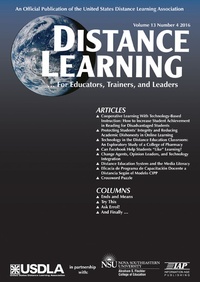
Distance Learning
Volume 13 #4
1st Edition
Published on 12. January 2016
89 pages
978-1-68123-903-3 (ISBN)
Description

Distance Learning is for leaders, practitioners, and decision makers in the fields of distance learning, e'learning, telecommunications, and related areas. It is a professional journal with applicable information for those involved with providing instruction to all kinds of learners, of all ages, using telecommunications technologies of all types. Stories are written by practitioners for practitioners with the intent of providing usable information and ideas. Articles are accepted from authors -new and experienced - with interesting and important information about the effective practice of distance teaching and learning.
Distance Learning is published quarterly. Each issue includes eight to ten articles and three to four columns, including the highly regarded 'And Finally...' column covering recent important issues in the field and written by Distance Learning editor, Michael Simonson. Articles are written by practitioners from various countries and locations, nationally and internationally.
Distance Learning is published quarterly. Each issue includes eight to ten articles and three to four columns, including the highly regarded 'And Finally...' column covering recent important issues in the field and written by Distance Learning editor, Michael Simonson. Articles are written by practitioners from various countries and locations, nationally and internationally.
All prices
More details
Other editions
Additional editions

Michael Simonson | Charles Schlosser | John G. Flores
Distance Learning Vol 13 Issue 4
Book
06/2017
Information Age Publishing
€47.00
Shipment within 3-4 weeks
Content
- Front Cover
- Featured Articles
- 1
- Cooperative Learning With Technology-Based Instruction: How to Increase Student Achievement in Reading for Disadvantaged Students
- 9
- Protecting Students' Integrity and Reducing Academic Dishonesty in Online Learning
- 17
- Technology in the Distance Education Classroom: An Exploratory Study of a College of Pharmacy
- 27
- Can Facebook Help Students "Like" Learning?
- 33
- Change Agents, Opinion Leaders, and Technology Integration
- 41
- Distance Education System and the Media Literacy
- 57
- Eficacia de Programa de Capacitación Docente a Distancia Según el Modelo CIPP
- Columns
- Cooperative Learning With Technology-Based Instruction
- How to Increase Student Achievement in Reading for Disadvantaged Students
- Aries Cobb
- Introduction
- Theoretical Foundations: Constructivism and Social Interdependence Theory
- Nature of Cooperative Learning: Core Principles of Cooperative Learning
- Positive Interdependence
- 1. A student must learn the material and make certain group members learn the material.
- 2. Joint rewards mean if all group members achieve above a certain percentage on the test, each will receive bonus points.
- 3. Materials and information are shared (one paper for each group or each member receives only part of the information needed to do the assignment).
- 4. In addition, students are assigned roles such as summarizer, encourager of participation, collaborator, and reporter.
- Individual Accountability
- Face-to-Face Interaction
- Interpersonal and Small-Group Skills
- Group Processing
- Disadvantaged Students' Attitudes Toward Cooperative Learning
- Cooperative Learning
- Enhancing Education Through Technology (EETT)
- CAI
- 1. There was a significant difference in the gains of reading achievement between the district Year 1 EETT schools and other non-EETT schools.
- 2. Schools in Year 1 of the EETT grant were significantly larger than non- EETT schools.
- 1. Of the subjects, 84% genuinely believed they increased their knowledge and learned more computer skills via group work.
- 2. Ninety percent of the participants preferred learning via group work.
- 3. Eighty percent of the students in the study were aware that cooperative learning allowed more discussion time with teammates.
- 4. Seventy-one percent reported that classmates were more willing to assist.
- 5. Eighty-seven percent felt that cooperative approach made them get along much better with others.
- 6. The majority of the learners enjoyed working with their teammates with computers and felt that the spontaneity of picking up tips and ideas from others in the group was both helpful and fascinating.
- Cooperative Learning and Gains in Technology Literacy
- Student Achievement: Meta-Analysis
- Effects of CAI and Cooperative Learning
- Cooperative Tools: ePals
- Conclusion
- References
- "Furthermore, cooperative group members who work together on a continuous basis have shown a greater ability to make psychological adjustments, which allows them to work together to achieve goals."
- Your Advertisement or Announcement Could Be Here
- USDLA 8 Winter Street, Suite 508 Boston, MA 02108 800-275-5162
- "Proctoring software include Examity, Kryterion, ProctorU, ProctorCam, Respondus Monitor, and Software Secure."
- Protecting Students' Integrity and Reducing Academic Dishonesty in Online Learning
- Lauren Cifuentes and Alexandra Janney
- Introduction
- Resources
- Authentication
- Features of Learning Management Systems That Minimize Cheating
- Preventive Technologies
- Proctoring
- Pedagogical Solutions
- Conclusions
- References
- Technology in the Distance Education Classroom
- An Exploratory Study of a College of Pharmacy
- Lydia R. Frass, Ryan Rucker, and Daniel Brown
- Introduction
- Literature Review
- Broadcast Delivery Classrooms
- Levels of Use of the Innovation
- Adoption of LMS Tools
- Purpose and Research Questions
- Design and Methods
- Participants
- Data Collection Procedures
- Survey Instrument
- 1. Level 0 (no interest in tool/taking no action to learn tool) = 1
- 2. Level 1 (taking an initiative to learn more about the tool) = 2
- 3. Level 2 (have a definite plan to begin using the tool) = 3
- 4. Level 3 (looking at ways to better organize using the tool) = 4
- 5. Level 4 (making few or no changes of using the tool/established pattern of use) = 5
- 6. Level 5 (making changes of using the tool to increase outcomes) = 6
- 7. Level 6 (making efforts to coordinate with others in using the tool) = 7
- or
- 8. Level 7 (Looking at effective alternatives of the current tool) = 8.
- Results
- Demographics
- Technology Adoption Levels Within Blackboard
- Table 2. Select the Answer That Best Matches How Often You Use These Tools Within Blackboard Learn (n = 13)
- 5.85
- 1.73
- 5.69
- 1.51
- 5.62
- 1.62
- 4.62
- 1.45
- 3.62
- 1.73
- 2.77
- 1.47
- 2.50
- 1.52
- 2.00
- 1.50
- 1.69
- 1.47
- 1.54
- 1.47
- Technology Adoption Levels Within Distance Education Classrooms
- Training and Support Usage
- Need for Additional Training
- Table 3. Select the Answer That Best Matches How Often You Use These Tools Within the Distance Education Classroom (n = 13)
- 5.85
- 1.33
- 5.77
- 1.55
- 5.54
- 1.42
- 5.46
- 1.49
- 5.17
- 1.56
- 4.69
- 1.42
- 4.69
- 0.93
- 4.62
- 1.06
- 4.54
- 1.25
- 4.31
- 1.46
- 4.08
- 1.08
- 3.54
- 1.07
- 3.38
- 0.73
- 3.31
- 1.07
- 1.92
- 1.30
- Table 4. How Did You Most Frequently Learn to Use the Tools and the Navigation of the Distance Education Classroom? (n = 13)
- 2.85
- 0.74
- 2.69
- 0.72
- 2.31
- 0.68
- 2.15
- 0.74
- 2.00
- 0.76
- 1.69
- 0.53
- 1.69
- 0.80
- 1.46
- 0.80
- 1.31
- 0.77
- Discussion
- Table 5. Select Your Level of Agreement With the Need for Training on the Following Tools (n = 13)
- 3.69
- 2.19
- 3.54
- 1.93
- 3.46
- 1.49
- 3.38
- 0.63
- 3.17
- 1.58
- 3.15
- 1.67
- 3.15
- 1.80
- 2.77
- 2.34
- 2.69
- 1.66
- 2.23
- 2.02
- 2.23
- 2.10
- 2.15
- 1.67
- 2.15
- 1.88
- 2.00
- 1.66
- 1.85
- 1.77
- Table 6. Preferred Format for Additional Training (n = 15)
- 8
- 5
- 4
- 4
- 2
- 1
- 1
- Future Research
- Recommendations
- References
- Table 1. Number of Faculty and Their Years of Experience Teaching Face-to-Face and Distance Delivery (n = 13)
- 1
- 5
- 5
- 7
- 2
- 0
- 2
- 1
- 3
- 0
- Can Facebook Help Students "Like" Learning?
- Danielle L. Karr
- Introduction
- The Negatives and Positives of Facebook
- Popularity of Facebook
- University CMS Versus Facebook
- Social Constructivist Approach
- Ways to use Facebook in the Classroom
- Follow Class Topics
- Get to Know Students
- Gather and Share Relevant Information
- Listen With Friends
- Live Streaming
- Polling Abilities
- Peer Aid
- Learning Gauge
- Assignment Reminders Through Events
- Easy Study Group Formation
- Central Class Calendar
- Fun and Useful Apps
- Easily Share Links and Videos
- Mobile Connectivity
- The Future of Web 2.0 Is Now
- References
- Call for Papers
- Publish in Distance Learning
- The editors of Distance Learning would like to publish your paper. We are interested in papers dealing with practical applications of distance education in a variety of settings. Contact Michael Simonson, editor, if you have questions about your idea...
- "Opinion leadership is the degree to which an individual is able to influence the attitudes and behaviors of others. Opinion leadership is not attached to the individual's status or formal position."
- Change Agents, Opinion Leaders, and Technology Integration
- Christopher Masullo
- Introduction
- The Problem
- Importance of a Technology Leader
- Role of the Technology Leader
- The Technology Coordinator as a Change Agent
- The Role of Technology Opinion Leaders
- Results
- Discussion
- Recommendations
- References
- Distance Education System and Media Literacy
- Mohsen Keshavarz
- Introduction
- Renewed Debates Over Media Literacy
- Is "Literacy' a Useful Term?
- What Is Media Literacy?
- Access
- Analysis
- Evaluation
- Content Creation
- 1. First layer: the importance of personal planning in the way of using media, which means that the audience has more attention to selecting and watching different programs and in a particular way, s/he uses TV, video, electronic games, films and oth...
- 2. Second Layer: in this level, the audience pays attention to the less recognizable (palpable) aspects of media and focuses on deeper questions and topics such as
- that makes the media message? What purposes are followed by making such messages? Who...
- 3. Third Layer: this is a layer for watching media critically. Using these skills, the audience questions and analyzes the framework of making a message and its missing aspects. What is of utmost significance in this layer is that the audience unders...
- Research Goal
- Research questions
- 1. Does distance education system have an effect on the media regime of higher education students in Tehran University?
- 2. Does distance education system have an effect on the critical analysis of higher education students in Tehran University?
- 3. Does distance education system have an effect on the content analysis of higher education students in Tehran University?
- Instruments and Methods
- Findings
- Table 3. Results of Levene Test for Homogeneity of Variance Error
- 98
- 1
- 1/52
- 0.054
- Table 4. Kolmogorov-Smirnov Test
- Media literacy
- 0.637
- Table 6. Test of the Effect of Within Variables
- 248/04
- 1
- 248/04
- 33/70
- 0.001
- 17/64
- 1
- 17/64
- 0.001
- 0.857
- 1054318/24
- 1
- 1054318/24
- 14/38
- 0.001
- 93818/96
- 1
- 93818/96
- 0.092
- 0.001
- 2480/04
- 1
- 2480/04
- 6112/45
- 0.001
- 17/64
- 1
- 17/64
- 4881/61
- 0.857
- 16903/72
- 98
- 172/49
- 14/38
- 0.001
- 18834/40
- 98
- 192/19
- 0.092
- 0.001
- 1073702/0
- 100
- ...
- ..
- ...
- 957038/0
- 100
- ...
- ..
- ...
- 19383/76
- 99
- ...
- ..
- ...
- 18852/04
- 99
- ....
- ..
- ...
- Table 7. Results of Analysis for T Test
- Conclusion and Discussion
- References
- Appendix 1
- Media Literacy Questionnaire Based on Thoman View
- Media Literacy Questionnaire
- 1
- 2
- 3
- 4
- 5
- Distance Learning journal welcome articles written by practitioners for practitioners, including languages other than English.
- Eficacia de Programa de Capacitación Docente a Distancia Según el Modelo CIPP
- Lourdes M. Cruz Ortiz
- Introducción
- Antecedentes y Justificación
- Propósito
- Revisión de Literatura
- La Educación a Distancia
- El Rol del Docente en la EaD
- La Capacitación del Docente en Educación a Distancia
- Competencias Para Enseñar en Línea
- Programa de Capacitación Docente en Educación a Distancia
- La Eficacia de los Programas
- Tabla 1. Competencias Específicas Para el Facilitador de la EaD
- Tabla 2. Principios Básicos Para el Desarrollo Profesional
- 1
- 2
- 3
- 4
- 5
- 6
- 7
- 8
- Evaluación de un Programa de Capacitación para la Educación a Distancia
- El Modelo CIPP
- Preguntas de Investigación
- 1. ¿Cuáles son las fortalezas y debilidades que perciben los docentes sobre el programa de capacitación en EaD ofrecido por una institución de educación superior en Puerto Rico en cuanto a aspectos relacionados con la etapa de proceso y producto?
- 2. ¿Cuál es el nivel de satisfacción del docente sobre el programa de capacitación recibido en una institución de educación superior en Puerto Rico con relación a su formación académica para dictar cursos a distancia?
- Metodología
- Participantes
- Diseño
- Resultados
- Recolección y Análisis de los Datos
- Presentación y Descripción de los Resultados
- Conclusiones y Recomendaciones
- Referencias
- Instructor Roles in Next Generation Digital Learning Environments
- Natalie B. Milman
- 1. interoperability and integration
- 2. personalization
- 3. analytics, advising, and learning assessment
- 4. collaboration
- 5. accessibility and universal design (Brown et al., 2015, p. 4).
- 1. be involved stakeholders and decision- makers in the development, creation, and implementation of NGDLEs (students should also be involved, as well)
- 2. reconceptualize their roles and mindsets so they align with the conceptual and concrete features of NGDLEs
- 3. design instruction that takes full advantage of the NGDLE's architecture, integration, data collection, and analysis tools
- 4. play a key role in choosing the tools that best support and personalize students' learning
- 5. determine how to engage students in meaningful collaboration
- and
- 6. bolster their own knowledge and skills-akin to their own "technological pedagogical content knowledge" (Mishra & Koehler, 2006) of NGDLEs.
- References
- Quarterly Review of Distance Education, Subscribe Today! www.infoagepub.com
- NGDLEs = Next generation digital learning environments = the next phase of learning management systems.
- The Joy and Ease of Using Professional Experience to Enhance Students' Classroom Experience
- Errol Craig Sull
- Notes
- The Suggestions
- 1. "Ah-that thesis statement you wrote: employers look for concise and easy- to-understand ones in so-called executive summaries."
- 2. Professional Alert: Great insight! Remember: this use of critical thinking is always appreciated by employers, colleagues, and customers!
- Some Helpful Links
- Professional Associations, Organizations, and Societies
- Websites With a Focus on Using Experience in the Classroom
- Ask Errol!
- Errol Craig Sull
- Being Selected to Present at Facultywide Webinars
- Student With a Potentially Dangerous Problem
- Getting Students to Understand the Process of Learning
- Helping Students to Turn in Assignments
- Online Teaching
- Across
- 1. A form of online communication that can increase student participation
- 4. A weather element that reminds folks of an online teaching bonus
- 5. Online educators often express angst about these
- 7. A rather new method some online instructors use to contact students
- 8. Called the "heartbeat" of an online course
- 10. Lack of this is the #1 complaint from students about online teachers
- 12. One type of online course delivery system
- 13. Technique to keep typos at bay
- 17. Important to develop this between online instructor and students
- 18. Where students and professors can meet in real time during course
- 20. An especially evil horror of teaching any online instructor can encounter
- 21. A type of support all involved in online courses sometime need
- 23. What students give as reason for not turning in an assignment
- 26. Another word to describe online teaching
- 28. Video software that captures audio and visual of the computer screen
- 29. Extras that online educators can post in their courses
- Down
- 2. On what most online students focus
- 3. Area in the online course where most of the materials can be found
- 6. Describes the environment of online education
- 9. More than one student work on this type of assignment
- 11. Crucial that online educators use this to enthuse their students
- 14. Type of assignment feedback often used in the online classroom
- 15. Online course version of MapQuest
- 16. The #1 form of research students use for assignments
- 19. What many online students have difficulty managing
- 20. The best of these guide educators in teaching effectively online
- 22. The newest trend in textbooks for online courses
- 24. The most overlooked online resource by distance learning students
- 25. Use this to make personalized videos for the online class
- Answer key appears on the next page.
- Answer Key
- Distance Education
- Central, Not Separate
- Michael Simonson
- Reference
- Distance Education-quality and accredited education anywhere, anytime, for anyone.
- Back Cover

