

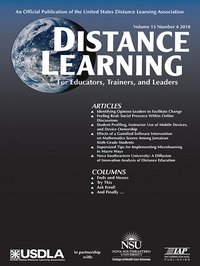
Distance Learning
Volume 15 #4
1st Edition
Published on 12. January 2018
87 pages
978-1-64113-666-2 (ISBN)
Description

"Distance Learning is for leaders, practitioners, and decision makers in the fields of distance learning, e-learning, telecommunications, and related areas. It is a professional journal with applicable information for those involved with providing instruction to all kinds of learners, of all ages, using telecommunications technologies of all types. Stories are written by practitioners for practitioners with the intent of providing usable information and ideas. Articles are accepted from authors--new and experienced--with interesting and important information about the effective practice of distance teaching and learning.
Distance Learning is published quarterly. Each issue includes eight to ten articles and three to four columns, including the highly regarded 'And Finally...' column covering recent important issues in the field and written by Distance Learning editor, Michael Simonson. Articles are written by practitioners from various countries and locations, nationally and internationally.
Distance Learning is published quarterly. Each issue includes eight to ten articles and three to four columns, including the highly regarded 'And Finally...' column covering recent important issues in the field and written by Distance Learning editor, Michael Simonson. Articles are written by practitioners from various countries and locations, nationally and internationally.
All prices
More details
Other editions
Additional editions

Book
06/2019
Information Age Publishing
€47.00
Shipment within 3-4 weeks
Content
- Front Cover
- Featured Articles
- 1
- Identifying Opinion Leaders to Facilitate Change
- 13
- Feeling Real: Social Presence Within Online Discussions
- 29
- Student Profiling, Instructor Use of Mobile Devices, and Device Ownership
- 39
- Effects of a Gamified Software Intervention on Mathematics Scores Among Jamaican Sixth-Grade Students
- 51
- Supersized Tips for Implementing Microlearning in Macro Ways
- 57
- Nova Southeastern University: A Diffusion of Innovation Analysis of Distance Education
- Columns
- Identifying Opinion Leaders to Facilitate Change
- Kathleen Hagen and Michael Simonson
- Introduction
- Identifying Opinion Leaders
- Attitudes and Behavior
- Opinion Leadership Behaviors
- Openness
- Rational Decisionmaking
- Self-Monitoring
- Sociability
- Using the OLI
- Table 1. Ranges and Most and Least Common Scores
- 15-3 /14-3
- 9, 25.6%
- 14 and 3, 0.77%
- 20-4 /19-8
- 12, 24%
- 18 and 8, 0.77%
- 20-4 /20-8
- 14 and 13, 17.8%
- 20 and 8, 0.77%
- 20-4 /20-6
- 14, 17%
- 20 and 6, 0.77%
- Conclusion
- References
- Appendix: Opinion Leader Index
- Feeling Real
- Social Presence Within Online Discussions
- Trish Harvey, Jennifer Carlson, Maggie Struck, and Karen Moroz
- Introduction
- Literature Review
- Discussion Forum Formats: Research on Social Presence
- Social Climate: It is What You Make It
- Being Real: Being Seen
- Membership in the Community of Learners: Peer Connections
- Quality of the Learning Experience: Student Engagement
- Methods
- Table 1. Discussion Formats
- Table 2. Survey Questions (n = 60)
- 60 (100%)
- 60 (100%)
- 60 (100%)
- 58 (94%)
- 56 (93%)
- 56 (93%)
- 55 (92%)
- 55 (92%)
- 54 (90%)
- 54 (90%)
- 54 (90%)
- 54 (90%)
- 53 (88%)
- 51 (85%)
- 50 (83%)
- 47 (78%)
- 44 (73%)
- 44 (73%)
- 40 (67%)
- 38 (61%)
- 35 (58%)
- 19 (32%)
- 0
- 0
- 0
- 2
- 4
- 4
- 5
- 5
- 6
- 6
- 6
- 6
- 7
- 9
- 10
- 13
- 16
- 16
- 20
- 22
- 25
- 41
- Table 3. Student Reflection Survey: Administered by Researchers Following a New Discussion Format
- Results
- Table 4. Results of Student Reflection Surveys
- 3.52
- (n = 36)
- 3.31
- (n = 45)
- 3.38
- (n = 37)
- 3.45
- (n = 38)
- 3.41
- (n = 36)
- 3.16
- (n = 45)
- 3.27
- (n = 37)
- 3.39
- (n = 38)
- 3.38
- (n = 36)
- 3.11
- (n = 45)
- 3.16
- (n = 37)
- 3.42
- (n = 38)
- 3.28
- (n = 36)
- 3.27
- (n = 45)
- 3.21
- (n = 37)
- 3.26
- (n = 38)
- 3.38
- (n = 24)
- 3.0
- (n = 24)
- 3.17
- (n = 24)
- 3.54
- (n = 24)
- Small Groups
- Large Groups
- Synchronous
- Artifact Based
- Implications and Recommendations
- Future Research
- Conclusion
- References
- Student Profiling, Instructor Use of Mobile Devices, and Device Ownership
- Cheng-Chang Pan, Jeffrey A. Graham, and Eunice Luyegu
- Background and Introduction
- Method
- Results and Discussion
- Table 1. Means and Standard Deviations on IIT as a Function of Learner Profile
- 250
- 2.72
- 1.66
- 442
- 2.63
- 1.44
- 688
- 3.38
- 1.62
- 255
- 1.86
- 1.70
- Table 2. One-Way Analysis of Variance of Perceived Instructor Integrated Use of Mobile Technology by Learner Profile
- 156.87
- 61.44
- .000
- 2.55
- References
- Get Your Copy Today-www.infoagepub.com
- Effects of a Gamified Software Intervention on Mathematics Scores Among Jamaican Sixth-Grade Students
- Janice Watson-Huggins
- Overview
- Problem
- Research Questions
- 1. How has implementation of gamification systems in the classroom improved mathematics scores of K-6 grade students?
- 2. What recommendations would you give on how to design the mathematics curriculum in the future to increase student interest and scores in math using technology?
- Theoretical Framework
- Literature Review
- Methodology
- Software
- Population
- Table 1. Number of Students Divided by Classes at the Lane Mout Primary School, Jamaica
- Grade 1
- 55
- 40
- 95
- Grade 2
- 70
- 59
- 129
- Grade 3
- 101
- 66
- 167
- Grade 4
- 85
- 62
- 147
- Grade 5
- 68
- 58
- 126
- Grade 6
- 74
- 71
- 145
- Instruments of Data Collection
- Design
- Gamification Intervention
- Table 2. Assignment of Respondents to Groups
- R
- 1 (n = 35)
- A1+ A2
- A3 (Z)
- A1+A4
- R
- 2 (n =26)
- A1+ A2
- -
- A4
- Data Analysis
- Research Hypotheses
- Results
- Experimental Group
- Table 3. Randomization Table
- 50
- 0.51
- 34
- 50
- 0.51
- 22
- 0.00
- (1.00)
- 53.85
- 17.74
- 34
- 53.95
- 16.15
- 22
- 0.11
- (0.982)
- 53.94
- 12.13
- 34
- 58.18
- 11.48
- 22
- 4.24
- (0.20)
- Table 4. Randomization Table
- 50
- 0.51
- 34
- 50
- 0.51
- 22
- 0.00
- (1.00)
- 53.85
- 17.74
- 34
- 53.95
- 16.15
- 22
- 0.11
- (0.982)
- 53.94
- 12.13
- 34
- 58.18
- 11.48
- 22
- 4.24
- (0.20)
- Regression Analysis
- Table 5. Impact of Technology on Students' Test Scores
- 0.91
- 0.80
- 0.67
- 57
- 5.39
- 0.37
- 0.48
- 57
- 1.35
- 0.64
- 0.55
- 57
- Findings
- Limitations
- 1. To strengthen the validity of the study, one elementary school located in an inner-city community was used.
- 2. The study used only sixth-grade math scores.
- 3. Current research gap was limited to the understanding of the potential nature of gamification as a learning tool to improve student math scores.
- Recommendations for Future Research
- Summary and Conclusion
- References
- Supersized Tips for Implementing Microlearning in Macro Ways
- Amy Winger
- Introduction
- Presenting Bite-Sized Learning
- Preparing Snackable Content
- Online Quizzes
- Videos
- Infographics
- Gamification
- Conclusion
- References
- Quarterly Review of Distance Education, Subscribe Today! www.infoagepub.com
- Nova Southeastern University
- A Diffusion of Innovation Analysis of Distance Education
- Loreta Costa and Greta Walsh
- Introduction
- Background
- Innovation
- Communication
- Time
- Social System
- Conclusion
- References
- Get Your Copy Today-Information Age Publishing
- Tips for Success
- The Online Instructor's (Short) Guide to Making Assignment Descriptions More Transparent
- Natalie B. Milman
- What Is a Transparent Assignment Description?
- Online Assignments Checklist
- References
- Further Your School Panache by Giving a Conference Presentation!
- Errol Craig Sull
- Know Your Expertise- And be Sure it is Just That
- Be on Top of the Latest Industry Research and Trends in Your Field
- Search out Conferences With a Good Fit to Your General Area
- Know the Type of Presentation You Want to Give
- The Key to Acceptance: Develop a Topic That is Unique and Audience Engaging
- Be Sure you Complete all Proposal Requirements
- When Accepted Immediately Confirm With the Conference Liaison
- Keep Your Presentation to the Stipulated Guidelines
- Incorporate all the Rules for Giving a Great Live Presentation
- A Bonus: Have a Handout for the Audience
- Ask Errol!
- Errol Craig Sull
- Doing it Wrong-Who Says?
- Michael Simonson
- Reference
- Back Cover

