

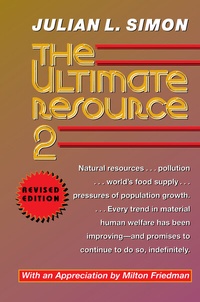
The Ultimate Resource 2
1st Edition
Published on 8. February 2021
778 pages
978-0-691-21476-4 (ISBN)
Description

Arguing that the ultimate resource is the human imagination coupled to the human spirit, Julian Simon led a vigorous challenge to conventional beliefs about scarcity of energy and natural resources, pollution of the environment, the effects of immigration, and the "perils of overpopulation." The comprehensive data, careful quantitative research, and economic logic contained in the first edition of The Ultimate Resource questioned widely held professional judgments about the threat of overpopulation, and Simon's celebrated bet with Paul Ehrlich about resource prices in the 1980s enhanced the public attention--both pro and con--that greeted this controversial book.
Now Princeton University Press presents a revised and expanded edition of The Ultimate Resource. The new volume is thoroughly updated and provides a concise theory for the observed trends: Population growth and increased income put pressure on supplies of resources. This increases prices, which provides opportunity and incentive for innovation. Eventually the innovative responses are so successful that prices end up below what they were before the shortages occurred. The book also tackles timely issues such as the supposed rate of species extinction, the "vanishing farmland crisis," and the wastefulness of coercive recycling.
In Simon's view, the key factor in natural and world economic growth is our capacity for the creation of new ideas and contributions to knowledge. The more people alive who can be trained to help solve the problems that confront us, the faster we can remove obstacles, and the greater the economic inheritance we shall bequeath to our descendants. In conjunction with the size of the educated population, the key constraint on human progress is the nature of the economic-political system: talented people need economic freedom and security to bring their talents to fruition.
Now Princeton University Press presents a revised and expanded edition of The Ultimate Resource. The new volume is thoroughly updated and provides a concise theory for the observed trends: Population growth and increased income put pressure on supplies of resources. This increases prices, which provides opportunity and incentive for innovation. Eventually the innovative responses are so successful that prices end up below what they were before the shortages occurred. The book also tackles timely issues such as the supposed rate of species extinction, the "vanishing farmland crisis," and the wastefulness of coercive recycling.
In Simon's view, the key factor in natural and world economic growth is our capacity for the creation of new ideas and contributions to knowledge. The more people alive who can be trained to help solve the problems that confront us, the faster we can remove obstacles, and the greater the economic inheritance we shall bequeath to our descendants. In conjunction with the size of the educated population, the key constraint on human progress is the nature of the economic-political system: talented people need economic freedom and security to bring their talents to fruition.
More details
Language
English
Place of publication
Princeton, NJ
United States
Publishing group
De Gruyter
Target group
Professional and scholarly
Edition type
Digital original
Product notice
Reflowable
Illustrations
5 halftones 143 line drawings 13 tables
ISBN-13
978-0-691-21476-4 (9780691214764)
Schweitzer Classification
Other editions
Additional editions
Book
07/1998
Princeton University Press
€74.20
Shipment within 10-20 days
Julian Lincoln Simon
The Ultimate Resource 2
Book
11/1996
Princeton University Press
€68.09
Article exhausted; check different version
Person
Julian L. Simon, until his death in 1998, was Professor of Business Administration at the University of Maryland and a Senior Fellow at the Cato Institute. Among his books are Population and Development in Poor Countries: Selected Essays (Princeton), The Economic Consequences of Immigration to the United States, Population Matters: People, Resources, Environment, and Immigration, and The State of Humanity.
Content
- Cover Page
- Half-title Page
- Title Page
- Copyright Page
- Contents
- Analytical Contents
- Figures
- Tables
- Preface
- Acknowledgments for the First Edition
- Acknowledgments for the Second Edition
- Introduction
- Preview of the Book
- Numbers, Writers, and Believability
- The Role of Political Economy
- The State of the Argument
- A Historical Afternote
- Part One: Toward Our Beautiful Resource Future
- 1. The Amazing Theory of Raw-Material Scarcity
- Between Pig Copper and Dentistry
- What Do We Mean by "Scarcity"?
- What Is the Best Way to Forecast Scarcity and Costs?
- Will the Future Break with the Past?
- A Challenge to the Doomsdayers to Put Their Money Where Their Mouths Are
- Summary
- Afternote 1: The "True" Cost (Price) of Natural Resources
- Afternote 2: The Ultimate Shortage
- 2. Why Are Material-Technical Resource Forecasts So Often Wrong?
- The Nature of Material-Technical Forecasts: Explaining the Paradox
- The Difficulties of Material-Technical Forecasting
- The Vast Differences among Technical Forecasts
- Summary
- Afternote to Investors
- 3. Can the Supply of Natural Resources-Especially Energy-Really Be Infinite? Yes!
- The Theory of Decreasing Natural-Resource Scarcity
- Resources as Services
- Are Natural Resources Finite?
- Summary
- Afternote 1: A Dialogue on "Finite
- Afternote 2: The "Law" of Diminishing Returns
- 4. The Grand Theory
- Entropy and Finiteness: The Irrelevant Dismal Theory
- Conclusion
- 5. Famine 1995? or 2025? or 1975?
- Famines
- Conclusions
- 6. What Are the Limits on Food Production?
- The Short-Run Outlook
- The Long-Run Outlook
- Food from Fish
- Why Is the Food Outlook Made to Seem Gloomy?
- Conclusions
- Afternote: Monocropping
- 7. The Worldwide Food Situation Now: Shortage Crises,Glut Crises, and Government
- Government Intervention
- Cycling between Glut and Shortage
- Food Stockpiles
- What Next?
- The US. Drought of 1976-1977
- The Situation in Some Other Countries
- Africa and the Cocoa-Producing Countries
- What Would Be the Best Foreign Aid for Agriculture?
- Conclusions
- 8. Are We Losing Ground?
- The Trend of Arable Land: Losing Ground?
- Is Land Different from Other Resources?
- Conclusion
- 9. Two Bogeymen: "Urban Sprawl" and Soil Erosion
- Soil Erosion
- Afternote: How Environmental Con Artists Work Their Scams
- 10. Water, Wood, Wetlands-and What Next?
- Nature of the Problem
- Consumer Water Issues
- Lumber
- Wetlands
- Conclusions
- 11. When Will We Run Out of Oil? Never!
- Energy, the Master Resource
- The Long-Run History of Energy Supplies
- Jumping Off the Eiffel Tower
- The Theory of Future Energy Supplies
- The Bogeyman of Diminishing Returns Again
- The Best-and Worst-Ways to Forecast Future Energy Availability
- Better Technical Forecasting Methods
- What about the Very Long Run?
- The Nonfiniteness of Oil
- Conclusions
- 12. Today's Energy Issues
- First Some Facts
- The Energy Crisis of the 1970s
- Politics and the Current Energy "Crisis
- Conclusions
- Afternote 1: Externalities of Energy Use
- Afternote 2: Energy Accounting
- 13. Nuclear Power: Tomorrow's Greatest Energy Opportunity
- Nuclear Power, Danger, and Risk Aversion
- Disposal of Nuclear Waste
- Conclusions
- 14. A Dying Planet? How the Media Have Scared the Public
- Summary
- 15. The Peculiar Theory of Pollution
- The Economic Theory of Pollution
- Conclusion
- Afternote: Ecologists' Criticisms of Economics
- 16. Whither the History of Pollution?
- Pollution and History
- Life Expectancy and Pollution
- Summary
- 17. Pollution Today: Specific Trends and Issues
- Water Pollution
- On the Politics of Environmental Hindering
- Conclusion
- 18. Bad Environmental and Resource Scares
- Known Killers
- Possibly Dangerous Threats
- Questionable Issues
- Definitely Disproven Threats
- Major Environmental Scares of the 1990s
- Summary
- Ajternote: Healing the Planet
- 19. Will Our Consumer Wastes Bury Us?
- The Dimensions of Our Waste
- The Theory of Waste and Value: Dump on Us, Baby, We Need It
- Conclusion
- 20. Should We Conserve Resources for Others' Sakes? What Kinds of Resources Need Conservation?
- Conservation of Replaceable Resources
- Conservation of Animals or People?
- Resources and Future Generations
- Resources and 'International Rape
- Summary
- 21. Coercive Recycling, Forced Conservation, and Free-Market Alternatives
- Why Do People Worry So Much about Wastes?
- Pros and Cons of Waste Disposal Policies
- Price and Value
- Conservation and the Government System
- Conclusion
- Part Two: Population Growth's Effect Upon Our Resources and Living Standard
- 22. Standing Room Only? The Demographic Facts
- Population Growth Rates
- The Approaching Victory against Premature Death
- Summary
- 23. What Will Future Population Growth Be?
- Voodoo Forecasting
- Do Current Trends Call for Coercive Policies?
- Who Will Support Whom? The Dependency Burdens
- Decreasing Population Density in the Future?
- Conclusion
- 24. Do Humans Breed Like Flies? Or Like Norwegian Rats?
- Summary
- 25. Population Growth and the Stock of Capital
- Simple Theory and Data
- The Transportation Connection
- The Effect of Population on Transportation Systems
- Summary
- Afternote: A Parable of Population Growth, Racquetball, and Squash
- 26. Population's Effects on Technology and Productivity
- Summary and Concluding Thoughts
- Afternote: On the Importance and Origins of Productive Knowledge
- The Gains from Knowledge Creation
- The Beneficiaries of Gains in Knowledge
- Can We Be Sure That Knowledge Will Solve Our Problems?
- 27. Economies of Scope and Education
- The Theory
- The Statistical Evidence
- Quantity and Quality of Education
- Summary
- 28. Population Growth, Natural Resources, and Future Generations
- The Family Analogy
- A Model of the Increase in Natural Resources
- The "Energy Crisis" and Population Policy
- Are We Running a Ponzi Scheme on Future Generations?
- Natural Resources and the Risk of Running Out
- Can We Be Sure Technology Will Advance?
- Summary: The Ultimate Resource-Is the Human Imagination in a Free Society
- Afternote from the Beach
- Afternote on the Economics of Chelm (Pronounced "Khelm")
- 29. Population Growth and Land
- Historical Examples
- Effects of Population Growth on Land Available for Recreation and Enjoyment
- The Future Benefits of "Blight
- Conclusion
- Afternote: Population, Land, and War
- 30. Are People an Environmental Pollution?
- Income, Growth, Population, and Pollution
- Aesthetics, Pollution, and Population Growth
- Pollution, Population, and Risk of Catastrophe
- Summary
- 31. Are Humans Causing Species Holocaust?
- Species Loss Estimates
- The Risks from Species Loss
- Knowing the Unknowable
- Discussing Matters with the Conservationists
- Conclusion
- Afternote on the Philosophy of Species
- 32. A Greater Population Does Not Damage Health or Psychological and Social Well-Being
- Population Density and Physical Health
- The Psychological and Sociological Effects of Crowding
- Population Growth and Intelligence
- Population Density and War
- What, Then, Determines Health?
- Conclusions
- 33. The Big Economic Picture: Population Growth and Living Standards in MDCs
- The Theory of Population and Income
- The Evidence versus the Malthusian Theory
- A More Realistic Model for MDCs
- At the Cost of the Poorer Countries?
- Summary
- Afternote 1: William Shakespeare, Procreation, and the Economics of Development
- Afternote 2: How Immigrants Affect Our Standard of Living
- 34. The Big Picture II: LDCs
- The Conventional Theoretical Models
- Again-The Data Contradict the Popular Models
- The Role of the Political-Economic System
- A Model That Reconciles Theory and Evidence for LDCs
- Some Objections Considered
- Summary
- Afternote: The Limits to Growth, Global 2000, and Their Relatives
- Part Three: Beyond the Data
- 35. How the Comparisons People Make Affect Their Beliefs about Whether Things Are Getting Better or Worse
- Some Reflections on Jogging through San Francisco
- 36. The Rhetoric of Population Control: Does the End Justify the Means?
- Inflammatory Terminology and Persuasion by Epithet
- Phony Arguments, Crude and Subtle
- Grabbing Virtue, Daubing with Sin
- Why Is Population Rhetoric So Appealing?
- Forces Amplifying the Rhetoric
- Finally-The Piper
- Afternote 1: A Rhetorical Analogy
- Afternote 2: Planned Parenthood's Rhetoric
- 37. The Reasoning behind the Rhetoric
- Rhetoric and Justification
- Conclusion
- 38. Ultimately-What Are Your Values?
- Some Values Relevant to Population Policy
- Conclusion
- 39. The Key Values
- The Value of a Poor Person's Life
- The Born and the Unborn
- What Is to Be Lost?
- The Value of Per Capita Income in the Short Run
- The Value of Saving versus the Value of Creating
- The Question about Sound Judgment
- People as Destroyers and Creators
- When Is Coercion Justified?
- The Value for Truth
- Values about Population in Relation to Other Values
- Summary
- Conclusion. The Ultimate Resource
- Is Our Age Different from Ages That Have Gone Before?
- What Does the Future Hold?
- Afternote 1: "Born without a Chance
- Afternote 2: Prometheus Bound
- Epilogue. My Critics and I
- Substantive Issues
- Epithets and Ridicule
- Politicized Criticism
- Response to the Personal Attacks
- The Effects of the "Criticism
- Two Letters from Hayek: Excerpts
- Notes
- References
- Index
