

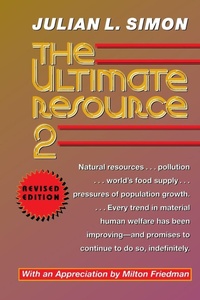
The Ultimate Resource 2
The Ultimate Resource 2
Published on 21. July 1998
Book
Paperback/Softback
784 pages
978-0-691-00381-8 (ISBN)
Description
Arguing that the ultimate resource is the human imagination coupled to the human spirit, Julian Simon led a vigorous challenge to conventional beliefs about scarcity of energy and natural resources, pollution of the environment, the effects of immigration, and the "perils of overpopulation." The comprehensive data, careful quantitative research, and economic logic contained in the first edition of The Ultimate Resource questioned widely held professional judgments about the threat of overpopulation, and Simon's celebrated bet with Paul Ehrlich about resource prices in the 1980s enhanced the public attention--both pro and con--that greeted this controversial book. Now Princeton University Press presents a revised and expanded edition of The Ultimate Resource. The new volume is thoroughly updated and provides a concise theory for the observed trends: Population growth and increased income put pressure on supplies of resources. This increases prices, which provides opportunity and incentive for innovation. Eventually the innovative responses are so successful that prices end up below what they were before the shortages occurred.
The book also tackles timely issues such as the supposed rate of species extinction, the "vanishing farmland crisis," and the wastefulness of coercive recycling. In Simon's view, the key factor in natural and world economic growth is our capacity for the creation of new ideas and contributions to knowledge. The more people alive who can be trained to help solve the problems that confront us, the faster we can remove obstacles, and the greater the economic inheritance we shall bequeath to our descendants. In conjunction with the size of the educated population, the key constraint on human progress is the nature of the economic-political system: talented people need economic freedom and security to bring their talents to fruition.
The book also tackles timely issues such as the supposed rate of species extinction, the "vanishing farmland crisis," and the wastefulness of coercive recycling. In Simon's view, the key factor in natural and world economic growth is our capacity for the creation of new ideas and contributions to knowledge. The more people alive who can be trained to help solve the problems that confront us, the faster we can remove obstacles, and the greater the economic inheritance we shall bequeath to our descendants. In conjunction with the size of the educated population, the key constraint on human progress is the nature of the economic-political system: talented people need economic freedom and security to bring their talents to fruition.
Reviews / Votes
"Julian Simon's 1981 book The Ultimate Resource excoriated prominent environmentalists for resorting to scare tactics and data-bending... As Simon notes, the past sixteen years have been kind to many of his ideas... Much as Simon had predicted, global per capita food production edged upward steadily while population rose and air quality improved in many places and ways."--Kathleen Courrier, The Washington Post "With a full understanding of the opposition and smears he would encounter, Simon nevertheless wrote The Economics of Population Growth, Population Matters, and his best-known book, The Ultimate Resource. To him, the ultimate resource was human intelligence. We should also add, in honor of Simon, the courage to use that intelligence."--Thomas Sowell, Chicago Sun-Times "The most powerful challenge to be mounted against the principles of popular environmentalism in the last fifteen years."--The Washington Post Book World "Compelling and often brilliantly original... [Simon's] economic analysis will leave a lot of readers heavily revising their thinking about the world around them."--Fortune "The Ultimate Resource is the most powerful challenge to be mounted against the principles of popular environmentalism in the last 15 years... What is most startling is its deep-rooted optimism about the human condition... [A] landmark book."--Washington Post Book World "The truly delightful aspect of the book is its persistent iconoclasm. Page after page, Simon punctures myths of scarcity and offers instead the counsels of optimism."--The American Spectator "Julian Simon, an economics professor, systematically, shockingly, irresponsibly explodes each and every foundation of the whole environmental movement. And he does so with so many facts, graphs and examples that it would be a strange person who could walk away from reading this book without his or her faith in the assumptions of the environmental movement being just a little bit shaken up... This is a magnificent book with the power to change minds."--Matt Ridley, The Sunday TelegraphMore details
Language
English
Place of publication
New Jersey
United States
Target group
Professional and scholarly
College/higher education
Product notice
Paperback (trade)
Illustrations
5 halftones 143 line drawings 13 tables
Dimensions
Height: 234 mm
Width: 156 mm
Thickness: 46 mm
Weight
1308 gr
ISBN-13
978-0-691-00381-8 (9780691003818)
Copyright in bibliographic data and cover images is held by Nielsen Book Services Limited or by the publishers or by their respective licensors: all rights reserved.
Schweitzer Classification
Other editions
Additional editions
Julian Lincoln Simon
The Ultimate Resource 2
E-Book
02/2021
1st Edition
Princeton University Press
€90.99
Available for download
Person
Julian L. Simon, until his death in 1998, was Professor of Business Administration at the University of Maryland and a Senior Fellow at the Cato Institute. Among his books are Population and Development in Poor Countries: Selected Essays (Princeton), The Economic Consequences of Immigration to the United States, Population Matters: People, Resources, Environment, and Immigration, and The State of Humanity.
Content
Analytical ContentsList of FiguresList of TablesPrefaceAcknowledgments for the First EditionAcknowledgments for the Second EditionIntroduction. What Are the Real Population and Resource Problems?31The Amazing Theory of Raw-Material Scarcity232Why Are Material-Technical Resource Forecasts So Often Wrong?413Can the Supply of Natural Resources - Especially Energy - Really Be Infinite? Yes!544The Grand Theory735Famine 1995? or 2025? or 1975?846What Are the Limits on Food Production?977The Worldwide Food Situation Now: Shortage Crises, Glut Crises, and Government1098Are We Losing Ground?1279Two Bogeymen: "Urban Sprawl" and Soil Erosion13910Water, Wood, Wetlands - and What Next?15111When Will We Run Out of Oil? Never!16212Today's Energy Issues18213Nuclear Power: Tomorrow's Greatest Energy Opportunity20314A Dying Planet? How the Media Have Scared the Public21215The Peculiar Theory of Pollution22316Whither the History of Pollution?23317Pollution Today: Specific Trends and Issues24118Bad Environmental and Resource Scares25819Will Our Consumer Wastes Bury Us?27520Should We Conserve Resources for Others' Sakes? What Kinds of Resources Need Conservation?28321Coercive Recycling, Forced Conservation, and Free-Market Alternatives29722Standing Room Only? The Demographic Facts31123What Will Future Population Growth Be?32624Do Humans Breed Like Flies? Or Like Norwegian Rats?34225Population Growth and the Stock of Capital35726Population's Effects on Technology and Productivity36727Economies of Scope and Education39128Population Growth, Natural Resources, and Future Generations39929Population Growth and Land41230Are People an Environmental Pollution?42931Are Humans Causing Species Holocaust?43932A Greater Population Does Not Damage Health, or Psychological and Social Well-Being45933The Big Economic Picture: Population Growth and Living Standards in MDCs47134The Big Picture II: LDCs49135How the Comparisons People Make Affect Their Beliefs about Whether Things Are Getting Better or Worse51336The Rhetoric of Population Control: Does the End Justify the Means?51937The Reasoning behind the Rhetoric53738Ultimately - What Are Your Values?54739The Key Values557Conclusion. The Ultimate Resource578Epilogue. My Critics and I593Notes617References653Index691