

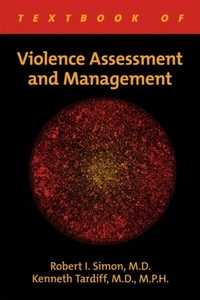
Textbook of Violence Assessment and Management
Description

Because violence is both endemic to our society and epidemic in our age, violence assessment is as critical as it is commonplace for the front-line clinician. Fortunately, the editors of the Textbook of Violence Assessment and Management have assembled an impressive roster of distinguished contributors who, in 28 informative chapters, combine evidence-based medicine with expert opinion to create the first comprehensive textbook on assessing the potentially violent patient and managing the patient who becomes violent.
Dr. Simon and Dr. Tardiff, themselves at the forefront of forensic psychiatry, lend the breadth and depth of their experience to this volume, which addresses the risk of violence across the full spectrum of psychopathology, clinical settings, and demographics. Crucial topics such as expert testimony, intimate partner violence, school and workplace violence, the duty to warn potential victims of patients, and the use of seclusion and restraint receive special emphasis. The book's scope makes it useful as both a textbook and a reference for clinicians.
Mental health professionals will find this book to be timely and necessary -- for their patients, but also for the families and communities who rely on their professional judgment.
All prices
More details
Other editions
Additional editions
Persons
Robert I. Simon, M.D., is Clinical Professor of Psychiatry and Director, Program in Psychiatry and Law, at Georgetown University School of Medicine in Washington, DC. He has been a practicing psychiatrist and forensic psychiatrist for over 40 years. Dr. Simon has authored or edited 25 other books for psychiatrists and other mental health professionals on topics in psychiatry and the law. He has also published numerous papers on civil and criminal matters, including a study of 33 murderers.
Kenneth Tardiff, M.D., M.P.H., is Professor of Psychiatry and Public Health at Weill Medical College of Cornell University, and Attending Psychiatrist at New York-Presbyterian Hospital/Weill Cornell Medical Center in New York, New York.
Content
ContributorsForewordPrefaceAcknowledgmentsPart I: ASSESSMENT PRINCIPLESChapter 1. Clinical Risk Assessment of ViolenceChapter 2. Structured Risk Assessment of ViolenceChapter 3. Cultural Competence in Violence Risk AssessmentChapter 4. Psychological Testing in Violence Risk AssessmentPart II: MENTAL DISORDERS AND CONDITIONSChapter 5. Mood DisordersChapter 6. Schizophrenia and Delusional DisorderChapter 7. Posttraumatic Stress DisorderChapter 8. Substance Abuse DisordersChapter 9. Personality DisordersChapter 10. Neurological and Medical DisordersChapter 11. Impulsivity and AggressionPart III: TREATMENT SETTINGSChapter 12. Outpatient SettingsChapter 13. Inpatient SettingsChapter 14. Emergency ServicesPart IV: TREATMENT AND MANAGEMENTChapter 15. Psychopharmacology and Electroconvulsive TherapyChapter 16. Psychotherapeutic InterventionsChapter 17. Seclusion and RestraintPart V: SPECIAL POPULATIONSChapter 18. Children and AdolescentsChapter 19. The ElderlyPart VI: SPECIAL TOPICSChapter 20. Forensic IssuesChapter 21. Legal Issues of Prediction, Protection, and ExpertiseChapter 22. Sexual Violence and the ClinicianChapter 23. Violence Toward Mental Health ProfessionalsChapter 24. Intimate Partner Violence and the ClinicianChapter 25. Workplace Violence and the ClinicianChapter 26. Vehicular Crashes and the Role of Mental Health CliniciansChapter 27. School ViolenceChapter 28. Clinically-Based Risk Management of Potentially Violent PatientsIndex

