

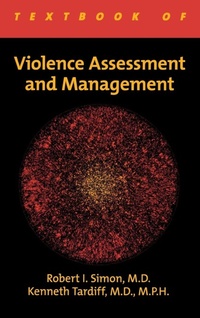
Textbook of Violence Assessment and Management
Published on 24. June 2008
Book
Hardback
638 pages
978-1-58562-314-3 (ISBN)
Description
Evaluating and treating patients with violent ideations and
behaviors can be frustrating, anxiety-provoking, and even dangerous, as
errors in judgment can lead to disastrous consequences. Fortunately, there
is the Textbook of Violence Assessment and Management, the first and
only comprehensive textbook on assessing the potentially violent patient for
mental health clinicians on the front lines of patient care.
Uniquely
qualified to produce this comprehensive volume, the editors have assembled a
distinguished roster of contributors who, in 28 practical chapters, combine
evidence-based medicine with expert opinion to address the topic of patient
violence in all its diversity of presentation and expression. Dr. Simon is
Director of the Program in Psychiatry and Law at Georgetown University
School of Medicine, as well as the author or co-author of more than two
dozen books. Dr. Tardiff, Professor of Psychiatry and Public Health at the
Payne Whitney Clinic, The New York Hospital-Cornell Medical Center, is the
author of The Concise Guide to Assessment and Management of Violent
Patients, an introduction to aggression management now in its second
edition.
Violence is both endemic to our society and epidemic in our
age. Skilled assessment and management of violence is therefore critical for
mental health professionals involved in patient care. The Textbook of
Violence Assessment and Management includes many features designed
to instruct and support these clinicians. For example:
* It is the first comprehensive textbook to take the mental health
professional from evaluation and assessment to treatment and management of
patients who are or may become violent.
* The 28 chapters address the
diversity of clinical settings, patient demographics, psychopathology and
treatment modalities, making this work useful as both a textbook and a
reference that clinicians can consult as needed for particular cases.
*
End-of-chapter "Key Points" highlight the most important concepts and
conclusions, allowing students to review and consolidate their learning and
practicing professionals to locate critical information quickly.
*
Clinical case examples abound, providing rich and nuanced perspectives on
patient behavior, evaluation and management.
* The textbook includes a
separate chapter on evaluating patients from different cultures, a
competency that becomes more crucial as patient populations become more
diverse.
Increasing numbers of veterans are diagnosed with PTSD and
traumatic brain injury. Campus tragedies such as Virginia Tech are fresh in
our collective memory. This text is both timely and necessary-not just for
mental health professionals and their patients, but for the families and
communities whose safety depends upon competent professional judgment.
behaviors can be frustrating, anxiety-provoking, and even dangerous, as
errors in judgment can lead to disastrous consequences. Fortunately, there
is the Textbook of Violence Assessment and Management, the first and
only comprehensive textbook on assessing the potentially violent patient for
mental health clinicians on the front lines of patient care.
Uniquely
qualified to produce this comprehensive volume, the editors have assembled a
distinguished roster of contributors who, in 28 practical chapters, combine
evidence-based medicine with expert opinion to address the topic of patient
violence in all its diversity of presentation and expression. Dr. Simon is
Director of the Program in Psychiatry and Law at Georgetown University
School of Medicine, as well as the author or co-author of more than two
dozen books. Dr. Tardiff, Professor of Psychiatry and Public Health at the
Payne Whitney Clinic, The New York Hospital-Cornell Medical Center, is the
author of The Concise Guide to Assessment and Management of Violent
Patients, an introduction to aggression management now in its second
edition.
Violence is both endemic to our society and epidemic in our
age. Skilled assessment and management of violence is therefore critical for
mental health professionals involved in patient care. The Textbook of
Violence Assessment and Management includes many features designed
to instruct and support these clinicians. For example:
* It is the first comprehensive textbook to take the mental health
professional from evaluation and assessment to treatment and management of
patients who are or may become violent.
* The 28 chapters address the
diversity of clinical settings, patient demographics, psychopathology and
treatment modalities, making this work useful as both a textbook and a
reference that clinicians can consult as needed for particular cases.
*
End-of-chapter "Key Points" highlight the most important concepts and
conclusions, allowing students to review and consolidate their learning and
practicing professionals to locate critical information quickly.
*
Clinical case examples abound, providing rich and nuanced perspectives on
patient behavior, evaluation and management.
* The textbook includes a
separate chapter on evaluating patients from different cultures, a
competency that becomes more crucial as patient populations become more
diverse.
Increasing numbers of veterans are diagnosed with PTSD and
traumatic brain injury. Campus tragedies such as Virginia Tech are fresh in
our collective memory. This text is both timely and necessary-not just for
mental health professionals and their patients, but for the families and
communities whose safety depends upon competent professional judgment.
Reviews / Votes
This collection of essays is comprehensive and written by anumber of leaders in the field. The book deserves its place on the shelf,
even in this crowded field. * Psychiatric Services * I think this is one of the best textbooks I have read. It
should be required reading in every residency program. I urge every
practicing psychiatrist to spend some time with this book: think of it as a
Red Cross lifesaving program. The textbook will also be useful to people who
study substance abuse, aging, school safety, and many other problems that
intersect with violence. * The Journal of Nervous and Mental Disease * This is an edited book that provides good overviews of
important topics in the broad field of psychiatric aspects of violence. The
highly respected editors chose experienced and expert chapter authors. The
organization is clear and consistent, with key points bulleted at the end of
each chapter. -- William H. Reid, MD, MPH * Journal of Psychiatric Practice *
More details
Language
English
Place of publication
VA
United States
Target group
Professional and scholarly
US School Grade: College Graduate Student and over
Product notice
Laminated cover
Illustrations
1 Line drawings, black and white; 37 Tables, unspecified
Dimensions
Height: 230 mm
Width: 162 mm
Thickness: 33 mm
Weight
953 gr
ISBN-13
978-1-58562-314-3 (9781585623143)
Copyright in bibliographic data and cover images is held by Nielsen Book Services Limited or by the publishers or by their respective licensors: all rights reserved.
Schweitzer Classification
Other editions
Additional editions
Robert I. Simon | Kenneth Tardiff
Textbook of Violence Assessment and Management
E-Book
02/2009
1st Edition
American Psychiatric Association Publishing
from
€245.99
Available for download
Persons
Robert I. Simon, M.D., is Clinical Professor of
Psychiatry and Director, Program in Psychiatry and Law, at Georgetown
University School of Medicine in Washington, DC. He has been a practicing
psychiatrist and forensic psychiatrist for over 40 years. Dr. Simon has
authored or edited 25 other books for psychiatrists and other mental health
professionals on topics in psychiatry and the law. He has also published
numerous papers on civil and criminal matters, including a study of 33
murderers.
Kenneth Tardiff, M.D., M.P.H., is Professor of
Psychiatry and Public Health at Weill Medical College of Cornell University,
and Attending Psychiatrist at New York-Presbyterian Hospital/Weill Cornell
Medical Center in New York, New York.
Psychiatry and Director, Program in Psychiatry and Law, at Georgetown
University School of Medicine in Washington, DC. He has been a practicing
psychiatrist and forensic psychiatrist for over 40 years. Dr. Simon has
authored or edited 25 other books for psychiatrists and other mental health
professionals on topics in psychiatry and the law. He has also published
numerous papers on civil and criminal matters, including a study of 33
murderers.
Kenneth Tardiff, M.D., M.P.H., is Professor of
Psychiatry and Public Health at Weill Medical College of Cornell University,
and Attending Psychiatrist at New York-Presbyterian Hospital/Weill Cornell
Medical Center in New York, New York.
Content
Contributors
Foreword
Preface
Acknowledgments
Part I:
ASSESSMENT PRINCIPLES
Chapter 1. Clinical Risk Assessment of
Violence
Chapter 2. Structured Risk Assessment of Violence
Chapter
3. Cultural Competence in Violence Risk Assessment
Chapter 4.
Psychological Testing in Violence Risk Assessment
Part II: MENTAL
DISORDERS AND CONDITIONS
Chapter 5. Mood Disorders
Chapter 6.
Schizophrenia and Delusional Disorder
Chapter 7. Posttraumatic Stress
Disorder
Chapter 8. Substance Abuse Disorders
Chapter 9. Personality
Disorders
Chapter 10. Neurological and Medical Disorders
Chapter 11.
Impulsivity and Aggression
Part III: TREATMENT SETTINGS
Chapter 12.
Outpatient Settings
Chapter 13. Inpatient Settings
Chapter 14.
Emergency Services
Part IV: TREATMENT AND MANAGEMENT
Chapter 15.
Psychopharmacology and Electroconvulsive Therapy
Chapter 16.
Psychotherapeutic Interventions
Chapter 17. Seclusion and
Restraint
Part V: SPECIAL POPULATIONS
Chapter 18. Children and
Adolescents
Chapter 19. The Elderly
Part VI: SPECIAL
TOPICS
Chapter 20. Forensic Issues
Chapter 21. Legal Issues of
Prediction, Protection, and Expertise
Chapter 22. Sexual Violence and
the Clinician
Chapter 23. Violence Toward Mental Health
Professionals
Chapter 24. Intimate Partner Violence and the
Clinician
Chapter 25. Workplace Violence and the Clinician
Chapter
26. Vehicular Crashes and the Role of Mental Health Clinicians
Chapter
27. School Violence
Chapter 28. Clinically-Based Risk Management of
Potentially Violent Patients
Index
Foreword
Preface
Acknowledgments
Part I:
ASSESSMENT PRINCIPLES
Chapter 1. Clinical Risk Assessment of
Violence
Chapter 2. Structured Risk Assessment of Violence
Chapter
3. Cultural Competence in Violence Risk Assessment
Chapter 4.
Psychological Testing in Violence Risk Assessment
Part II: MENTAL
DISORDERS AND CONDITIONS
Chapter 5. Mood Disorders
Chapter 6.
Schizophrenia and Delusional Disorder
Chapter 7. Posttraumatic Stress
Disorder
Chapter 8. Substance Abuse Disorders
Chapter 9. Personality
Disorders
Chapter 10. Neurological and Medical Disorders
Chapter 11.
Impulsivity and Aggression
Part III: TREATMENT SETTINGS
Chapter 12.
Outpatient Settings
Chapter 13. Inpatient Settings
Chapter 14.
Emergency Services
Part IV: TREATMENT AND MANAGEMENT
Chapter 15.
Psychopharmacology and Electroconvulsive Therapy
Chapter 16.
Psychotherapeutic Interventions
Chapter 17. Seclusion and
Restraint
Part V: SPECIAL POPULATIONS
Chapter 18. Children and
Adolescents
Chapter 19. The Elderly
Part VI: SPECIAL
TOPICS
Chapter 20. Forensic Issues
Chapter 21. Legal Issues of
Prediction, Protection, and Expertise
Chapter 22. Sexual Violence and
the Clinician
Chapter 23. Violence Toward Mental Health
Professionals
Chapter 24. Intimate Partner Violence and the
Clinician
Chapter 25. Workplace Violence and the Clinician
Chapter
26. Vehicular Crashes and the Role of Mental Health Clinicians
Chapter
27. School Violence
Chapter 28. Clinically-Based Risk Management of
Potentially Violent Patients
Index