

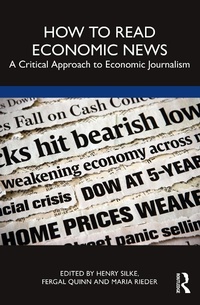
How to Read Economic News
A Critical Approach to Economic Journalism
1st Edition
Published on 31. August 2023
336 pages
978-1-000-88100-4 (ISBN)
Description

Closely examining how the news media reports economic and financial matters, this book equips students with solid methodological skills for reading and interpreting the news alongside a toolkit for best practice as an economic journalist.
How to Read Economic News combines theory and practice to explore the discourse surrounding economics in the mass media and how this specialised form of reporting can be improved. Beginning by introducing major concepts such as financialised economic reporting, media amnesia and loss of trust, the book goes on to help students to interpret, understand and analyse existing news discourse and to identify subtle biases in news reports stemming from hegemonic belief systems. The final section puts this analytical knowledge into practice, providing students with methods for the critical production of news and covering such skills as identifying newsworthiness, story sourcing, achieving clarity, and using complex datasets in news stories.
This is a key text for students and academics in the fields of financial journalism and critical discourse analysis who wish to approach the subject with a critical eye.
How to Read Economic News combines theory and practice to explore the discourse surrounding economics in the mass media and how this specialised form of reporting can be improved. Beginning by introducing major concepts such as financialised economic reporting, media amnesia and loss of trust, the book goes on to help students to interpret, understand and analyse existing news discourse and to identify subtle biases in news reports stemming from hegemonic belief systems. The final section puts this analytical knowledge into practice, providing students with methods for the critical production of news and covering such skills as identifying newsworthiness, story sourcing, achieving clarity, and using complex datasets in news stories.
This is a key text for students and academics in the fields of financial journalism and critical discourse analysis who wish to approach the subject with a critical eye.
More details
Edition
1. Auflage
Language
English
Place of publication
London
United Kingdom
Publishing group
Taylor & Francis Ltd
Target group
College/higher education
Illustrations
23 Tables, black and white; 8 Line drawings, black and white; 17 Halftones, black and white; 25 Illustrations, black and white
ISBN-13
978-1-000-88100-4 (9781000881004)
Copyright in bibliographic data and cover images is held by Nielsen Book Services Limited or by the publishers or by their respective licensors: all rights reserved.
Schweitzer Classification
Other editions
Additional editions
Henry Silke | Fergal Quinn | Maria Rieder
How to Read Economic News
A Critical Approach to Economic Journalism
Book
08/2023
1st Edition
Routledge
€59.80
Available immediately
Henry Silke | Fergal Quinn | Maria Rieder
How to Read Economic News
A Critical Approach to Economic Journalism
Book
08/2023
1st Edition
Routledge
€208.30
Shipment within 15-20 days
Persons
Henry Silke is a lecturer in Journalism at the University of Limerick. His research interests include ideology and how it manifests in the media. He has previously published work looking at the role of journalism in economic and political crises.
Fergal Quinn is a lecturer in Journalism at the University of Limerick. He worked for over a decade as a print and multimedia journalist. His research interests include the representation of minorities and societal inequality in journalism output, and journalism training, particularly in developing-world and post-conflict environments.
Maria Rieder is a lecturer in Applied Linguistics at the School of Modern Languages and Applied Linguistics at the University of Limerick. Her research is concerned with the critical role of language in situations of economic and social inequality. She has been involved in research on media and social protest, issues of immigration and asylum, critical intercultural communication and minority languages and economics. Her published work focuses on social and economic inequality, human rights and minority communities.
Fergal Quinn is a lecturer in Journalism at the University of Limerick. He worked for over a decade as a print and multimedia journalist. His research interests include the representation of minorities and societal inequality in journalism output, and journalism training, particularly in developing-world and post-conflict environments.
Maria Rieder is a lecturer in Applied Linguistics at the School of Modern Languages and Applied Linguistics at the University of Limerick. Her research is concerned with the critical role of language in situations of economic and social inequality. She has been involved in research on media and social protest, issues of immigration and asylum, critical intercultural communication and minority languages and economics. Her published work focuses on social and economic inequality, human rights and minority communities.
Content
List of Figures
List of Tables
List of Contributors
Chapter 1: Introduction - How to Read Economic News
Henry Silke
Fergal Quinn
Maria Rieder
Part I: Connecting economic theory, ideology and journalism
Chapter 2: Economic Imaginaries, Economics Theories And The Role Of Economic Journalism
Hendrik Theine
Chapter 3: What can journalism learn from Heterodox Economics
Andrea Grisold
Chapter 4: Ideology, Economics and Journalism
Henry Silke
Chapter 5: Journalism Studies and Crises: Economic, Environmental and Political - Towards a political Economic Approach.
Paschal Preston
Part II: Methodological approaches for evaluation of economy-related media output
Chapter 6: Using Content Analysis to study Economic Journalism
Fergal Quinn
Muireann Prendergast
Chapter 7: Analysing Economic News Sources: Who gets to speak?
Henry Silke
Chapter 8: Corpus Linguistics and Economic Media research
Brian Clancy
Elaine Vaughan
Chapter 9: Breaking Down the Discourse, Exposing Power in Economic Journalism - Critical Discourse Analysis
Maria Rieder
Hendrik Theine
Chapter 10: Deconstructing Economic Discourses on Broadcast News
Ciara Graham
Brendan O'Rourke
Chapter 11: Deconstructing Discourse: Applying Interview Research in the Economic Newsroom
Sophie Knowles
Nadine Strauss
Chapter 12: Researching Audiences: Understanding how economic news is received
Mike Berry
Part III: News production: Best practices for investigating economic and business stories
Chapter 13: Making sense of economic data
Donal Palcic
Darragh Flannery
Chapter 14: Economic news approaches
Audrey Galvin
Brian Hurley
Chapter 15: Where theory meets practice - tips for BETTER economic journalism
Fergal Quinn
Maria Rieder
Henry Silke
Index
List of Tables
List of Contributors
Chapter 1: Introduction - How to Read Economic News
Henry Silke
Fergal Quinn
Maria Rieder
Part I: Connecting economic theory, ideology and journalism
Chapter 2: Economic Imaginaries, Economics Theories And The Role Of Economic Journalism
Hendrik Theine
Chapter 3: What can journalism learn from Heterodox Economics
Andrea Grisold
Chapter 4: Ideology, Economics and Journalism
Henry Silke
Chapter 5: Journalism Studies and Crises: Economic, Environmental and Political - Towards a political Economic Approach.
Paschal Preston
Part II: Methodological approaches for evaluation of economy-related media output
Chapter 6: Using Content Analysis to study Economic Journalism
Fergal Quinn
Muireann Prendergast
Chapter 7: Analysing Economic News Sources: Who gets to speak?
Henry Silke
Chapter 8: Corpus Linguistics and Economic Media research
Brian Clancy
Elaine Vaughan
Chapter 9: Breaking Down the Discourse, Exposing Power in Economic Journalism - Critical Discourse Analysis
Maria Rieder
Hendrik Theine
Chapter 10: Deconstructing Economic Discourses on Broadcast News
Ciara Graham
Brendan O'Rourke
Chapter 11: Deconstructing Discourse: Applying Interview Research in the Economic Newsroom
Sophie Knowles
Nadine Strauss
Chapter 12: Researching Audiences: Understanding how economic news is received
Mike Berry
Part III: News production: Best practices for investigating economic and business stories
Chapter 13: Making sense of economic data
Donal Palcic
Darragh Flannery
Chapter 14: Economic news approaches
Audrey Galvin
Brian Hurley
Chapter 15: Where theory meets practice - tips for BETTER economic journalism
Fergal Quinn
Maria Rieder
Henry Silke
Index
