

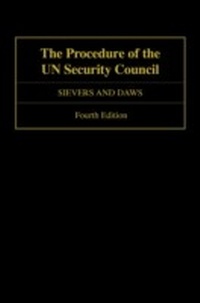
The Procedure of the UN Security Council
4th Edition
Published on 11. September 2014
900 pages
978-0-19-150843-1 (ISBN)
Description

The Procedure of the UN Security Council is the definitive book of its kind and has been widely used by UN practitioners and scholars for nearly 40 years. This comprehensively revised edition contains over 450 pages of new material documenting the extensive and rapid innovations in the Council's procedures of the past two decades.
A one-stop handbook and guide, with meticulous referencing, this book has served diplomats, UN staff and scholars alike in providing unique insight into the inside workings of the world's preeminent body for the maintenance of international peace and security. Thoroughly grounded in the history and politics of the Council, it brings to life the ways the Council has responded through its working methods to a changing world.
The book explains the Council's role in its wider UN Charter context and examines its relations with other UN organs and with its own subsidiary bodies. This includes the remarkable expansion in UN peacekeeping, peacebuilding and political missions, sanctions and counter-terrorism bodies, and international legal tribunals. It contains detailed analysis of voting and decision-taking by the Council, as well as the place, format, and conduct of meetings. It also seeks to illuminate the personalities behind the Council's work - ranging from the diplomats who sit on the Council itself to the UN Secretary-General, and those outside the Council affected by its decisions. It concludes with reflections on the improvements that have made to the Council's procedures over many decades, and the scope for further reform.
More details
Other editions
Additional editions
Loraine Sievers | Sam Daws
The Procedure of the UN Security Council
Book
09/2014
4th Edition
Oxford University Press
€223.70
Shipment within 15-20 days
Persons
Loraine Sievers served the United Nations for over thirty years, concluding her career as Chief of the Security Council Secretariat Branch. Amongst her primary responsibilities was providing guidance to Council members, particularly each month's rotating Presidency, concerning the Council's procedures and practices. Loraine also participated as the Secretariat expert in the Security Council Informal Working Group on Documentation and Other Procedural Questions from 2006-11. Previously, she served as Secretary to the Afghanistan and Sierra Leone Sanctions Committees, Programme Officer in the Iraq Oil-for-Food Programme, political analyst in the Regional Affairs Division, and speechwriter. Loraine contributed to the Repertoire of the Practice of the Security Council and several of the UN 'Blue Books' on conflict situations addressed by the Organization.
Sam Daws has served in a variety of UN related roles over the last 25 years, and currently directs a project on UN governance and reform at the Centre for International Studies, Oxford University. Sam has recently served as Senior Principal Research Analyst in the Multilateral Policy Directorate of the UK Foreign and Commonwealth Office and then as Deputy Director (United Nations, Prime Minister's Post-2015 team) in the Cabinet Office. He spent six years as Executive Director of the UN Association of the UK, and then became Senior Advisor and UK Representative to the UN Foundation. From 2000 to 2003 he served as First Officer in the Executive Office of UN Secretary-General Kofi Annan. Co-author or editor of six books on the UN, Sam has degrees in social anthropology and international conflict analysis, and undertook doctoral studies in international relations at Oxford University. He has been a Visiting Fellow at Cambridge University (in international law) and Yale University (in UN studies).
Content
- I: The Constitutional Framework
- 1: Role of procedure
- 2: The Charter
- 3: Role and function of the Security Council
- 4: Provisional Rules of Procedure
- 5: Further documentation of procedures
- II: Place and Format of Council Proceedings
- 1: Formats of meetings
- 2: Formal public (open) meetings
- 3: Formal private (closed) meetings
- 4: 'Periodic meetings', summits, and high-level meetings
- 5: Thematic debates
- 6: 'Orientation debates'
- 7: Wrap-up meetings
- 8: Meetings away from Headquarters
- 9: Place of meeting at Headquarters
- 10: Informal consultations of the whole
- 11: 'Arria-formula' meetings and 'Somavía-formula' meetings
- 12: Informal interactive dialogues or discussions
- 13: Other informal formats
- 14: Interpretation and translation
- III: The People
- 1: The President
- 2: Permanent members
- 3: Non-permanent members
- 4: Regional and other groups
- 5: 'Groups of friends'
- 6: Political coordinators and experts
- 7: Credentials
- 8: Representation of China and of the Russian Federation
- 9: Permanent Missions and representation
- 10: Secretary-General and the Secretariat
- 11: Individual actions can make a difference
- IV: The Council Convenes
- 1: Convening a meeting
- 2: Rejection of items
- 3: Agenda and Summary statement of matters of which the Council is seized
- 4: No requirement of a quorum
- 5: Notice of meetings
- 6: Timing of meetings
- V: Conduct of Meetings and Participation
- 1: States invited to participate in Council proceedings
- 2: Individuals invited to participate in Council proceedings
- 3: Participation of Palestinian officials
- 4: Order of speakers
- 5: 'Right of reply' or 'further statements'
- 6: Motions, proposals, and suggestions
- 7: 'Blue' draft resolutions and order of submission
- 8: Non-member submission and co-sponsorship of resolutions
- 9: Amendments
- 10: Points of order
- 11: 'Precedence motions'
- 12: Rulings by the President
- 13: 'Stopping the clock'
- VI: Voting
- 1: Substantive decisions and the veto
- 2: Insufficient affirmative votes
- 3: Procedural matters and the 'double veto'
- 4: Voting on the establishment of subsidiary organs
- 5: Voting on amendments
- 6: Separate voting on paragraphs
- 7: Interruption of voting
- 8: Unanimity, consensus, and adoption by acclamation
- 9: Abstentions
- 10: Non-participation in the vote
- 11: Absences
- 12: Finality of the voting process
- 13: Statements before or after the vote
- 14: Draft resolutions withdrawn or not brought to a vote
- 15: Reconsideration of texts not adopted
- VII: Decisions and Documents
- 1: Formats of decisions
- 2: Decisions in the context of the Charter
- 3: Resolutions
- 4: Statements by the President
- 5: Decisions to recommend appointment of Secretaries-General
- 6: Decisions relating to UN membership
- 7: Letters by the Council President
- 8: Notes by the President
- 9: Statements by the President to the press
- 10: Monthly forecast and calendar
- 11: Reports of the Secretary-General
- 12: Communications
- 13: Communications from private individuals and NGOs
- 14: Compendium documents
- 15: Categories of individual documents
- VIII: Subsidiary Bodies
- 1: Military Staff Committee
- 2: Peacebuilding Commission
- 3: Subsidiary bodies concerned with Council procedure
- 4: Subsidiary bodies concerned with United Nations membership
- 5: Subsidiary bodies concerned with the maintenance of international peace and security
- 6: Thematic subsidiary bodies
- 7: Appointment of bureaux of subsidiary bodies
- 8: Reporting by subsidiary bodies
- IX: Relations with other Organs and Entities
- 1: General Assembly
- 2: Economic and Social Council
- 3: Trusteeship Council
- 4: International Court of Justice
- 5: United Nations agencies, funds, and programmes
- 6: International Atomic Energy Agency
- 7: International Criminal Court
- 8: Special courts, tribunals, and investigative panels
- 9: Regional and subregional organizations
- X: Concluding Reflections
