

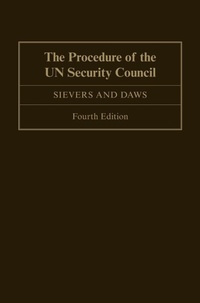
The Procedure of the UN Security Council
4th Edition
Published on 11. September 2014
Book
Hardback
744 pages
978-0-19-968529-5 (ISBN)
Description
The Procedure of the UN Security Council is the definitive book of its kind and has been widely used by UN practitioners and scholars for nearly 40 years. This comprehensively revised edition contains over 450 pages of new material documenting the extensive and rapid innovations in the Council's procedures of the past two decades.
A one-stop handbook and guide, with meticulous referencing, this book has served diplomats, UN staff and scholars alike in providing unique insight into the inside workings of the world's preeminent body for the maintenance of international peace and security. Thoroughly grounded in the history and politics of the Council, it brings to life the ways the Council has responded through its working methods to a changing world.
The book explains the Council's role in its wider UN Charter context and examines its relations with other UN organs and with its own subsidiary bodies. This includes the remarkable expansion in UN peacekeeping, peacebuilding and political missions, sanctions and counter-terrorism bodies, and international legal tribunals. It contains detailed analysis of voting and decision-taking by the Council, as well as the place, format, and conduct of meetings. It also seeks to illuminate the personalities behind the Council's work - ranging from the diplomats who sit on the Council itself to the UN Secretary-General, and those outside the Council affected by its decisions. It concludes with reflections on the improvements that have made to the Council's procedures over many decades, and the scope for further reform.
A one-stop handbook and guide, with meticulous referencing, this book has served diplomats, UN staff and scholars alike in providing unique insight into the inside workings of the world's preeminent body for the maintenance of international peace and security. Thoroughly grounded in the history and politics of the Council, it brings to life the ways the Council has responded through its working methods to a changing world.
The book explains the Council's role in its wider UN Charter context and examines its relations with other UN organs and with its own subsidiary bodies. This includes the remarkable expansion in UN peacekeeping, peacebuilding and political missions, sanctions and counter-terrorism bodies, and international legal tribunals. It contains detailed analysis of voting and decision-taking by the Council, as well as the place, format, and conduct of meetings. It also seeks to illuminate the personalities behind the Council's work - ranging from the diplomats who sit on the Council itself to the UN Secretary-General, and those outside the Council affected by its decisions. It concludes with reflections on the improvements that have made to the Council's procedures over many decades, and the scope for further reform.
Reviews / Votes
The fourth edition . . . is an authoritative compilation of the work of the Council, and thereby serves as a kind of guide to the efforts of the international community, over almost 70 years, to maintain world peace. The volume documents the Councils attempts, in the face of new and novel crises and conflicts, to develop a work practice and a toolkit in order to properly fulfil its Charter mandate. . . . The [book will] quickly become established as a standard reference for practitioners and academicians. * Vereinte Nationen, German Review on the United Nations * The book covers almost everything ... the accompanying website is a real gold mine. It is used to keep the book continuously updated. These updates, which appear frequently, are linked to specific sections in the book. If you want, you can print them out and insert them into the book. When you subscribe to the alert service, it is almost as if you are witnessing the continuous process of evolution of the Councils procedures, and of the books content. You feel as if you are witnessing the fifth edition in the making. * Otto Spijkers, Academic Council on the United Nations System * The book successfully makes the councils work plain to interested readers, be it scholar, student, diplomat or journalist. Its a surprisingly uncomplicated, highly readable book, compared with the usual scholarly works on the UN, written in academic jargon...The book is like its predecessors a unique source of information. It is highly recommended to all interested in the UN, as appreciating the important changes can play a key role in building support for the councils work in maintaining international peace. * Helmut Volger, PassBlue (website) * For a 744-page book that deals with procedure, it is a highly readable tome written in a non-scholarly fashion that combines the rigor of an academic text with the prose of a journalist. * Denis Fitzgerald, UN Tribune *More details
Edition
4th Revised edition
Language
English
Place of publication
Oxford
United Kingdom
Target group
College/higher education
Professional and scholarly
Edition type
Revised edition
Dimensions
Height: 250 mm
Width: 175 mm
Thickness: 44 mm
Weight
1440 gr
ISBN-13
978-0-19-968529-5 (9780199685295)
Copyright in bibliographic data and cover images is held by Nielsen Book Services Limited or by the publishers or by their respective licensors: all rights reserved.
Schweitzer Classification
Other editions
Additional editions
Loraine Sievers | Sam Daws
The Procedure of the UN Security Council
E-Book
09/2014
4th Edition
OUP eBook
€102.99
Available for download
Persons
Loraine Sievers served the United Nations for over thirty years, concluding her career as Chief of the Security Council Secretariat Branch. Amongst her primary responsibilities was providing guidance to Council members, particularly each month's rotating Presidency, concerning the Council's procedures and practices. Loraine also participated as the Secretariat expert in the Security Council Informal Working Group on Documentation and Other Procedural Questions from 2006-11. Previously, she served as Secretary to the Afghanistan and Sierra Leone Sanctions Committees, Programme Officer in the Iraq Oil-for-Food Programme, political analyst in the Regional Affairs Division, and speechwriter. Loraine contributed to the Repertoire of the Practice of the Security Council and several of the UN 'Blue Books' on conflict situations addressed by the Organization.
Sam Daws has served in a variety of UN related roles over the last 25 years, and currently directs a project on UN governance and reform at the Centre for International Studies, Oxford University. Sam has recently served as Senior Principal Research Analyst in the Multilateral Policy Directorate of the UK Foreign and Commonwealth Office and then as Deputy Director (United Nations, Prime Minister's Post-2015 team) in the Cabinet Office. He spent six years as Executive Director of the UN Association of the UK, and then became Senior Advisor and UK Representative to the UN Foundation. From 2000 to 2003 he served as First Officer in the Executive Office of UN Secretary-General Kofi Annan. Co-author or editor of six books on the UN, Sam has degrees in social anthropology and international conflict analysis, and undertook doctoral studies in international relations at Oxford University. He has been a Visiting Fellow at Cambridge University (in international law) and Yale University (in UN studies).
Sam Daws has served in a variety of UN related roles over the last 25 years, and currently directs a project on UN governance and reform at the Centre for International Studies, Oxford University. Sam has recently served as Senior Principal Research Analyst in the Multilateral Policy Directorate of the UK Foreign and Commonwealth Office and then as Deputy Director (United Nations, Prime Minister's Post-2015 team) in the Cabinet Office. He spent six years as Executive Director of the UN Association of the UK, and then became Senior Advisor and UK Representative to the UN Foundation. From 2000 to 2003 he served as First Officer in the Executive Office of UN Secretary-General Kofi Annan. Co-author or editor of six books on the UN, Sam has degrees in social anthropology and international conflict analysis, and undertook doctoral studies in international relations at Oxford University. He has been a Visiting Fellow at Cambridge University (in international law) and Yale University (in UN studies).
Content
I: THE CONSTITUTIONAL FRAMEWORK; II: PLACE AND FORMAT OF COUNCIL PROCEEDINGS; III: THE PEOPLE; IV: THE COUNCIL CONVENES; V: CONDUCT OF MEETINGS AND PARTICIPATION; VI: VOTING; VII: DECISIONS AND DOCUMENTS; VIII: SUBSIDIARY BODIES; IX: RELATIONS WITH OTHER ORGANS AND ENTITIES; X: CONCLUDING REFLECTIONS