

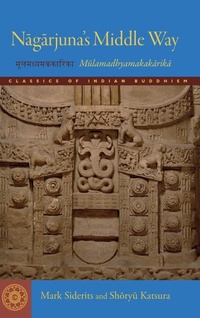
Nagarjuna's Middle Way
Mulamadhyamakakarika
Published on 22. April 2013
368 pages
978-1-61429-061-2 (ISBN)
Description

Winner of the 2014 Khyenste Foundation Translation Prize.
Nagarjuna's renowned twenty-seven-chapter Fundamental Verses on the Middle Way (Mulamadhyamakakarika) is the foundational text of the Madhyamaka school of Mahayana Buddhist philosophy. It is the definitive, touchstone presentation of the doctrine of emptiness. Professors Siderits and Katsura prepared this translation using the four surviving Indian commentaries in an attempt to reconstruct an interpretation of its enigmatic verses that adheres as closely as possible to that of its earliest proponents. Each verse is accompanied by concise, lively exposition by the authors conveying the explanations of the Indian commentators. The result is a translation that balances the demands for fidelity and accessibility.
Nagarjuna's renowned twenty-seven-chapter Fundamental Verses on the Middle Way (Mulamadhyamakakarika) is the foundational text of the Madhyamaka school of Mahayana Buddhist philosophy. It is the definitive, touchstone presentation of the doctrine of emptiness. Professors Siderits and Katsura prepared this translation using the four surviving Indian commentaries in an attempt to reconstruct an interpretation of its enigmatic verses that adheres as closely as possible to that of its earliest proponents. Each verse is accompanied by concise, lively exposition by the authors conveying the explanations of the Indian commentators. The result is a translation that balances the demands for fidelity and accessibility.
More details
Other editions
Additional editions
Book
06/2013
Wisdom Publications,U.S.
€57.14
Shipment within 3-4 weeks
Persons
Mark Siderits was trained in Asian and Western philosophy at the University of Hawaii and Yale University. He has taught both Asian and Western philosophy, for many years at Illinois State University, and most recently as Professor of philosophy at Seoul National University, from which he retired in 2012. He is the author or editor of five books and has published numerous articles on a wide variety of subjects in Indian Buddhist philosophy and comparative philosophy. Much of his work aims at building bridges between the classical Indian tradition and contemporary philosophy, by using insights from one tradition to cast light on problems arising in the other.
Professor Shoryu Katsura received his training in Sanskrit and Buddhist Studies at Kyoto University and the University of Toronto. From 1974 to 2004 he taught in the Department of Indian Philosophy at Hiroshima University; from 2004 he was Professor of Buddhist Philosophy at Ryukoku University, Kyoto, until his retirement in 2012. He remains active at Ryukoku University, where he is Director of their Research Center for Buddhist Cultures in Asia. He is the author or editor of seven books, and has published over sixty articles on various facets of classical Indian Buddhist thought. He is perhaps best known for his work on Buddhist epistemology-the thought of Dignaga, Dharmakirti, and their commentators-but has also made important contributions to the study of Madhyamaka, Abhidharma, and later Mahayana thought. In addition he serves as chief priest of Kodaiji, a small Jodo-shinshu temple in Shiga Prefecture.
Professor Shoryu Katsura received his training in Sanskrit and Buddhist Studies at Kyoto University and the University of Toronto. From 1974 to 2004 he taught in the Department of Indian Philosophy at Hiroshima University; from 2004 he was Professor of Buddhist Philosophy at Ryukoku University, Kyoto, until his retirement in 2012. He remains active at Ryukoku University, where he is Director of their Research Center for Buddhist Cultures in Asia. He is the author or editor of seven books, and has published over sixty articles on various facets of classical Indian Buddhist thought. He is perhaps best known for his work on Buddhist epistemology-the thought of Dignaga, Dharmakirti, and their commentators-but has also made important contributions to the study of Madhyamaka, Abhidharma, and later Mahayana thought. In addition he serves as chief priest of Kodaiji, a small Jodo-shinshu temple in Shiga Prefecture.
Content
- Cover
- Title
- Copyright
- Publisher's Acknowledgment
- Contents
- Preface
- Introduction
- Mulamadhyamakakarika by Nagarjuna
- Dedicatory Verse
- 1. An Analysis of Conditions
- 2. An Analysis of the Traversed, the Not Yet Traversed, and the Presently Being Traversed
- 3. An Analysis of the Ayatanas
- 4. An Analysis of the Skandhas
- 5. An Analysis of the Dhatus
- 6. An Analysis of Desire and the One Who Desires
- 7. An Analysis of the Conditioned
- 8. An Analysis of Object and Agent
- 9. An Analysis of What Is Prior
- 10. An Analysis of Fire and Fuel
- 11. An Analysis of the Prior and Posterior Parts (of Sa?sara)
- 12. An Analysis of Suffering
- 13. An Analysis of the Composite
- 14. An Analysis of Conjunction
- 15. An Analysis of Intrinsic Nature
- 16. An Analysis of Bondage and Liberation
- 17. An Analysis of Action and Fruit
- 18. An Analysis of the Self
- 19. An Analysis of Time
- 20. An Analysis of the Assemblage
- 21. An Analysis of Arising and Dissolution (of Existents)
- 22. An Analysis of the Tathagata
- 23. An Analysis of False Conception
- 24. An Analysis of the Noble Truths
- 25. An Analysis of Nirva?a
- 26. An Analysis of the Twelvefold Chain
- 27. An Analysis of Views
- Bibliography
- Index
- About the Translators
- About Wisdom Publications
